
No age limit on ambition
The Older Students of Western Club helps nontraditional students find a sense of belonging on campus
Story and photo by Sabrina Diamond
Published Feb. 27, 2026
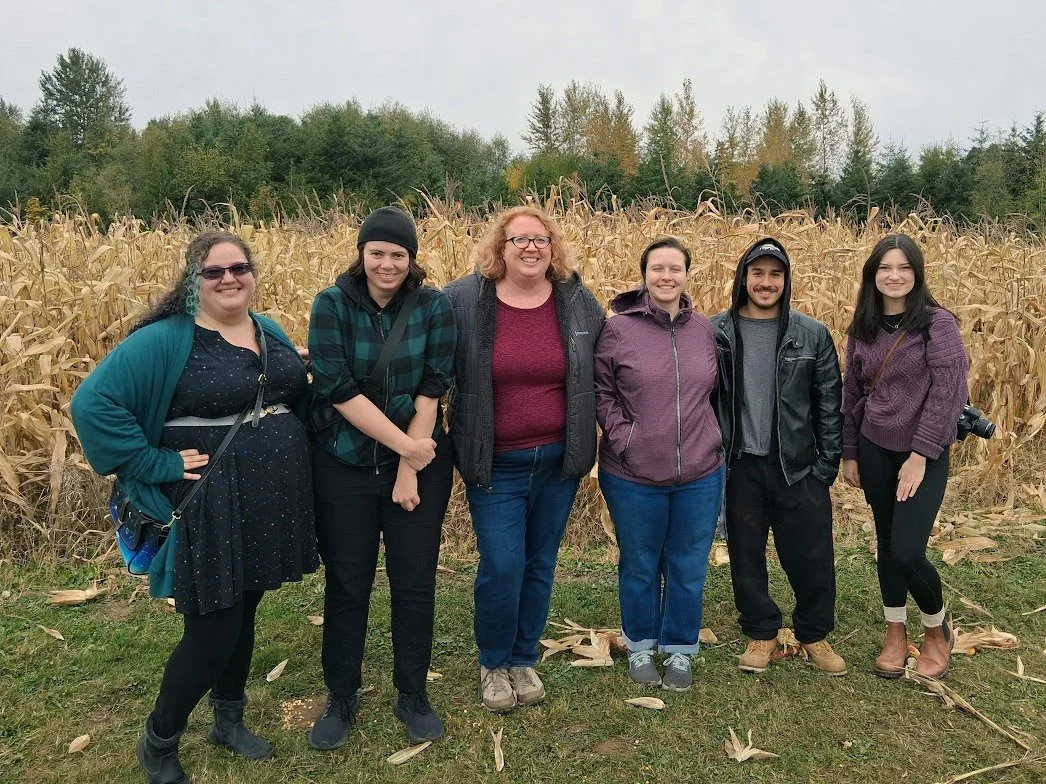
The Older Students of Western Club pose for a group photo at Bellewood Farms and Distillery in Lynden, Wash., on Saturday, Oct. 18, 2025. Pictured is Nyssa Rodriguez, on the far left, Courtney Hegert, in the center, myself on the far right and additional club members.
On the first day of fall quarter 2023, I realized I hadn’t set foot on an academic campus since I graduated high school. I felt the same mix of excitement and unease I had at 18 — except this time, I was 24 and walking on the Western Washington University campus.
Being an older student presents its own set of challenges along with the usual college trials. Before returning to college, I had spent the last four years working in retail management and living on my own. I was worried that I’d stick out like a teenager in kindergarten.
Many of us older students walk onto campus with experiences our classmates don’t share, like careers started or paused, marriages and growing families. While those experiences can give us perspective, they can also make us feel like outsiders in a place that’s dominated by a younger demographic.
According to the 2025 WWU Factbook, only 6% of students were ages 25 to 39, and less than 1% were 40 or older. These numbers underscore the need for spaces where older students can find camaraderie.
The Older Students of Western Club was formed in winter 2024, when Katie Harrison, the club’s original president, and Courtney Hegert bonded over being the most talkative students in their linguistics class. After noticing their younger classmates spoke up less often, Katie suggested creating a club to support older students.
“We realized we were the only four people [who] talked, and we were all older,” Hegert recalled, laughing.
Members now range from their mid-20s to their 50s in a group bonded by shared experiences of returning to academia.
In my nearly two-and-a-half years at Western, I’d never made a friend close in age to me. I avoided study halls and on-campus events, always aware of the age gap between most students and me. Over time, distance settled into a quiet, lingering loneliness.
Courtney Hegert, a 40-year-old linguistics major, is proud to be a founding member of the club, but her path back to college included a detour, like many other returning adult learners. She tried higher education right after high school, but academic life felt overwhelming. Eventually, two weeks before her 37th birthday, she discovered the root cause was undiagnosed ADHD.
After years of working in childcare — a job she found rewarding but emotionally draining — Hegert decided to re-enroll for her undergraduate degree. She moved to Bellingham a few years before beginning classes at Western and didn’t have any social networks until starting the Older Students Club.
"I feel very insecure a lot of the time about being older,” Hegert said “(It feels) weird that I'm around a bunch of people that technically, I could be their parent.”
For Hegert, the club has proven to be more than a social outlet, providing a dedicated space where she can share experiences, laugh over cultural references younger students may miss and build authentic friendships. "I'd like to be around people who get my cultural references, because, literally, that is a huge part of (socializing),” Hegert said.
Returning to school gave her a renewed sense of purpose, and she now plans to pursue a career in higher education as an academic advisor, where she can help other students find their footing.
Nyssa Rodriguez, a 31-year-old psychology student at Western, first heard about the club through Reddit. “I had never actively tried to do anything on Reddit,” Rodriguez said. “I saw that, and I was like, ‘Oh my goodness, this would be so fun, because everybody around me is so young.’ I was telling my therapist, ‘I really wish I could connect with people my age,’ and then I saw (the post)."
Rodriguez’s journey back to college was shaped by financial, health and personal challenges. She had originally been accepted to Western for marine biology in 2017; however, she was still awaiting Washington residency after moving between states, and decided to redirect her education to Whatcom Community College due to the high cost of out-of-state tuition. She also faced the added difficulty of being diagnosed with fibromyalgia at age 20, which made balancing school, work and her health a constant battle.
After earning her associate degree, Rodriguez took a break from academia to stabilize her health and personal life and returned to Western in 2024 as a part-time student. Her career path has now shifted to psychology as Rodriguez hopes to specialize in mental health, clinical therapy and relationship counseling with specific interests in polyamory and sex therapy.
Rodriguez is now acting as the club's co-president alongside Liz Sterley. Through her leadership, Rodriguez works to create a space where older students feel seen, supported and connected, which has motivated her continued engagement and commitment to the club’s success. "The ‘not alone’ feeling is definitely what has powered me to continue in a leadership role and make sure that the club lasts as long as it possibly can," Rodriguez said.
As an older student, Rodriguez describes her experience as challenging, but admits returning to school later in life has allowed her to approach her education with more intention. "I'm the one that (decided) to come back,” she said. “I'm the one that is paying the tuition. I chose this, so I'm going to choose to wake up, go to class and do my homework.”
While the club offers support at the campus level, the higher education industry as a whole is beginning to take notice of the four million older students pursuing higher education across the U.S. According to an Inside Higher Ed report, older learners are becoming a larger part of the student population. According to learner-reported Census Bureau data, over four million older learners were enrolled in postsecondary education in the United States.
Thomas Farrell, 50, has been back at Western for just under a year and is taking art courses part-time as he returns to the campus he first attended in the 1990s. At the time, Farrell struggled to focus in his classes and felt isolated from his peers. “I had friends, but I didn’t have any scholastic associates or people that were interested in the same things as me,” he said.
Music and art have always been passions for Farrell, but without guidance or a clear path, he eventually left Western in the 90s. His return happened unexpectedly, with a chance encounter at a downtown Bellingham bar where he works graveyard shifts. After overhearing a regular mention working in Western’s Admissions Office, Farrell asked what the reapplication process might look like. He’d wanted to go back to school for years, he explained that life had kept getting in the way.
A couple of months later, an email from that same regular encouraged him to take the first step toward reapplying.
"College campus is difficult, and I'm totally still intimidated by it, but I'm trying to just jump into the deep end and keep swimming,” he said.
Although Farrell appreciates the camaraderie of older students on campus, he hasn’t joined the Older Students Club. Between a full-time bartending schedule and the demands of his classes, seeing family and creative projects, he doesn’t have the bandwidth for extracurriculars.
“Getting to school at 5 p.m. is early for me,” he said. Balancing work, school and personal time takes its toll. “I still function like a student where I don’t really eat correctly, I don’t take care of myself the way I should.”
Farrell’s experience balancing work and school reflects a broader challenge faced by many students who juggle jobs while pursuing a degree. As noted in “College vs. Paycheck,” a New York Times opinion piece written by a grad student working full time, “jobs were as much a part of my college life as textbooks and study sessions.” The piece highlights the reality that working learners often navigate responsibilities that traditional college programs aren’t designed to accommodate.
For Farrell, returning to Western is less about joining clubs and more about personal growth and exploring new passions. “I like to go up to campus. It’s like I get excited to go up there, even though I’m tired,” he said. “ I don’t think I’m going back for a career, just a change. (I’m) building my tools and looking at a refreshing new world.”
The Older Students of Western Club brings together people with diverse motivations and life paths, which ultimately reminds institutions that flexibility, inclusivity and community are necessities. Beyond the club activities, these students show how returning to school later in life can foster resilience, self-awareness and renewed aspiration. This club represents just part of the broader story, showing that returning to school later in life is becoming more common and continues to prove ambition truly has no age limit.