
Behind the Black Mirror
How the right-to-repair movement is protecting technology
Story by George Cox
Published Sept. 24, 2026
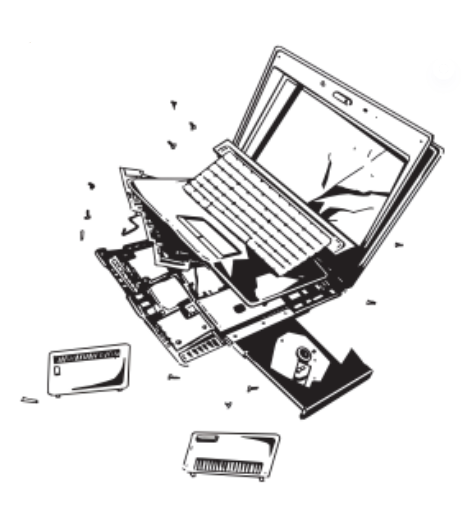
Cracks cascade across the screen, crossing over each other and dividing the display into hundreds of tiny glass chips.
For months, it was just a tiny crack in the top-right corner of my iPad. One day, I lifted the cover, pressing on the fracture and the entire screen shattered. In a second, the glass was ruined.
I took the iPad Pro, which at the time was the newest model, to the Apple store. Nothing else was wrong with it; the only part that was broken was the screen. Apple did not replace the screen, instead they opted to replace the iPad with a new one at a reduced price
Right to repair is a movement that says consumers should be able to repair the products that they bought and supposedly own.
The national movement is based on establishing consumer rights and fighting back against planned obsolescence, security through obscurity or any other tactics companies use.
“People are tired of planned obsolescence,” Mitch Karmer, owner of Fixco, a computer and phone repair shop in downtown Bellingham, said. At some point, things began to be designed to fail and now it’s everywhere in our society, said Karmer.
Karmer brought up Maytag’s 1967 commercial, where the man repairing a Maytag washer said, “It’s not often anybody needs us Maytag repairmen, that’s why we’re the loneliest guys in town.” The joke was that none of the Maytag washers ever broke because of their reliability.
“My mom still has the washer that we had when I was a kid. I remember not even being able to see over it,” Karmer said. In contrast, my much newer washing machine broke last February and had to be completely replaced.
On the Apple website, the iPhone 17 is listed at $799. The smartphone has become a functionally essential part of modern life. According to a survey by the Pew Research Center, 91% of Americans own a smartphone.
Karmer holds up his phone. “This device right here, this smartphone, there’s only one part that is guaranteed to fail at some point. It’s the battery,” Karmer said.
"Do you have a pair of AirPods?” Karmer asks me. “Yep,” I nod. “Can’t change the batteries,” Kamer said.
Once that battery dies, “you gotta buy another $200 pair,” Karmer said. I’m on my third pair of AirPods. I lost my first pair and the battery died on my second pair.
The goal of right to repair is to make those AirPods or $800 smartphones last longer. It’s meant to give the consumer more choice about who repairs their product and more autonomy over the devices they paid for and own.
In Washington State, a right-to-repair law went into effect in January 2026. This law requires manufacturers to provide fair access to the parts, tools and information required to repair digital devices. The law also makes the practice of parts pairing illegal.
“The phones are smart enough, where every part is serialized to the motherboard. It’s got a chip on it,” Karmer said. Before, if a part was switched out, the phone would say Apple could not verify the authenticity of the part and tell the owner to take it to an Apple store.
“That’s illegal for them to do now,” Karmer said. “The messages still pop up, but we can go through and finish the repair. We can go into a diagnostic mode, it connects to their servers and completes the repair, so that’s a major step.”
This makes replacing specific parts cheaper for consumers, since they can take it to an independent repair shop and get specific parts replaced rather than buying an entirely new device.
Another part of the right-to-repair movement is debunking the security through obscurity argument.
Paul Roberts is on the board of repair.org and the president of Secure Resilient Future Foundation, both are right-to-repair organizations. He said, Cyber risk is real. What's not real is the idea of “security through obscurity.”
“Vendors have always wanted to promote the idea that, yes, there are security risks and the way to keep things secure is to just basically let us [the vendors] control them,” Roberts said.
That gives the companies a huge amount of power over anyone who uses that software. Companies could do things like charge customers for security updates or completely stop supporting the software on a device, rendering it useless and making the user have to buy a new one. It gives them a monopoly, Roberts said.
“Keeping something secure means locking it up, right? Keeping it dark. Keeping it out of people's view, except with software that's really not the case,” Roberts said. “Keeping something secure means designing it in a secure fashion, coding it in a secure way, emphasizing secure design and development.”
Robers said it’s like designing a building. The building needs to be designed safely. A construction crew wouldn’t just cover a building with a tarp and tell everyone that makes it safe; it obviously doesn’t. What matters is building it architecturally stable and safe.
Security through obscurity was a right-to-repair battle in Colorado’s most recent legislative session, which, like Washington, had a right-to-repair law go into effect in January 2026.
Andrew Brandt, executive director of Elect More Hackers, a group focused on electing people with backgrounds in information security, to address issues like right to repair, was on the front lines in the Colorado Legislature, fighting to stop an anti-right-to-repair bill.
The biggest tactic that they were fighting back against was that companies could pay lobbyists to be at the capital and bombard lawmakers all day long, Brandt said.
It’s hard to compete with the sheer amount of time corporations can put into pressuring lawmakers. They can pay people to be there, while advocates of right to repair don’t have those sorts of resources.
The right-to-repair law in Colorado survived this neutering attempt, but it was close; the committee vote was 7 to 6.
Roberts said the next thing right to repair has to do in Washington is to survive similar attempts to undermine the right-to-repair law and to see that the law is actually enforced.
As Karmer said, “We started winning battles, but the 800-pound gorilla in the room is Apple, and they’re not giving up.”