
Researchers found a cause of sea star wasting disease. Now what?
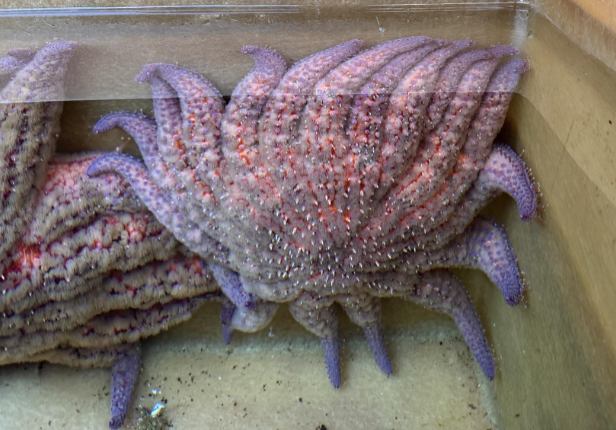
Sunna, the only sea star who didn’t get sick. // Photo taken by Tess Chapman courtesy of Jason Hodin.
In the summer of 2025, Jack Beeson — a Western Washington University student studying environmental sciences — began collecting data on sea stars in Bellingham Bay for an internship with the Community Boating Center. Dressed head-to-toe in scuba gear, he regularly dove from the concrete platform hanging off Taylor Dock and descended to the seafloor. There, he counted each sea star, logging their species, their age and snapping photos of his findings.
On his test dives before he began officially collecting data, Beeson also discovered sea stars with tiny, pale lesions on their arms.
In the coming days, these sea stars would grow deflated and lethargic, refusing to accept food. The lesions would spread across their body in sprawling patterns and surrounding healthy sea stars would begin fleeing to avoid infection. Then, the sea star’s hydrovascular system fails. The arms contort, decay and detach from the body in fragments. Flesh and bodily structure melt away while the sea star is still alive.
This is sea star wasting disease (SSWD). It kills in a matter of days. It began spreading rapidly across the Pacific Coast in 2013 and has taken the lives of over 5 billion sea stars in its wake.
Beeson found no sea stars with wasting disease in Bellingham Bay outside of the few test dives. Bellingham Bay was populated primarily by ochre stars and mottled stars. While neither species is immune, both are more resistant to SSWD than species such as sunflower stars — a species that had over a 95% loss of population across its historic range because of SSWD, and has been driven to the brink of extinction off the coast of Oregon and California.
Like many researchers, Jason Hodin, a senior research scientist with the University of Washington’s Friday Harbor Labs, was horrified when the outbreak was first noticed in 2013. By 2019, he began a breeding program with the Nature Conservancy in California as a key step in restoring sea star populations.
In early 2024, Hodin and his full-time research assistants gathered in Seattle for the Society for Integrative and Comparative Biology Conference. During this conference, Hodin received a fateful call from the part-time research assistant who’d stayed behind in the labs on San Juan Island.
One of their sea stars had dropped an arm.
“Back in that day, we did not have any way of treating a star that had advanced disease like that,” Hodin said. “We kind of knew because we’d seen that happen before, that the prognosis for that star was very poor.”
The other five sea stars in the tank had suffered long-term, extreme exposure to the diseased star. Hodin told his research assistant that the best she could do was separate the stars as soon as possible, but by the time they’d been put into isolated aquaria, it was too late. One by one, each sea star began wasting—except for a single sunflower star.
Immediately, Hodin called a research team in Canada he knew was looking for wasting sea star specimens. The researchers were in Seattle to collect samples from coelomic fluid, the internal fluid of sea stars, the very next day. They deep sequenced the coelomic fluid samples and isolated a strain of Vibrio pectenicida they dubbed FHCF-3. This strain was cultured and when healthy sunflower stars were exposed, they would waste away and die.
After over a decade of toiling over potential causes and correlative factors, the causative agent of SSWD in one of the most vulnerable species had finally been discovered.
“The authors wanted to be really sure, so for the next year and a half after that, they wanted to repeat things, dot every I and cross every Ton this research and make sure 100% this bacteria was the cause,” Hodin said.
In 2014, another paper was published claiming to have found the causative agent — sea star-associated densovirus.
According to Hodin, researchers took the coelomic fluid from diseased stars and filtered it through a filter so small the infectious bacteria wouldn’t have been able to get through.
The material that passed through the filter induced disease in sea stars, which suggested the causative agent was a virus, but other researchers couldn’t replicate the results; to this day, nobody knows what went wrong with the original experiments.
“I’ve heard things like, sometimes the filters aren’t very good,” Hodin said. “If you’re carrying around a bag with a hole in the bottom of it, you spill all your groceries before you get home. This seems like it was a bad bag, you know?”
The cause of SSWD being unknown created a colossal roadblock in combative efforts against the disease. Now that Vibrio pectenicida has been pinpointed as a culprit, researchers across the country are banding together to develop treatment efforts to attack SSWD at its roots.
Research efforts have been launched on bacteriophage therapy — in which bacteriophages are applied to kill certain species of bacteria — as a potential treatment method for SSWD, according to Hodin. Other rehabilitation efforts focus on experimental exposure, a process now achievable thanks to the discovery of the causative agent.
“What you really wanna do is be able to take a bunch of different stars and expose them to different levels of the disease,” Hodin said. “See if there are individuals that are more resistant than others, and then potentially breed those and see if the next generation is even more resistant.”
These resistant populations could then be outplanted to wild sea star populations. In addition to Hodin’s ongoing breeding program, several other selective breeding efforts have been launched, this time with the express purpose of combatting wasting disease.
In March of 2023, the Oregon Coast Aquarium launched a treatment method for SSWD. Sick sea stars are placed into an iodine dip to remove foreign bacteria, fungi and ciliates. Then, the water temperature slowly drops in their tank — 1 degree Celsius per day.
The third of seven steps for this treatment? They’re given a probiotic for shrimp.
“If an off-the-shelf shrimp aquaculture probiotic product is helpful, we imagine that a very specific one designed specifically for sea stars and SSWD could be even more effective,” Hodin said.
A specialized cocktail of probiotics could cultivate a healthier microbiome in sea stars and inhibit the spread of SSWD. Hodin said that if this could be applied to sea stars before they’re released back into the wild, treated individuals could be given long-term protection through cultivation of microbes that combat the disease.
“You might think of it kind of like yogurt for a sea star,” he said.
In Hodin’s lab, the sole sunflower star who didn’t get sick from exposure — Sunna — is still alive today. In fact, she’s still reproducing to this day. For her highly vulnerable species, she is a beacon of hope. True recovery from SSWD is still a long way off, but it’s looking like sea star researchers have finally found the upper hand in a battle that’s lasted over a decade.