
Left for (the) Dead
What we can learn from abandoned buildings and their ghost stories
Story by Carden Mercier
Published Sept. 24, 2026
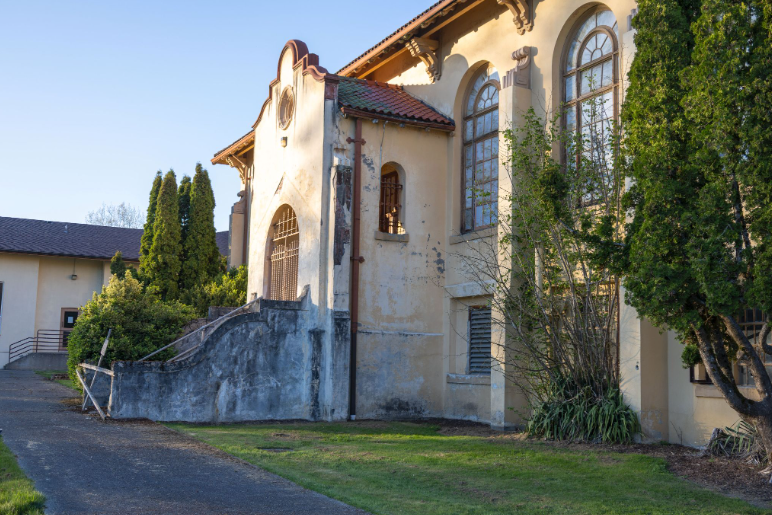
Northern State Hospital’s Hub Building. Today, Northern State Hospital buildings house Sedro-Woolley’s SWIFT Center. The general public is strictly prohibited from entering the interior of Northern State Hospital buildings. // Photo by Courtney Sipila.
Ghost stories are often passed quietly around a community. from whispered rumors between a town’s residents, to campfire tales, to scary stories for the purpose of frightening children. The truth behind ghost sightings is a frequent topic of debate — but what can’t be denied is the ways in which these stories transform a location in the eyes of the public.
Charles Crooks, a tour guide of Bellingham Ghost Tours, documents a number of key locations for the accumulation of ghost stories. Sometimes these hotspots are areas naturally associated with death, such as cemeteries. Other times, they’re social gathering places like bars or restaurants. Even a traumatic past can draw ghost stories to certain areas.
Among these locations that naturally accrue ghost sightings, according to Crooks, are abandoned buildings.
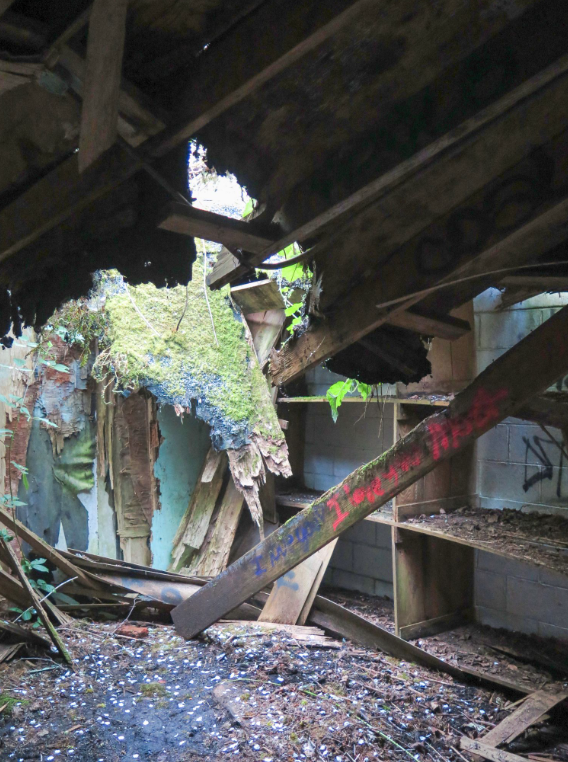
A collapsed building in the Northern State Recreation Area. Declarations of love are spray-painted across decaying planks of wood and plant life has sprung up among the rubble. // Photo by Allie Van Parys.
Northern State Hospital, formerly the largest mental health hospital in Washington, closed down in 1973 after an appropriation veto. The main campus isn’t quite abandoned; since the location’s closure, it’s been the home of Job Corps and rehabilitation programs. Eventually, it became known as the Northern State Multi-Purpose Center. Now, the campus has been bought by the State of Washington and currently houses the SWIFT Center, but the majority of the hospital interior is both unused and strictly prohibited for public entry.
The Northern State Recreation Area, however, has the long-abandoned hospital farms open for public entry. The roofs of abandoned barns and shacks have collapsed in on themselves; colonies of moss and lichen flourish on broken planks and between cracks in the concrete. The buildings are covered in layers upon layers of spray paint; graffiti covers the walls, the ceiling rafters and even the upper floors that are often only reachable through holes in the rotten wood.
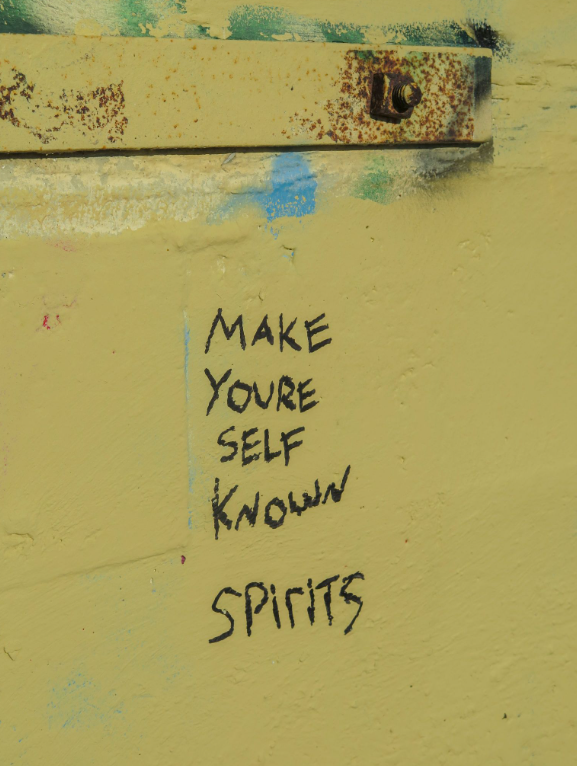
Graffiti scrawled on the outer wall of a shack in Northern State Recreation Area. Most of the abandoned buildings in the recreation area are covered head-to-toe in vandalism. // Photo by Allie Van Parys.
For people who don’t know much about Northern State Hospital, the ghost stories tend to encourage demonization of the hospital, said Horne. He said that for some people, Northern State Hospital allowed people to live the best lives they could’ve had at the time, where people could care for them.
Bad things also happened at this location, Horne acknowledges. In 1921, according to the Northern State Hospital website, a law was introduced that permitted sterilization for a wide range of people, including state hospital patients. Northern State Hospital was among many locations across the country that rolled out sterilizations, though it required the permission of the patient or a family member. Northern State Hospital also practiced extensive shock therapy and performed lobotomies in the 1940s; the Northern State Hospital website ultimately documents the hospital as having a “mixed history of treatment.”
Horne notes a lack of resources as a contributing factor for why these treatments occurred. “What they did back then for mental health was barbaric, because that’s what we had,” he said. “Unfortunately, that’s how we learned, and we learned a lot of things along the way that should’ve never been done.”
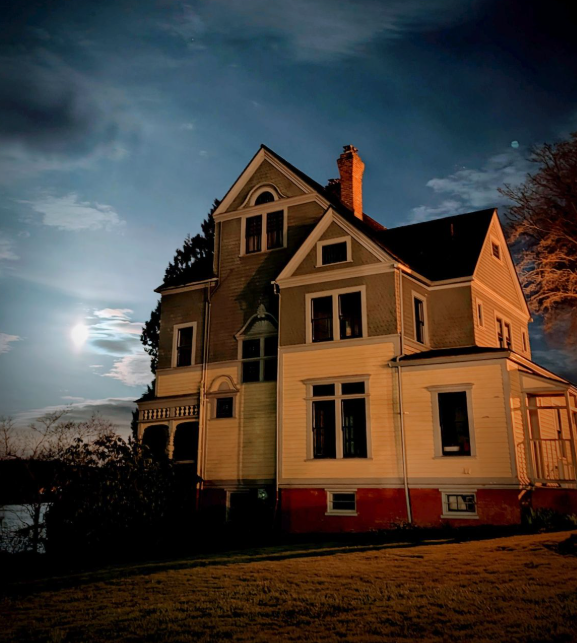
The Walker-Ames House in Port Gamble on a dreary sunset. The Victorian house overlooks Port Gamble Bay and sits next to the town’s historic museum. // Photo courtesy of Pete Orbea.
Ghost stories surrounding the Walker-Ames Hospital emerged around the 1950s, according to paranormal investigator and ghost tour guide Pete Orbea. Like Northern State Hospital, it’s not clear why this location is haunted—Orbea said there’s no written record of deaths or murder in the house; its residents moved out after the mill Port Gamble centered around closed in 1995.
“Ain’t nothing I can point to to say, ‘that would cause a haunting here,’” he said. “My best guess – emphasis on guess – based on experiences that I’ve had, that other people have had over the years, it just seems like the long-term residents love it here so much, they just don’t wanna leave.”
Ghost stories in Port Gamble have been passed down through Port Gamble’s population since the 1950s, although they were kept between the residents of the town. Orbea describes the town as “insulated” before 1995, as a company town built around the local mill. The recent investigations into paranormal activity in the town have been highly publicized in comparison.
After the original residents moved out, the Walker-Ames House was left vacant and without heat for several years. Seasons passed, and the house grew more and more damaged the colder and damper it got over the years.
In 2002, town manager Shana Smith hired a contractor to place a new H-VAC system in to preserve the house. Then, she started getting calls. While the contractors were doing work in the basement, they claimed they were hearing footsteps and voices upstairs. Orbea said one worker had even been punched.
So Smith dialed Evergreen Paranormal, A team from Seattle, who’d happened to stop in Port Gamble. When they ran an investigation, they found significant evidence of paranormal activity. As Evergreen Paranormal’s investigations continued, Smith pulled in teams from across the state to look into the Walker-Ames House, and the evidence and personal experiences kept piling up.
Orbea came to Port Gamble in 2007 and began picking up ghost stories from fellow tenants; after he was hired by the city in 2011, he took over the local ghost tours.
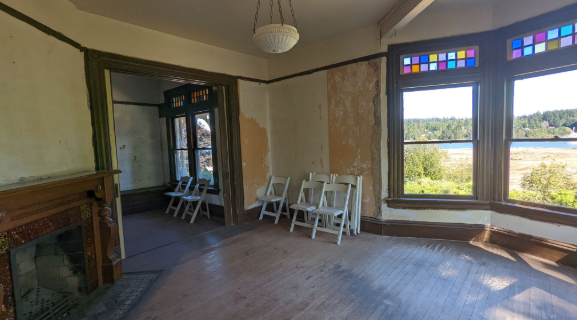
A room inside the Walker-Ames House; the fireplace has long since been extinguished, and paint chips off the pale walls. The wet climate of Port Gamble worsened the damage that accumulated over the years, the house was left vacant. // Photo courtesy of Pete Orbea.
The Walker-Ames House has since starred in multiple paranormal investigation shows and horror movies, such as ZMD: Zombies of Mass Destruction.
“All the TV shows that are out there, paranormal shows, it’s a real double-edged sword. But I think they have kind of helped make the paranormal subject and experiences that people have more acceptable,” Orbea said. “So in general, people are more open to that sort of thing. So as far as the town goes, it attracts people to come here because of the ghosts.”
People are more open and accepting of paranormal activity in part because of that publicity, Orbea said. Sometimes the ghosts are what attract people to Port Gamble, which helps bolster local businesses. Other times, the prominence of stories around the Walker-Ames House creates a pre-formed bias around the house.
“When you come in with such a strong pre-formed bias that there are ghosts in this location, as a human being, you’re probably going to have some sort of experience because you’re expecting it so much, and it may be a false experience,” Orbea said. These false flags make it significantly harder to research and collect data on paranormal activity in the house.
Orbea has been telling the history of the house and the surrounding buildings since he began investigating and running ghost tours.
“I hope that helps make it more acceptable and people more open to learning about it through maybe an interest in history,” he said. “Both history and the paranormal go hand in hand.”
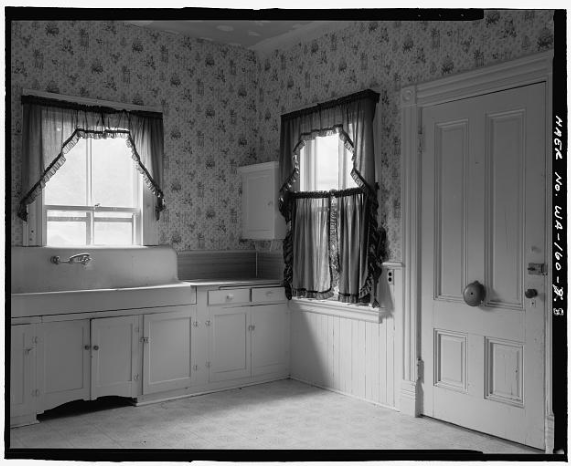
An old photo of the interior of the Walker-Ames House before its vacancy in 1995. It’s adorned with patterned paper over the walls and frilly curtains over the windows. This place was loved then, and it still is now. // Photo courtesy of Pete Orbea.