
Letter to a Sea Lemon
On tidepooling, sea slugs and suspecting you have OCD
Story by Carden Mercier
Published Sept. 24, 2026
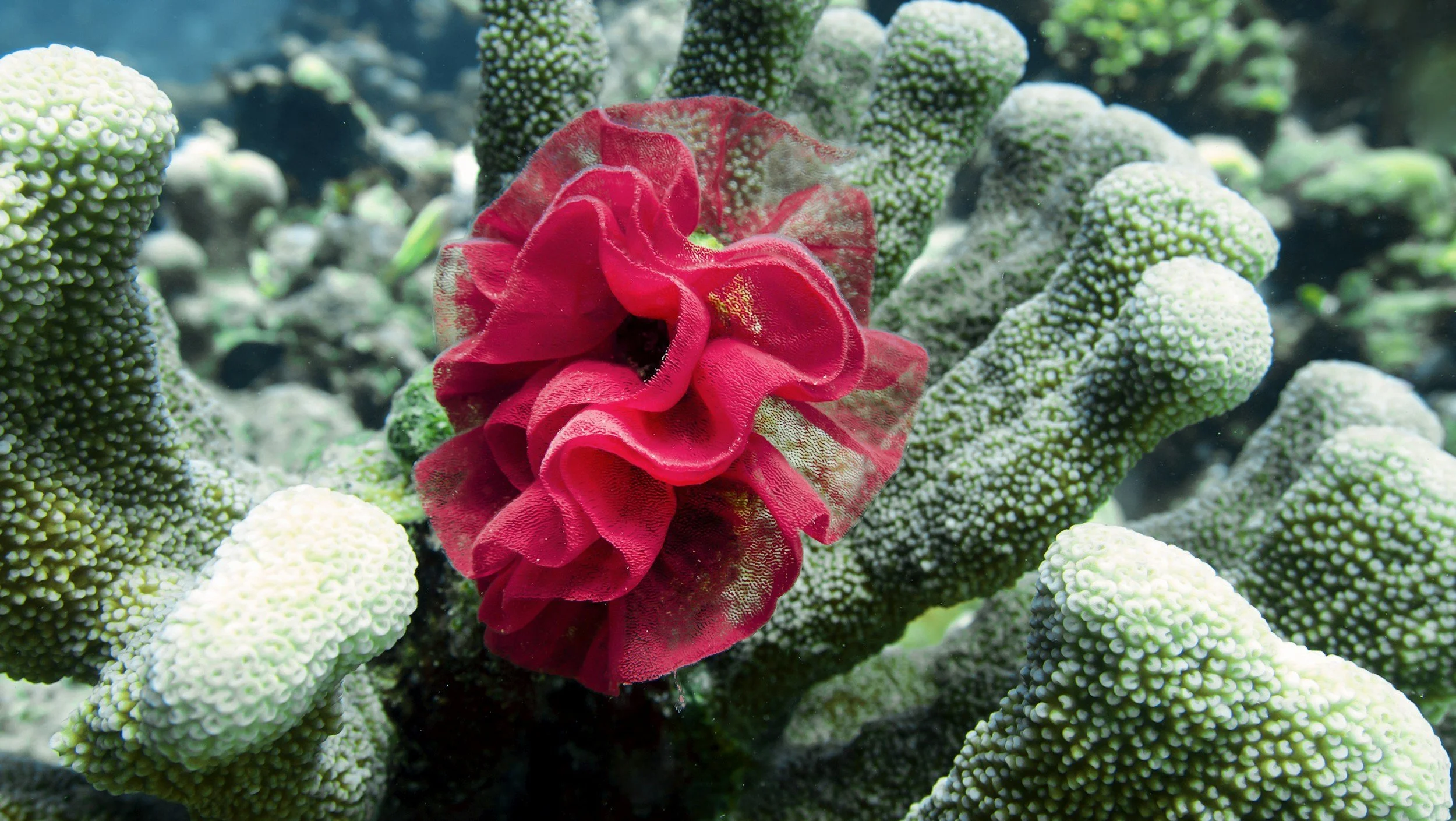
A nudibranch, a type of sea slug, rests among coral. // Photo by Heidi Bruce/Unsplash
The night I first met you, I was dragging behind the rest of the Tidepooling Club on the walk down to the beaches of Marine Park. I’d just stumbled off the rocky slope and hit my stride on smooth sand. Mere minutes after I began scouring the beaches for sea creatures, a jet of water shot up from beneath the heel of an unsuspecting tidepooler. The culprit is an anemone, small and perfectly camouflaged on the beach, visible only through a small shift in the sand and the mucus gleaming off its soft skin.
“Try not to step on them,” another student says. The idea takes firm root in my mind. They’re everywhere along the shore and too hard to spot under the cover of night unless you’re constantly scanning the sand. The image of sea anemones crushed beneath my boots is burning itself into my brain. What would the people I love think if they knew I’d killed innocent animals with my recklessness?
Every step I take, I scan the sand obsessively — I do not plant my foot until I know the coast is clear of hidden sea creatures. These sorts of rituals are routine to me; I have spent years constantly over-clarifying speech, relentlessly rationalizing every action, seeking constant reassurance to dissuade thought spirals. It was during one of these spirals, in fact, that a friend pitched the possibility I could have obsessive-compulsive disorder.
I’d read about OCD before and it had lingered as a possibility in the back of my mind. That conversation brought it to the forefront, but I had other things to attend to. So, I let it fester for a year, until I was waddling along the shoreline Marine Park, my brain abuzz with all the murders I could commit if I wasn’t careful enough.
Then, a crowd of students huddled beneath the railway bridge caught my eye. I flagged down the nearest student to ask what had them so entranced.
“There’s a nudibranch under there,” they said.
To this day, I don’t know how the other tidepoolers first found you. You were down a side path, crammed a good few yards under the dark and rickety bridge, and sea slugs aren’t exactly known for being large and flashy creatures. Regardless, you’d been found and the moment I heard, I knew that I needed to meet you.
The path under the bridge to the tidepool where you hid was cleaved in half by a river, laden with jagged rocks and brimming with fragile sea creatures. The route to the left was made of rocks large enough to make me second-guess teetering over with stiff rainboots. The route to the right appeared more gravelly and easier to cross — but halfway down, when I shone my flashlight forward, I found the road blocked by massive, barnacle-covered boulders.
I can’t see the anemones and sea critters properly beneath the distorted surface of the water. With every step, I’d risk stepping on an animal.
But I needed to see you. I needed to cross the river.
According to a study run by University of Utah professor Donald Godfrey (you probably won’t know what that place is — it’s not exactly a school for sea slugs), exposure and response prevention — considered the “gold-standard treatment for OCD” --- involves refraining from engagement in compulsions after OCD is triggered. The study specifically found that prolonged ERP treatment improves distress tolerance, and the more distress tolerance the patients developed, the more OCD symptoms improved—especially the obsessions themselves.
This is the trick of it; to face this disorder, you have to confront your worst fears head-on.
But the brief relief from indulging in compulsions is addicting. The fantasy of banishing your intrusive thoughts once and for all with the right ritual is comforting and easy to indulge. Still, the fear never went away. I’d spent my whole life standing on the edge of the water and all I wanted was to dip my toes in. All I wanted was to live.
The first step I take around the boulder and into the stream feels clear; the sand shifts beneath my boot. I lurch over a cluster of rocks, plant my boot again and I swear I feel something squish underneath. Seaweed, if I’m lucky, but it could be an anemone and I’d never even know.
“I think I stepped on something,” I call out to the students that surround you only a few feet ahead. I speak it like a confession, covering it up with a half-hearted laugh. I step again and again as I stagger past the edge of the river, onto a damp patch of sand. I lean over the rocks and peer into the circle of light and—
You are hidden beneath a smooth stone, cowering away from the open air beneath the surface of a shallow tidepool. Beneath the dull glow of ten-dollar flashlights, you are a pallid yellow covered in grey freckling (which doesn’t seem too common for your species—maybe I’d be frantically Googling sea slug skin diseases if I were you). You blend perfectly with the stony floor of the stream and I wonder again: how could anyone possibly have found you?
I still don’t have the answer to that question (and that’s okay — I’m learning to live with the uncertainty), but I like to think it was meant to be. After all, I was only living half a life until I met you.