
From Famous to Forgotten
Medieval manuscripts bring thirteenth-century Europe to Western
Story by George Cox
Published Sept. 24, 2026
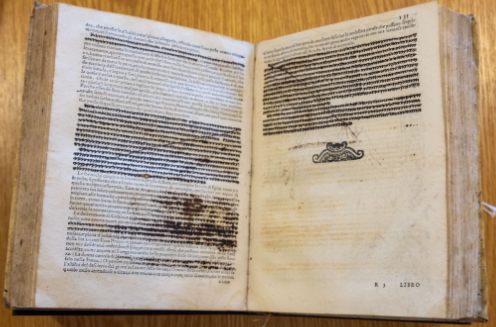
The censored book Taylor showed during our interview. Before the internet, where things can now be digitally archived, scribbling out portions of text or burning books would have been an effective way to control information. // Photo by Courtney Sipila.
Squinting at the handwritten manuscript we slowly sound out each word, "Here bigynneth the knyghtes tale."
Words are written in an older form of English using spellings from a bygone time. The manuscript includes ornate artwork along the left margin. The red and blue marginalia — artwork in the margins — is faded, but the gold still stubbornly shines.
The lines of the artwork twist into vines, weaving themselves across the left side of the folio. Drop caps sprout from the vines, indicating the beginning of paragraphs. The script on the folio is ornate and meticulous, letters arching into fine points. Together, the work looks like something out of a fantasy tale.
An illustration of a knight sits on his horse in the opposite margin, a sentinel directing the reader to the start of the story, his hand pointing to the line Courtney Sipila, Klipsun photographer, and I struggle to read.
This is not where the knight was originally drawn, explains Kathryn Vulić, a professor and medievalist at Western Washington University. Vulić points to a faint outline lower on the folio. Someone originally drew the knight lower, but they moved him up so he could point to the start of his story.
“The artwork typically has a job to do. You can see sometimes in the revision process how someone tries to make the artwork more functional to understand the text,” Vulić said.
The folio is from “The Canterbury Tales” written by Geoffrey Chaucer in the early 15th century. It’s an anthology about a group of 30 people traveling on horseback on a pilgrimage to Canterbury, England, sharing stories along the way. It’s one of the medieval manuscripts kept in the Special Collections section of Western’s Wilson Library.
The version kept at Western is a facsimile, an exact high-quality copy of the original text. The original, known as the Ellesmere Manuscript, is kept at the Huntington Library in California. The version at Western is as close to the original as possible in scale, color and material.
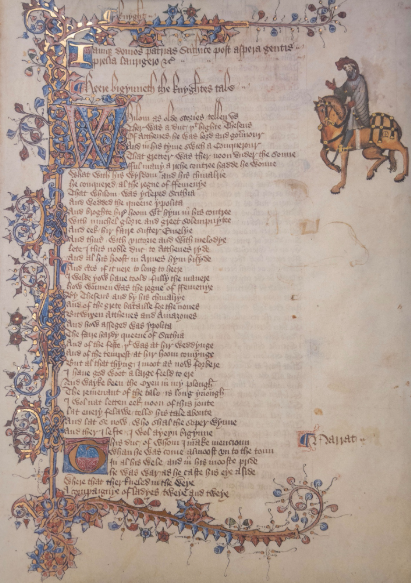
A folio from Western’s facsimile of “The Canterbury Tales.” See the outline of where the knight was originally drawn before being re-drawn higher up so his hand and eyes could direct readers to the line, “Heere bigynneth the knyghtes tale." // Photo by Courtney Sipila.
Special collections houses facsimile works and some original works like Bible leaves, folios from Bible manuscripts. The ones at Western range in age with the oldest being up to 800 years old.
Unlike “The Canterbury Tales,” I can’t read the Bible leaves. Dense Latin words are written in a Gothic script. The leaves evoke the functionally imperial authority of the 13th-century Catholic Church, when it was at the peak of its medieval power.
The tight script is diminutive, much smaller than “The Canterbury Tales.” It’s hard to imagine someone writing it by hand. There is less artwork, but what is there is more ornate. Its small size makes it one of the most impressive of the manuscripts in the room.
The colors of the Bible leaves are striking, despite their age. They share the same colors as “The Canterbury Tales,” but the colors of the Bible leaves aren’t faded.
Dark but vivid, royal blue crawls up between the two lines of Latin script and molds into the letter “P,” beginning the second column of text. Inside the “P” is an illustration of what is most likely Saint Paul. Saint Paul’s background is illuminated with real gold, hammered into extremely thin sheets. The gold leaf still sparkles; it shimmers under the hanging library lights.
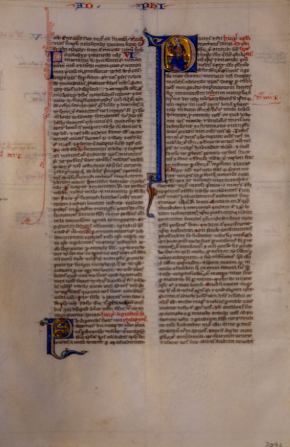
13th-century Bible leaf. Saint Paul is depicted inside the letter “P.” See the words written in red. They are in red to help guide the reader and indicate things like the start of a new part of text. // Photo by Courtney Sipila.
The manuscripts are kept under specific conditions to prevent natural wear and damage. Leaves are kept in individual acid-free folders. Everything, including manuscripts, are kept in boxes in a climate-controlled vault kept around 65 degrees, with built-in fire suppression.
Keeping the manuscripts under special conditions preserves the information and allows them to continue to be learned from and admired by future generations.
“It’s fine to just read the things online or to get a new copy, that still helps you learn,” said Josh Mossman, a Western student who’s been in two classes that involved special collections. “But to actually see them in the way that people were reading them hundreds of years ago gives you a much different perspective on it; it lets you feel a lot closer to the literature.”
Handlers of the manuscripts are required to thoroughly wash and dry their hands and pens are not allowed in the same room to minimize the risk of the manuscripts being damaged. I sheepishly look down at the pen I'm using to take notes as Michael Taylor, Special Collections Librarian and associate professor, explains this.
Vulić tries to bring her classes to see the manuscripts and learn from them. All the classes Taylor teaches directly involve special collections and use the materials for hands-on experience.
“Anybody in the world, really, not necessarily just at the university, can come here and look at this stuff,” said Taylor. “As long as you treat it with care, you can look at it to your heart's content.”
Mossman echoed a similar sentiment as Taylor regarding the accessibility of the archives: “Anybody can go up to special collections. You don’t have to be an English student, you don't have to be a journalism or history student,” said Mossman. “You can even check them out online, and it’s really cool to see that this book is 400 years old, and it’s also right here in the library, and I can just show up and read it.”
Looking at “The Canterbury Tales” again, Sipila and I stumbled through the alien — but somewhat familiar — spelling. As we sifted through the “extra” letters and intricate handwriting with some help from Vulić, she explained how a manuscript like this would have been written.
Vulić picks up a replica of a medieval quill, which, to my disappointment, was not a comically long feather. They would’ve cut the feather part off and just used the end for writing, Taylor explained.
Quill in one hand, a scribe would use a knife to hold down the parchment, scrape mistakes and trim down the quill, like sharpening a pencil, Vulić explained.
While writing “The Canterbury Tales” Chaucer would’ve sat at a lectern. Armed with the medieval equivalent of a pencil and eraser, he wrote a book that would be studied in schools over 600 years later.
This version of “The Canterbury Tales” contains 240 folios. In modern books, one side of a piece of paper is a page. For manuscripts, a folio means the entire piece of parchment front and back. For reference, a modern variation of “The Canterbury Tales” has 504 pages. Which, in the Middle Ages, would have taken scribes a long time to handwrite, as well as add illustrations to.
That's not even mentioning the process of creating parchment from animal skin, ink from oak galls, quills from feathers and binding the book.
“It’s one thing to read something from a textbook; it’s quite another thing to experience the materials firsthand and to learn how much labor went into the creation of them,” said Vulić. “So, when not that much survives to now, it’s because of how hard it was to produce in the first place.”
Books and manuscripts had to survive through centuries of obstacles like censorship, accidents, loss or theft just for them to be around for us to view today.
Taylor shows us a censored book. Dark, methodical scribbles obscured certain portions of writing, making it impossible to read; only hints of the letters peek through.
“There were all kinds of ways you could censor books. It’s an issue that's been with us for a long time,” Taylor said. Books were burned or banned through lists issued by institutions such as the Catholic Church and secular governments.
“Or if only part of the book was a problem, you could just send somebody around with a pen and mark it out. That’s what happened here,” Taylor said as he pointed to the scribbled-out text on the page.
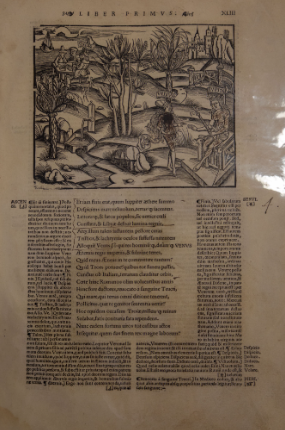
Another example of censorship. Someone, offended by nudity in the artwork, scribbled over Venus’s bare chest. They also lightly scribbled over Jupiter's chest and both Venus's and Jupiter’s thighs. // Photo by Courtney Sipila.
A 2022 study, “Forgotten books: The application of unseen species models to the survival of culture” found that over 90% of medieval chivalric narratives, stories like King Arthur, have been lost forever. It’s paramount that the ones that still survive are preserved.
Knowing the labor involved in making these manuscripts makes it easier to understand why there aren’t many of them around today. That, along with having to survive hundreds of years' worth of history, wear and censorship, makes these surviving manuscripts rare and valuable artifacts that give a glimpse into the past.
Looking at these pieces of history in front of me, it hits me. I’m looking at handwritten works that are hundreds of years old. It’s a miracle that they’ve survived this long, and being able to see them, even touch them, is surreal. These wouldn't be here without the type of preservation methods they’re kept under. All it would take for some of these works to be lost is a pen exploding or an uncareful hand accidentally ripping a fragile folio.
Archives like the one at Western keep a physical record of human history. History, that without archivists' efforts, would be lost forever.
Hands on with History
Western medieval manuscripts
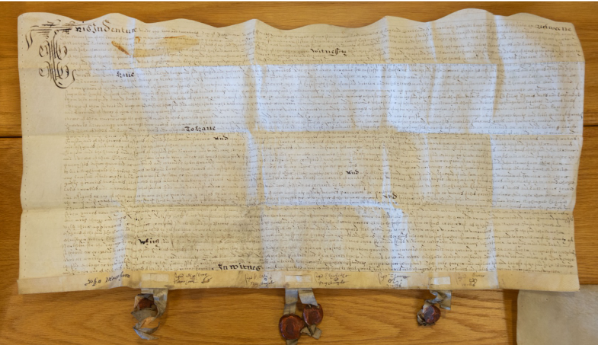
A type of legal contract called an indenture. This specific indenture spells out the terms of a land ownership agreement. It is from the 15th century and is written in an older form of English. // Photo by Courtney Sipila.
Western Washington University houses a surprising collection of medieval manuscripts that are preserved and used as a unique teaching resource.
“I see special collections as a place where students at Western can travel abroad and back in time without leaving campus,” said Michael Taylor, special collections librarian and associate professor at Western. “We can’t go back to the Middle Ages or to the 17th century, but we have things from those time periods right here on campus.”
“There were ways of authenticating the truth of something in an earlier age,” said Kathryn Vulić, a professor and medievalist at Western.
Originally, there would have been two parts to this contract. “One half would have been kept by the people renting the piece of land, the other half by the landowner. It’s just like an apartment lease today,” Taylor said.
Holders of the contract would know the contract was authentic because the curved part at the top would align perfectly with the other half. The seals at the bottom of the manuscript would indicate who the involved parties were, said Vulić.
The writing on the contract is technically legible; a line on it reads, “Made the two and twentieth day of July in the fifteenth year of the reign of our sovereign lord, Charles of England.”
Bolded words in the script of the contract are there to let readers know where a new or important section starts. At the bottom of the manuscript, the people involved signed their names. People who were illiterate would sign with a mark instead of their name.
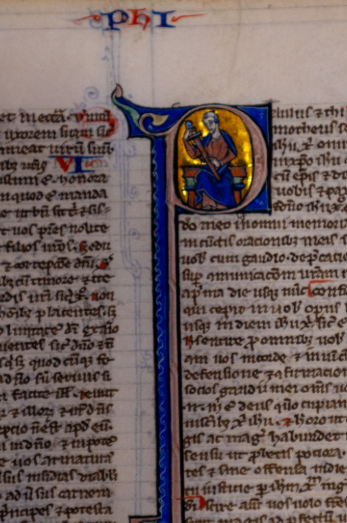
A close-up of the iconography adorning this 800-year-old French Bible leaf. The leaf is from one of the books of the Bible’s New Testament, “The Epistle to the Philippians,” and is written in Latin, which, at the time, was the standard language of Bibles. // Photo by Courtney Sipila.
The artwork most likely depicts Saint Paul inside the letter “P.” Vulić said they know this for two reasons.
One: Saint Paul wrote this part of the Bible, “The Epistle to the Philippians.”
Two: In medieval iconography, Saints are usually depicted with the instruments of their martyrdom. Saint Paul is also sometimes depicted with a book or scroll, he is not depicted with either in this work since the artwork is so small, said Vulić.
“A book and sword are the common attributes of Saint Paul. The book carried by Saint Paul represents his epistles in the New Testament of the Bible. The sword is a reminder of the means of his martyrdom – he was beheaded in Rome in 67 AD,” according to the London National Gallery’s website.
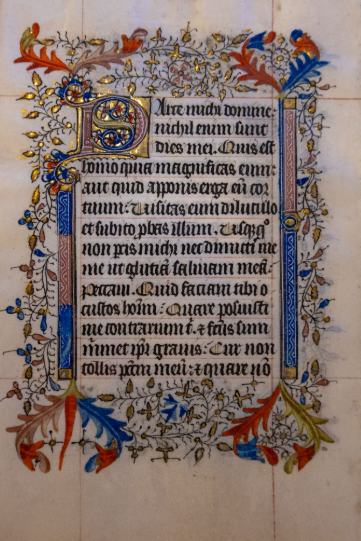
A leaf from a French 13th-century Book of Hours. The Latin script is framed in intricate artwork of vines and leaves, as was common for medieval Books of Hours. // Photo by Courtney Sipila.
Intricate weaving vines were a common decoration in the margins of medieval manuscripts. Grape vine artwork commonly accompanied religious texts. It was heavily associated with the communion wine and the sacrificial blood of Christ Elena Lichmanova in The British Library's website.
Books of hours were popular books in the Middle Ages. They were prayer books made for people who were not part of the clergy for at-home use. They contained daily prayers the owner could recite and prayers for specific occasions like death, plague, warfare, travel or bad weather. Books of hours were often highly personalized; they could be simple or extremely ornate depending on the owner's wealth and personal tastes, according to The Cleveland Museum of Art.
A translation of the page from Vulić, “Spare me, for my days are nothing. What is a man that you should magnify him? Or why do you set your heart upon him? You visit him early in the morning, and you prove him suddenly. How long will you not spare me, nor suffer me to swallow down my spittle? I have sinned: What shall I do to you, O keeper of men? Why have you set me opposite to you, and I am becoming burdensome to myself? Why do you not remove my sin?”
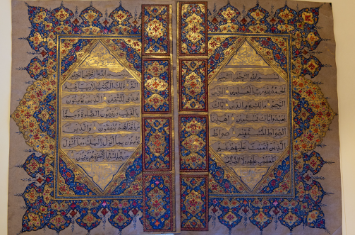
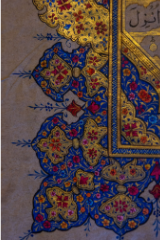
Not all the manuscripts held at Western’s Special Collections Library are European. This Islamic manuscript is from the Quran. It was possibly written sometime in the 1800's; the library is unsure of the date. It’s written in Arabic. // Photo by Courtney Sipila.
Unlike the European manuscripts, it does not include any artwork depicting people. “The Islamic resistance to the representation of living beings ultimately stems from the belief that the creation of living forms is unique to God, and it is for this reason that the role of images and image makers has been controversial,” The Metropolitan Museum of Art’s website said.
There are four basic components of Islamic ornament: calligraphy, vegetal patterns, geometric patterns and figural representation, said the Metropolitan Museum's Department of Islamic Art. The manuscript at Western includes elements of geometric and vegetal patterns.