
Muscle Memory
Three adults in different stages of life return to a beloved sport
Story by Calvin Lowe
Published Sept. 24, 2026
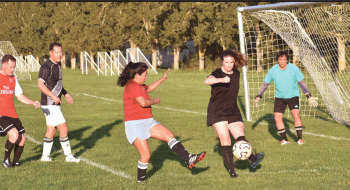
Robey and several others chase after the soccer ball. Robey takes control of the ball and steers it away from her team’s goal and then kicks it to the right, passing it off to her teammate. // Photo by Calvin Lowe.
Cameron Becker sprints after a loose soccer ball as it ricochets between players during an intramural match. With his team already trailing by several points, Becker chases down an opposing player before he has the chance to kick the soccer ball into his team’s net. He doesn’t make it in time and his opponent takes a ferocious shot. The goalie deflects it with his right foot, sending the ball off to the side.
This is one of Becker’s first soccer games since returning to the sport as a college student. He quit in 2017, after his two best friends and teammates quit.
“I think a big part of why I had so much fun was that I was playing with my two best friends,” Becker said. “I didn't know what that dynamic was going to look like if I'm on the team without them. I didn't want to be playing without them.”
Becker was hesitant when his friend invited him to join their intramural team, but the opportunity to play alongside friends rekindled the sense of camaraderie he had missed.
“I haven't played in a long time, but the more I thought about it, the more excited I got about having that nostalgic feeling and playing again,” Becker said. “So I said ‘yes’ and I've been enjoying it a lot.”
Jessyca Arthur-Cameselle, a kinesiology professor at Western, was also a student-athlete. She gave up soccer and basketball as a child to concentrate exclusively on tennis in college and played professionally after graduation. She can attest to the motivations of athletes who quit.
Child athletes often lack control over parents dictating which sports they play and how much they practice, which can erode motivation. Falling behind can also push young athletes toward quitting. Others leave because they lack meaningful connections with teammates or coaches, or because they find the environment unenjoyable. Arthur-Cameselle describes this as the self-determination theory of motivation.
“One of the reasons people come back more motivated is perhaps it was their choice to return rather than their parents’ choice,” Arthur-Cameselle said. “Especially people who take a break as a minor and then come back as an adult… That’s absolutely key to feeling like you’re in control.”
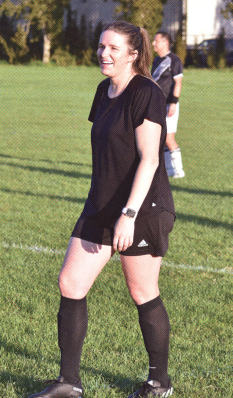
Robey catches her breath before both teams start playing again. She is happy to be there. // Photo by Calvin Lowe.
On the side, Arthur-Cameselle plays recreational soccer with Hillary Robey, an associate professor.
“She’s just so skilled,” Arthur-Cameselle said. “She was a defensive player in college, and that’s her strength, but we often ask her to play up as a forward and she scores a lot. You can’t take the ball from her.”
Arthur-Cameselle's account proved accurate, as Robey showed off her skills at the Phillips 66 soccer field on a Monday afternoon.
As the soccer ball rolls toward her team’s goal, Robey catches up and secures the ball. Once she gains enough ground, she pivots to her right and kicks the ball upfield to her teammate, who advances it toward the opposite end of the field. He sends the ball to a teammate adjacent to the goal and she scores.
Robey’s relationship with soccer has been cyclical. Though life has forced her to step away, she always finds her way back. She grew up playing soccer, having started at around five years old. By her junior year of high school, she had committed to Central Washington University to play on its soccer team.
“I played there for four years and I just had the best time,” she said. “A lot of my closest friends now were people that I had met on the team.”
Robey has built friendships with her teammates and hangs out with them outside of playing time. She finds it nice to be a part of a community of people with similar interests.
“I'm a social person, so I really like the social aspect,” Robey said. “I love the people.”
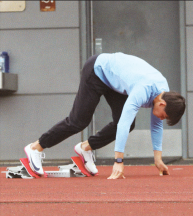
Brenek gets into position for his block start drill. He positions his hands and feet as he prepares to sprint. // Photo by Claire Mayne.
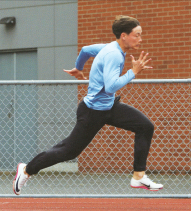
Brenek explodes out from his starting position. He sprints as fast as he can. // Photo by Claire Mayne.
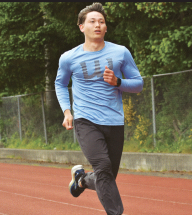
After sprinting, Brenek eases into a jog. He transitions into a brisk walk before stopping. // Photo by Calvin Lowe.
Robey played in Colorado for two and a half years. After earning her PhD from the University of Northern Colorado, she accepted a job at Western and moved to Bellingham in 2018. Once again, she found herself in a new city where she didn’t know anyone. Eventually, a colleague at Western invited her to join her soccer team. During her tenure at Western, Robey gave birth to two children. Each time, she recovered for about a year before returning to soccer.
While Robey’s returns were periodic, Lucas Brenek had only one chance at a comeback.
Kneeling on the red track, Brenek plants his fingertips on the surface and leans forward. He lifts his hips, arches his back and lowers his head. He explodes out, spikes tearing up rubber and sprints as fast as he can for several meters. He transitions into a light jog before stopping to catch his breath.
Brenek is a Western graduate who returned to pursue a post-baccalaureate studying business analytics and to accomplish his goal of running the 400-meter dash in under 48 seconds, a feat he was unable to achieve by his senior year while on the track team.
“All I've ever wanted to do was run track,” Brenek said. “I graduated and I just felt like I was never able to put in 100%, and I kind of was just forced out of the sport.”
After working for about a year and a half, in October 2025, he decided to quit his full-time job and sell his car to come back to Western to beat his record, even if it was 47.99 seconds, which he acknowledges sounds ridiculous to most.
“I knew if I didn't take the chance to come back, I would regret it for a really long time, if not forever,” Brenek said.
Getting back in shape was an uphill battle for Brenek.
“It was really hard on me because nobody agreed with my decision. For my performance to be so low in the very beginning, it hurt a lot,” he said. “But I just told myself, ‘hey, it’s already happening, and I don’t like living with regret, and I made this decision, so I’m going to make the best of it.’”
After calling his coach, Dena Birade, to ask for her opinion, she told Brenek, “You have your whole life to work. But this is only a once-in-a-lifetime chance.”
The Great Northwestern Athletic Conference (GNAC) is the NCAA Division II athletic conference in which Western competes against schools from across the Pacific Northwest and western Canada.
On May 4, Brenek thought he was prepared, but felt anxious. The stadium was packed at the 2026 GNAC Outdoor Track & Field Championships. When the gun sounded off, Brenek ended up not following his race plan and ran 400 meters in 47.84 seconds. Though he technically met his goal of running under 48 seconds, Brenek felt disappointed and angry at himself.
On May 5, Brenek knew this was it.
“I told myself, no matter how I’m feeling, if I execute my race plan, I will run fast,” Brenek said.
His skin tanned under the intense heat as he waited for the gunshot. He went out like a bullet. The wind carried him down the backstretch and 250 meters in, he was right beside the top racers. He finished the last 100 meters with every ounce of energy left in his body.
“I was exhausted, but I turned around to look at the board and I saw my name with a 46.55 pop up,” Brenek said. “I was so happy my adrenaline boosted and it felt like I could run another 400.”
Brenek finished third at GNAC and broke a record as one of the top-three fastest runners in league history in the 400-meter dash. He finished 16th in the nation, which qualified him to attend the 2026 DII Outdoor Track and Field Championships in Emporia, Kansas, from May 21 to May 23. Only the top 22 runners are eligible to compete.
At Emporia, Brenek ran 47.53 in the 400-meter dash, finishing 18th in the nation. He made history in the 4x400 meter relay with Western’s men’s relay team, placing seventh, the first time the university made the NCAA final.
“This whole thing has been one of the best decisions of my life,” Brenek said. “My whole goal was to run 47, and I ended up running 46.55 and making the national team, which I never would have thought I could do. It's really just about how much you want it. You’ve got to believe in yourself."