
Where the Signal Holds
Local radio in Bellingham continues through a network of people, routines and infrastructure that few people see
Story by Devin Green
Published Sept. 24, 2026
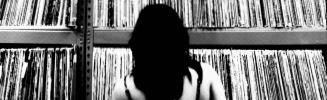
The vinyl catalog at KUGS predates everything else inside the studio. Although some disks are warped and cannot be used anymore, the repository of vinyls continues to be a driving force to document the station’s history. // Photo by Devin Green
On a clear day in Bellingham, the transmission tower on Sehome Hill rises above the trees. Steel support cables stretch into the hillside, holding equipment carrying music, news and conversation across the city.
KUGS, Western Washington University’s student-run station, has broadcasted in Bellingham since 1974. History is visible in a back room behind the studio where shelves hold vinyl records, cassette tapes and older broadcasting equipment, the majority of it cataloged and in use.
Every broadcast from KUGS 89.3 FM depends on the tower. Behind each tune and voice on the radio sits a chain of work starting in a small studio. This process ends high over Bellingham through equipment requiring constant maintenance and repair.
Local radio survives on more than nostalgia. It thrives because students, DJs and engineers maintain the network. Local culture inherently becomes self-supporting on the air despite the dominance of streaming and podcasts.
Ari Santos, a former KUGS student volunteer that graduated last spring, leans toward the microphone, adjusting audio levels with practiced familiarity. The room is compact with soundproofed walls, shelves of vinyl records and cables running beneath the control board.
“I started out as a newsreader,” Santos said. “I did their whole training program, and I did music for the math students afterwards for a really long time just because that’s what was in my schedule as an urban science student.”
The studio runs on a frantic, temporary pulse. Songs crash into silence. Segments vanish. Students cycle through the booth every shift, some going over their own designated hour, before turning over the microphone to another voice, creating a relentless, shifting rhythm.
Even though this is Santos’s last quarter, she still gushes over the station that gives local voices space that is increasingly difficult to find elsewhere.
“I’m grateful to have a consistent hour on KUGS,” Santos said. “Filipino history in the county and the culture we have here has been overshadowed on radio for years. I’m glad I can be a mold that helps preserve it.”
Outside the studio, preservation depends on infrastructure many listeners never see unless they love hiking the Sehome Hill Arboretum.
Perched atop Sehome Hill, the communications tower, a vital hub for KUGS broadcasts, has long served as a guardian of communication over Bellingham. While the previous tower endured decades of the region’s relentless heavy rain, high winds and seasonal temperature shifts, the original tower eventually reached the end of its functional life.
In early 2021, the city completed a project to replace the aging, weather-worn structure, which had become too limited for modern equipment. Today, a new, robust tower stands at the south end of the arboretum, ensuring the continued, reliable reach of KUGS broadcasts throughout the city and beyond.
The studio demands constant attendance from students. Archives require people to organize and save the recordings. Engineers must fight to maintain systems that have run for decades.
Rather than competing directly with streaming platforms, stations like KUGS use the same infrastructure to explore how communication can be used in different ways. KUGS was one of the first radio stations in the Pacific Northwest to create a website in 1995.
Since then, every time a new local innovation in media has rolled in, KUGS has found a way to use it to its advantage instead of something to compete against.
“There’s something different about hearing someone from your own community speaking directly to you,” Santos said. “It makes the station feel alive in a way playlists don’t.”
The studio demands constant attendance from students. Archives require people to organize and save the recordings. Engineers must fight to maintain systems that have run for decades.
When storms begin to hit Whatcom County, the people that live here need to be able to hear weather warnings and emergency broadcasts that might follow.
As the afternoon broadcast at KUGS continues, another song fades into the studio speakers, carrying from Sehome hill and over the city.
Radio waves hum over the landscape and saturate the air. Commuters driving to and from campus, gripping a steering wheel in morning traffic on the freeway. The heater fan whirs while that driver remains oblivious to the engineering that keeps the broadcast clear.
The driver does not think about the windswept steel on the hillside. A finger presses a button and music fills the car. The broadcast keeps the commuter company on the drive to work, unaware of the constant battle against the elements happening just above the treeline.