
Self-Medicated
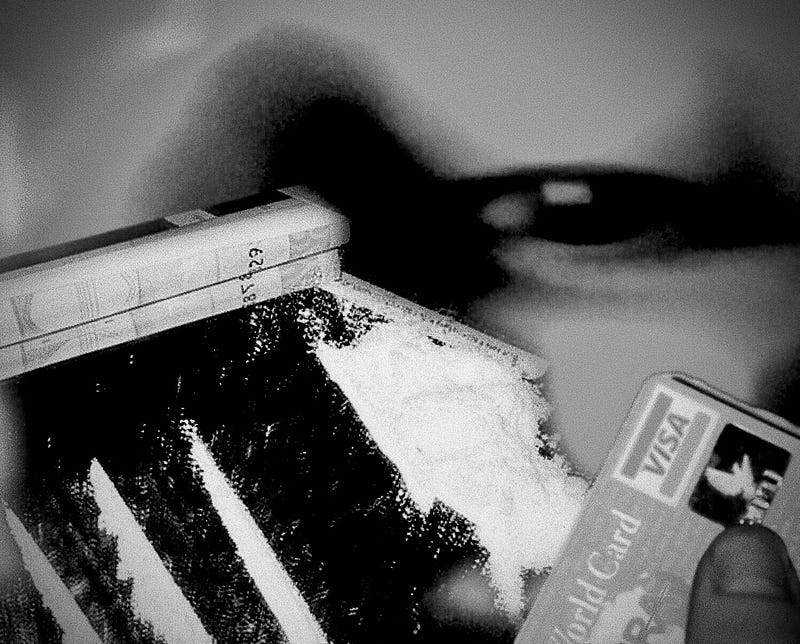
A reflection on fleeting highs and why I stopped chasing them.
Story by Anonymous | Content warning: suicide, addiction
Editor’s note: The author has chosen to remain anonymous because substances referenced in the story remain criminalized in the state this story was published in.
I woke up and dragged my aching body to the kitchen table. I sat down and surveyed the empty cans of beer that surrounded a mirror laid flat on the table. I looked at the mirror covered in smudges and fine white powder. My eyes caught the reflection of my bloodshot eyes, bags bulging under them. I stared.
When I was 16-years-old, I smoked weed for the first time. Up until then, I saw weed as the most dangerous drug imaginable, besides maybe heroin. But finally, after years of peer pressure, the walls came tumbling down. “Why not?” I thought as I was taking my first hit. Once I’d capitulated, I smoked almost daily until my first quarter of college in 2014.
I was excited for college and the prospect of making new friends and achieving the great GPA I’d always wanted. I missed my partner and my friends from home, many of whom I’d known since elementary school, but any apprehension I had went away by the thought of starting anew.
I smoked regularly for the first couple months of college until I decided to test my tolerance. I took 60 milligrams of edibles in one sitting, and before long, I started panicking in my dorm room. All alone, anxiety and sadness washed over me, and I curled on my small, hard mattress and cried myself to sleep.
The next day, those feelings of sadness from the night before hung over me. I tried smoking again and the paralyzing anxiety came back just as intense. At that point, I decided I was done with marijuana. It wasn’t good for me.
Instead, I turned to drinking, and like most college students, my drinking accelerated. Men are the biggest offenders of binge drinking, which is the consumption of five or more drinks over two hours.
Drinking is not immune to the law of diminishing returns, and at this point I wasn’t achieving the highs I once had, but the lows remained constant.
Binge drinking is most common among people aged 18–34 years old. The University of Michigan found that 35% of college students binge drank in 2014.
Like many broke college students looking to stockpile booze, I settled on Skol vodka which runs $15 for a half gallon. At first, drinking was relegated to one or two nights on the weekends. Some friends from high school and I would huddle around a TV, play video games and drink until the screen was burned into our retinas.
I loved the escapism drinking provided. I could make an entire week disappear in a few hours on a Friday night. Weekend drinking began to bleed into weekdays now that I wasn’t smoking. If I finished my homework early enough, I’d grab a bottle of Gatorade and a handle of Skol and drink by myself until I fell asleep.

Despite my weekend binging with friends, I spent a lot of time isolated in my dorm. Meaningful face to face interactions were rare and it weighed on me. At first, I tried to replace those interactions with things like music and video games, but those distractions aren’t as meaningful when you can’t share them with someone.
I could make an entire week disappear in a few hours on a Friday night.
By the end of fall quarter, my solitary lifestyle had taken a toll on my mental health. The most painful moments were spent in my cramped, sterile dorm room where I’d just sit and think. As the end of my first year approached, it became increasingly clear that I was going to fail calculus. I hadn’t made any new friends, and my partner broke up with me.
When I returned home for the summer of 2015, I felt like l hadn’t achieved any of my goals. The breakup hit me the hardest, amplifying the feelings of loneliness I’d felt all year.
I quickly got on anti-depressants and started drinking more frequently with friends. They would recount stories about their new friends and their academic success. I was embarrassed because I had no stories of my own.

I began taking the anti-depressant Sertraline hoping it would instantly make everything better. It didn’t, and in hindsight, it’s easy to see why. The label of that little orange bottle read: “Do not mix with alcohol.”
Reading the fine print was a light bulb moment for me. If I combined alcohol with Sertraline, I could get drunker, faster. Every time before I started drinking, I’d throw a pill in my mouth and wash it down with alcohol. And It worked. I’d black out nearly every time.
I spent the summer building a routine around drinking. I proudly touted a three-week streak where I didn’t go a day without drinking. Any emotion, any occasion seemed to justify drinking.
I returned to Western for the 2015–2016 academic year and my routine, which I promised myself I’d stop, returned with me. After three months of nearly nonstop drinking, I knew I was reliant on alcohol to regulate my emotions. From the second I began taking my anti-depressants with alcohol I knew what I was doing. I even joked about it. To mitigate my concerns, I established a rule that was never to be broken: never show up to a test drunk.
In May 2016, I took a biology test drunk. The problem with my rule was that I was the only one responsible for enforcing it. And this time, I didn’t enforce my rule. In fact, I found it pretty amusing that I’d done something so ridiculous.
The academic year ended and I was no further in my computer science major. I hadn’t managed to get into any classes I needed for the major, and I was frustrated my second year had gone so similarly to my first.
By the 2018–2019 academic year, I had changed my major to journalism and felt my interest in school return after having no direction for several years, but the drinking and blackouts persisted. My roommates and friends from high school had all graduated the previous academic year, and I watched as they jumped out into the real world and I settled right back into school.
Drinking is not immune to the law of diminishing returns, and at this point I wasn’t achieving the highs I once had, but the lows remained constant.
In October 2018, I took MDMA for the first time in a couple years. The first time, I’d only taken a single point at a concert. I was terrified at first, shaking and laughing nervously when I popped the pill into my mouth. When it finally hit, my fears were immediately assuaged. The high was light and fleeting, but I loved it.
I’d forgotten how happy MDMA made me. My whole body tingled and I couldn’t stop smiling. I couldn’t stop telling my friends how much I loved them, and I couldn’t wait to do it again the next morning.
When I was in bed, I stared at the ceiling and contemplated how my parents would feel if I was gone.
Prior to this, I’d tried cocaine and oxycontin on several occasions. I used cocaine in excess for holidays and special occasions, sometimes to the point of nosebleeds, but the cost kept it a luxury item.
MDMA, on the other hand, is not expensive, and having recently found a drug dealer, I started taking it two or more times a month. The best part of MDMA was also the most problematic: the massive serotonin release in your brain.
Serotonin is a neurotransmitter that affects your mood. It’s associated with happiness in particular, which is why MDMA makes you tell your friends how much you love them ad-nauseam. But the next day, your serotonin levels are heavily depleted, which often leads to depressive spells. Combining this with a preexisting chemical imbalance in your brain can lead to deep depressions.
One of the biggest turning points in my drug use followed a night I mixed MDMA, alcohol and oxycontin. I woke up the next day wanting to die. I’d thought about suicide frequently for several years, but this urge was stronger than anything I’d felt before. Paradoxically, I was so wiped out I didn’t have the energy to act on that urge.
For the next week I didn’t eat anything. I would periodically drag myself to class, but spent most days moving from my bedroom to my balcony to smoke cigarettes. When I was in bed, I stared at the ceiling and contemplated how my parents would feel if I was gone.
Shortly after my depression spell, a friend living in Seattle visited me for the weekend. We spent the first night drinking and texted my drug dealer requesting MDMA. We joked about buying some ketamine, which he had offered to us in the past, because it seemed like an absurd drug to try. Ketamine is an anesthetic, but has fallen out of medical use due its side effects.
The joke didn’t last long, as we egged each other on until we added ketamine to our order. We cackled like hyenas as we held the bag and examined the fine white powder. We cut up our first lines on our favorite mirror, bent over and sniffed as hard as we could.
We set a timer on our phones for 20 minutes and waited for the ketamine to hit us. About 18 minutes in, my friend and I started giggling uncontrollably and it wasn’t long before we were howling. I felt completely out of control of my body and mind, but it wasn’t terrifying, it was freeing. The sensation was analogous to waking up after having your wisdom teeth pulled, except you’re not as loopy. My whole body had gone rubbery, making walking, talking and even thinking difficult.
My friend continued to visit on the weekends, and we continued to buy gram after gram of ketamine. The first time was incredible, and we needed to experience the same euphoria all over again.
Several months later, my friend and I sat across the table from each other after a night of drinking and ketamine. The mirror from the night before sat between us smudged with fingerprints and caked with powder.
I looked at him and said, “It’s never going to feel like it did the first time, huh?”
“Nah,” he responded.
At some point along the way, we seemed to have both realized this, but we kept going.

In late July 2019, I decided it was time to stop drinking and doing drugs. My frequent ketamine use made me reflect on the past five years. I had spent most of my time trying to reach highs that were never going to come, and if they did, they were fleeting. I wasn’t sure how I’d move forward without alcohol. Not only had it become a part of my routine, it was a part of my person.
Being the guy who can drink the most or who’s always ready to dive into drugs became my entire persona. It’s all I wanted to do, all I wanted to talk about, all I wanted to be known for. I was not only changing my entire routine, but my entire identity.
My roommates were surprised by my decision, but I knew telling them was the best way I could keep myself in check. Rather than keeping my promise to myself, my promise was public.
I told my parents that I’d stopped drinking too, which was a surprise to my mom. She had given me countless talking-tos throughout the years. My parents don’t know about most of the things I’ve done, nor how bad it got, and they probably never will, but they were supportive of my decision to stop.
A couple weeks of sobriety passed, and I attended a going-away party for a friend. She offered me a drink and I told her I had quit drinking.
“Forever?” she asked.
“Most likely, that’s what I’m feeling right now,” I responded.
“I’m glad to hear that. Me and C were so worried, we thought about having an intervention for you,” she said.
It was hard at first. Social gatherings were awkward, and I had trouble sleeping. I missed drinking immensely and came close several times to giving up.
I floundered deciding how long I would give up drinking. I spent much of those five years miserable, but I also had a lot of fun. Drinking and drugs made me happy, they gave me an escape. Was I willing to give up that escape forever?
When we talk about substance abuse, what often gets forgotten is that binge drinking and drug use are symptoms. They may cause problems, but they aren’t the problem. I’ve always disliked myself, and once I got the opportunity to manage those feelings, I did something about it. That something was self-medicating.
Now that I’ve been sober, I’m looking forward to life. I’m not living for the weekend or the next free moment I can get obliterated. I’m living for the future. I’m excited to leave college and get a job doing something I love.
I’m even starting to love myself. I still have odd depressive spells and wrestle with the same anxieties, but it’s a lot easier to fight when I’ve got a clear mind. I love that I’m doing better in school, that I’ve prioritized my relationships and that I’ve even lost a little weight since I stopped drinking.
Sometimes an urge to drink rushes at me on a holiday or a bad day. I remember all the misery of the past five years, feeling constantly hungover, depressed or anxious. I remember how far I’ve come since then, and realize there’s no way I can go back to being who I was.