
Language, Faith and the Classrooms of Senegal, West Africa
Story and photos by Trinity Kaeding
Published April 7, 2026
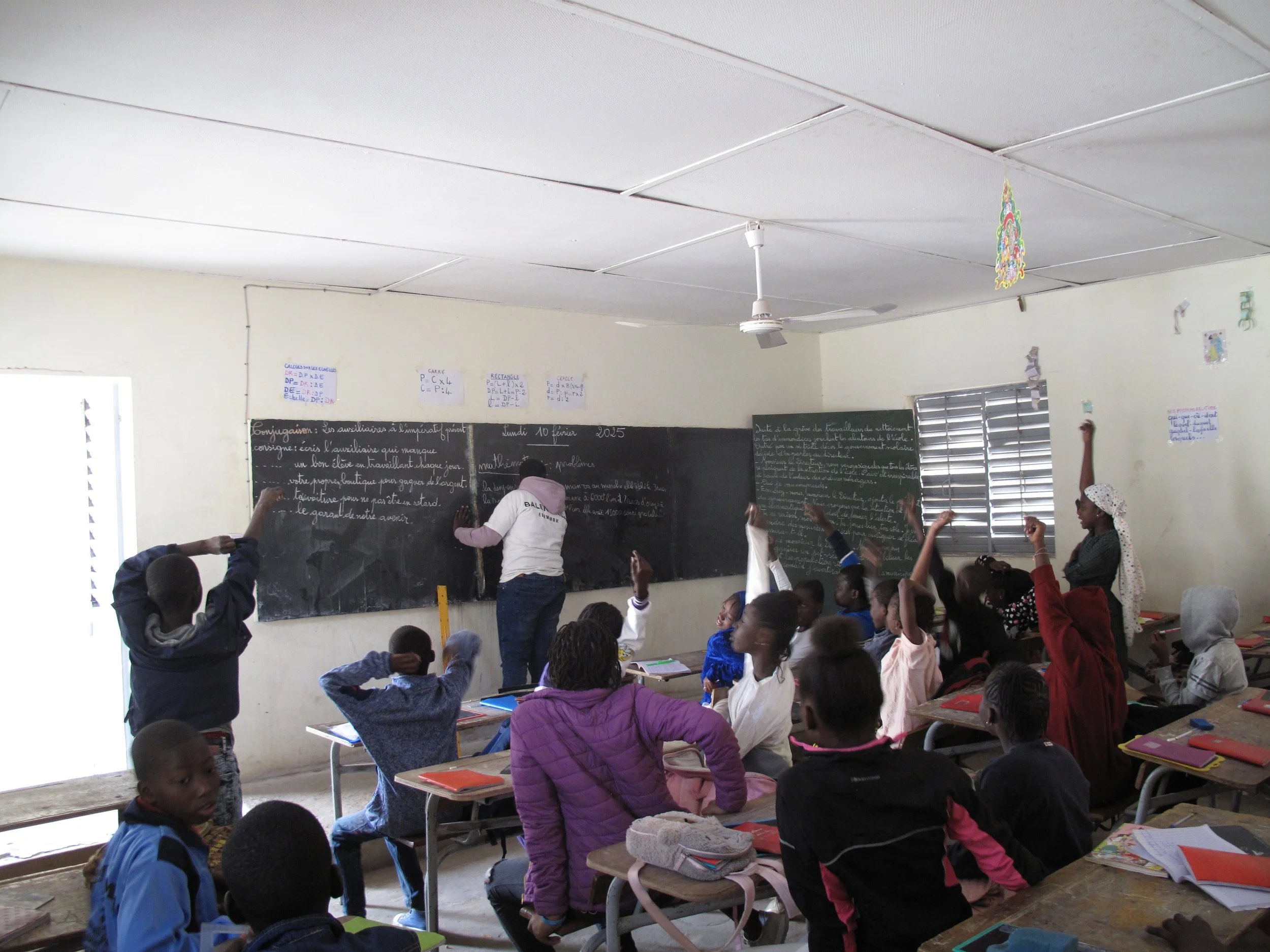
At the elementary school of HLM 4B, the math class of CMl B bustled with activity. Eager to engage with the materials, students shot up their hands to answer questions, some standing in hopes to show off their skills.
The bus pulled over along the desert dirt road, and all we could hear was the thumping of rhythmic chants. We were hours away from the Podor city center, deep within the Sahara Desert. Our tired feet hit the cold, night-soaked sand and rock as we slowly approached the boom of the microphone and hum of chatter that echoed into the darkness. The blisters on my back were still healing from the sun's rage three weeks ago.
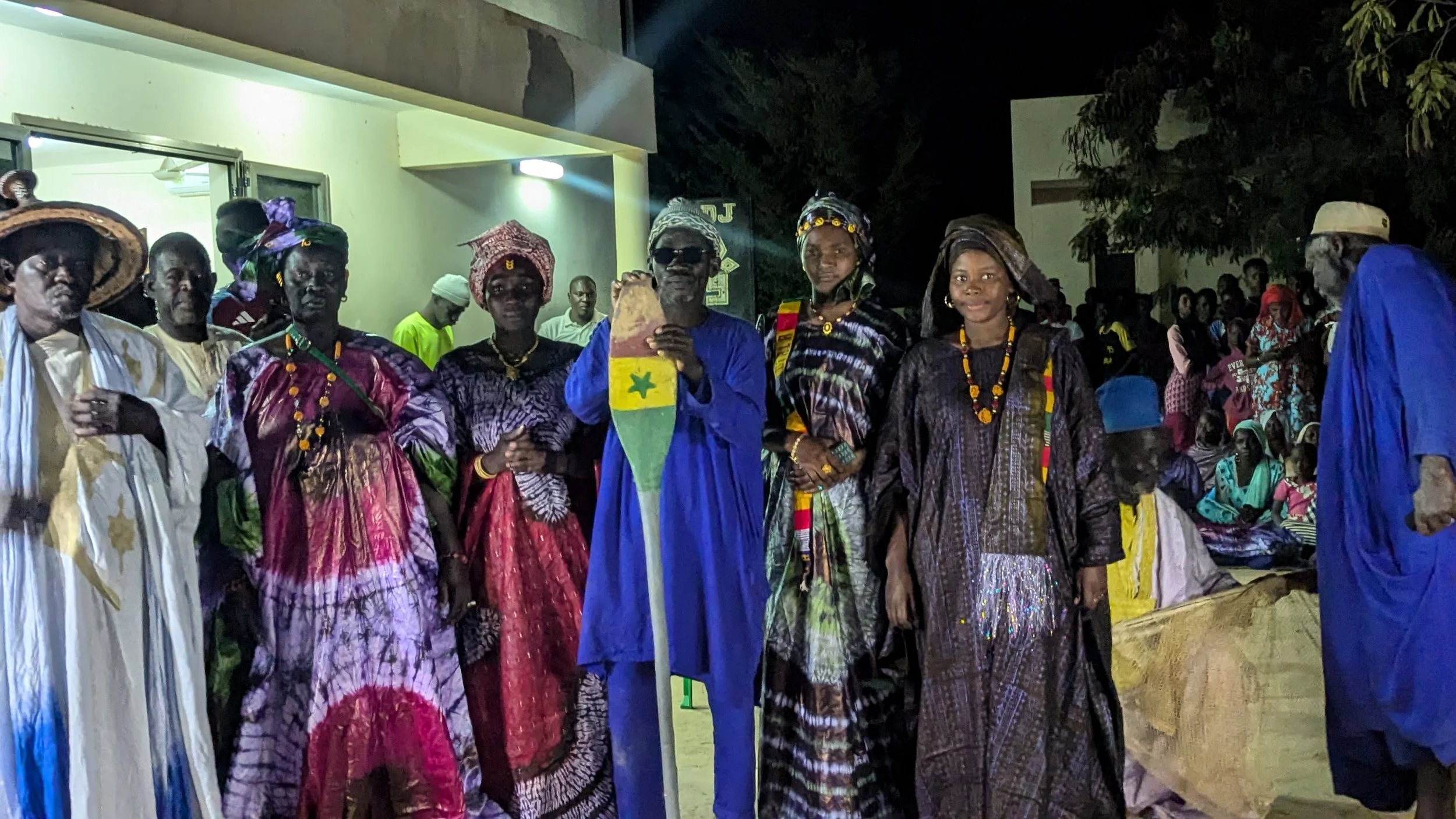
Joy radiated from the village of Donaye in West Africa, which was surrounded by flashing lights and bustling crowds. Among them walked the fully dressed leaders of the fishing villages of Donaye-Taredji, Diambo, Wuro Madiw, Guia and Guédé. Standing to attend to us, they share their handmade ancestral fashion and culture with pride.
Our chaperone for the night, Alassane Dia, a scholar of English and comparative literature born in one of Podor's small fishing villages, welcomed us to his home village of Donaye, now settled in the Dieri. He led us to our plastic chairs on the outskirts of the crowd, which had already erupted into the night's events: a poetry slam.
Their voices poured out history and emotion into a song I couldn't understand, nor could anyone who wasn’t from the northern Senegal villages of Donaye-Taredji, Diambo, Wuro Madiw, Guia or Guédé. Their language was not that of Wolof, French or Arabic, but the language of their ancient small villages, Pulaar, the language of the Fulani.
Each person was clothed in colorful textiles and handmade hats representing their homes and communities. As we sliced through the crowd, locals welcomed us with excitement and curiosity. Children sat beside their parents atop colorful blankets. Leaders and community members took the microphone, some speaking softly as if recalling a story to a friend, while others spoke with great gusto.
According to Christopher Wise, professor of English and comparative literature at Western Washington University, the fishermen from this village do not preserve their culture through textbooks or written history. Rather, they use oral storytelling methods such as seasonal poetry slams at festivals, weddings and the occasional canoe race to preserve history as knowledge and pass down stories. The celebrations bring together neighboring fishing clans, who praise and boast about their group’s prowess through song and memory.
That night, I witnessed language as inheritance, without the need for pen or paper.
MY FIRST STEP TO WITNESSING LANGUAGE
When I saw the notification for Western’s winter 2025 study abroad trip to Senegal, my first thought was, "Where even is Senegal?" That question quickly became less about geography and more about perspective, challenging the limits of my own understanding and how I perceived the unknown.
A Google search was followed by an application. Before I knew it, I was reading about the Muridiyya and the Tijaniyya, the largest branches of Islam within West Africa, and packing my bags.
We began in Dakar, the westernmost point of Africa, moved to the holy city of Touba, continued north to Saint-Louis, and finally to Podor, near the Mauritanian border. Each place revealed a different relationship between language, faith and education.
THE IMPACT OF COLONIALISM ON EDUCATION AND LANGUAGE
Small fishing boats decorated the placid waters, and the sun reflected off the island's shore. The ferry was packed. Claps and dancing quickly filled the limited space, my ears full of joyful music.
As we approached Gorée Island, off the coast of Dakar, the buildings were vibrant hues of orange and yellow. Under the island sun, vendors selling beaded necklaces and tiny drums called to us. We followed our tour guide along the sidewalks lined with flowers as he told us a dark history that sharply contradicted the island's tropical serenity. It was here that the dark legacy of French colonization became impossible to ignore.
French colonization began in 1659 and deeply influenced the incorporation of the French language throughout West Africa. Senegal gained political independence in 1960 under its first president, Léopold Sédar Senghor, who maintained a positive relationship with France during this transition.
Today, the influence is stark, especially within their education system.
Elementary schools in Senegal are modeled directly on the French schooling system. Since independence, schools have incorporated more Senegalese-focused material, though the overall French-based structure remains.
No matter where we went, what city, village, school or convenience store, we were welcomed in French. As I stepped off the bus at one of our many stops along the road, children as young as five tried to communicate with us in French. Asking me questions with excited looks on their faces, ready to practice what they had learned in school.
In Senegal, the French language functions much like English does globally, connecting people from diverse linguistic backgrounds and functioning as a common academic bridge. However, it’s not the only language shaping education.
Wolof is the most widely spoken language throughout Senegal and much of West Africa. It’s heard in markets, music and the home, and it’s often the language the people of Senegal return to after formal conversations.
According to Wise, who led the study abroad program, Ajami is a modified Arabic script adapted to African languages and used for more than 900 years. It was first used to disseminate Islamic teachings in non-Arabic-speaking communities. French colonizers dismissed it as "garbled Arabic,” he said. That arrogance strengthened its cultural role. Today, Ajami is used for religious instruction, poetry, business and record-keeping, especially in religious communities such as Touba, home to the Muridiyya.
“Throughout West Africa, which is 95% Muslim, children will leave their parents as young as 4 years old to study with marabouts in Quranic schools,” Wise said in an email. In this system of education, the children “will not return to their parents until they have memorized the Quran and can orally recite it. This is why you can say many Muslims in West Africa are ‘walking Qurans.’ They don’t need physical copies of it.”
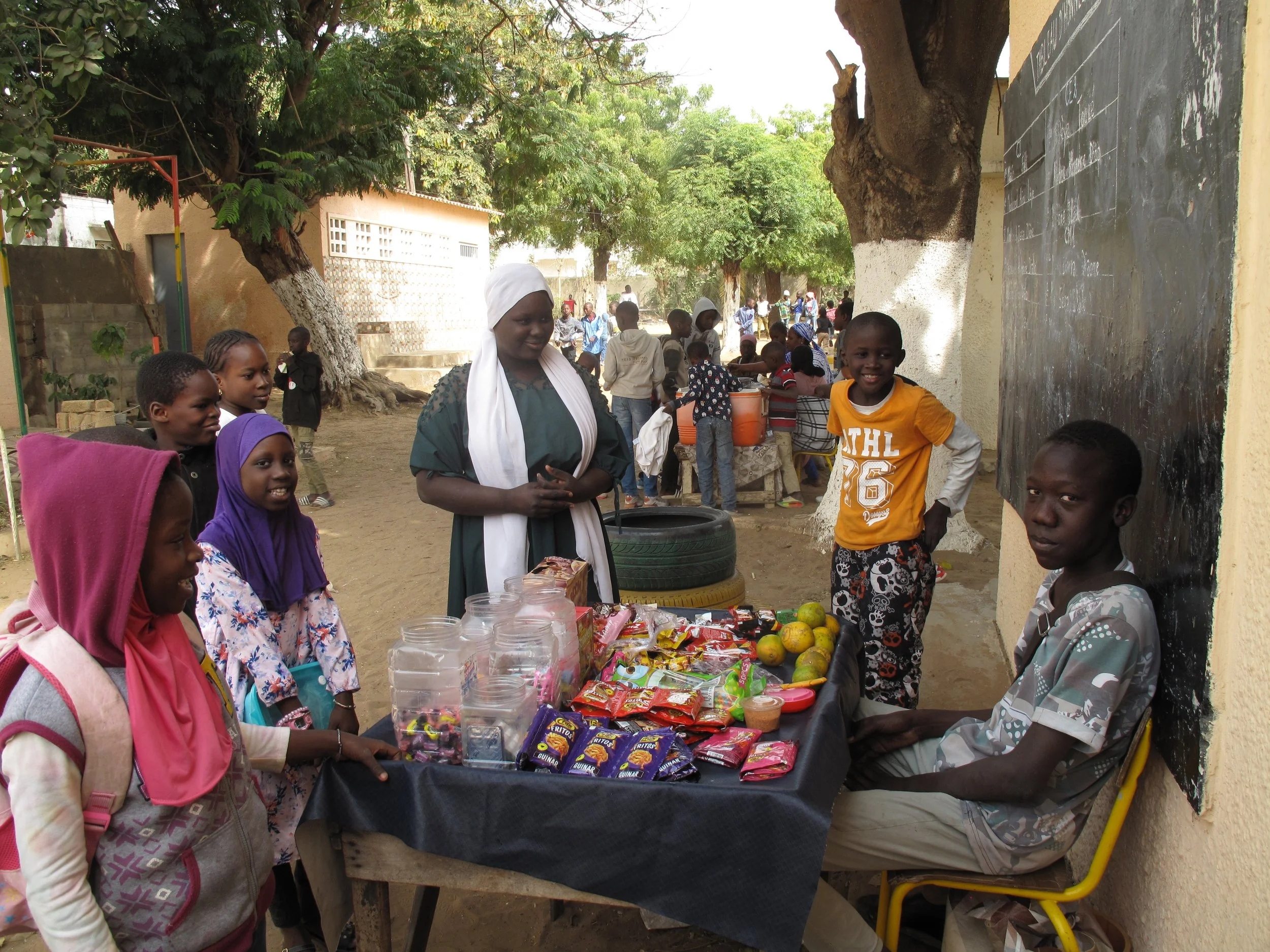
Students examine the snacks offered by a vendor stationed inside the school walls of HLM 4B.
VISITING THREE SCHOOLS IN DAKAR AND SALY
As part of the study abroad program, I conducted research on elementary schools in Dakar and Saly. I visited three schools and interviewed deans and students, with translation help from Fatima Kane, an assistant in the program.
In Madieye Sall, a private school in Saly, I walked up to the tall concrete walls that surrounded the three-story school in front of me. The metal gates unlatched, allowing me to see into the open courtyard. Clothes lines stretched to my right, where the live-in school caretaker would hang his belongings. To the left, children ran around the courtyard, kicking a soccer ball back and forth in their navy blue uniforms.
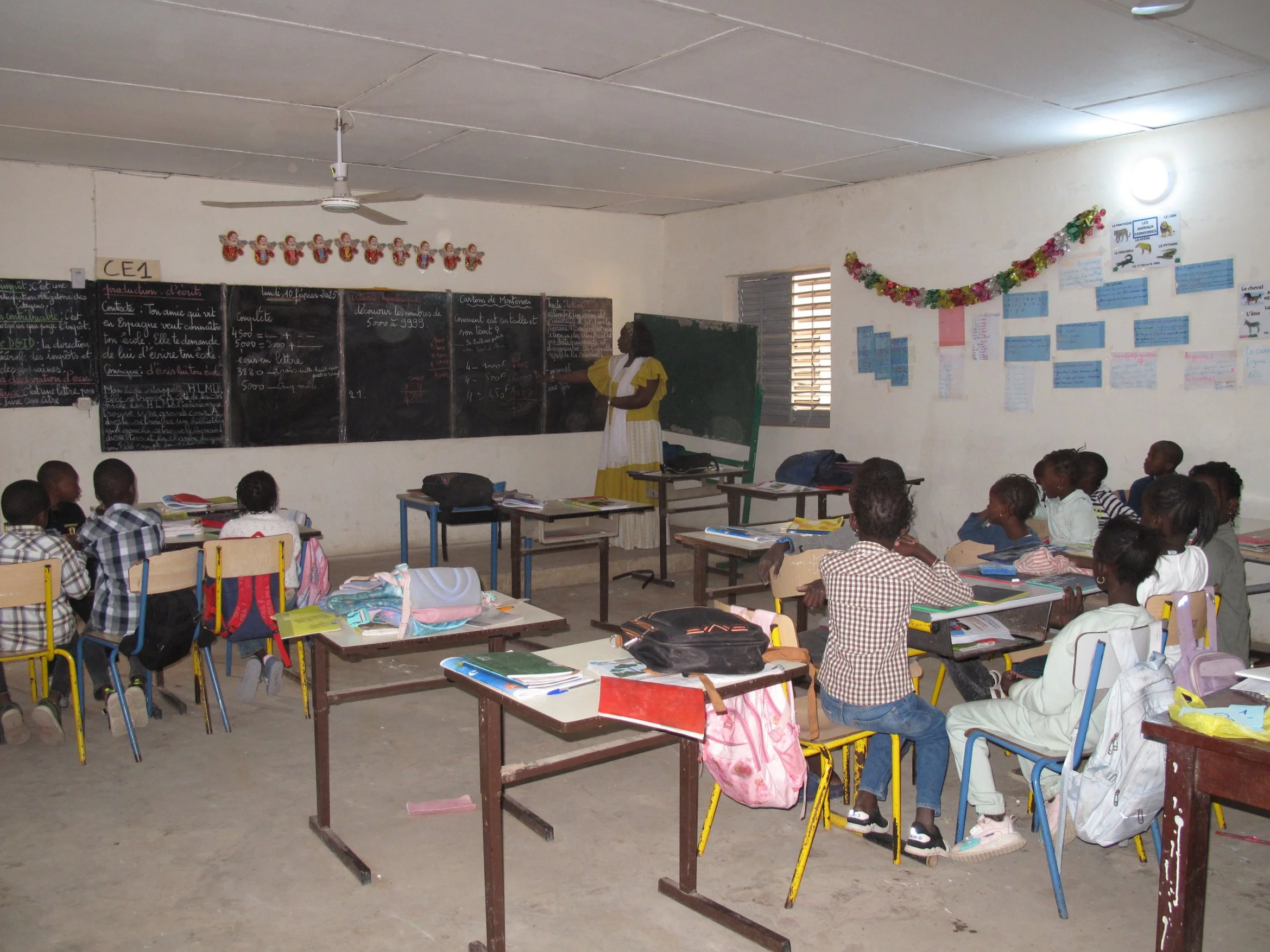
Classrooms tend to be small, fully concrete and painted with yellows and blues. Chalkboards sit at the front of the room. Posters are usually hand-made or painted murals. Fans substitute for air conditioning, circulating the air that rarely drops below 75-80 degrees.
As I entered the classrooms with the vice principal, students stood at attention. Their bags were full of their own textbooks and pencils, and fresh paintings coated the stairwell walls. Here, students receive breakfast and lunch prepared by school employees.
When I asked the vice principal what subject mattered most, the response was simple, "Every subject is important." That answer echoed across all three schools, as the two other deans and the vice principal recalled their devotion to a well-rounded education for all students. Dissolving my own assumptions on different schools prioritizing French or Qur'anic lessons based on their location and type.
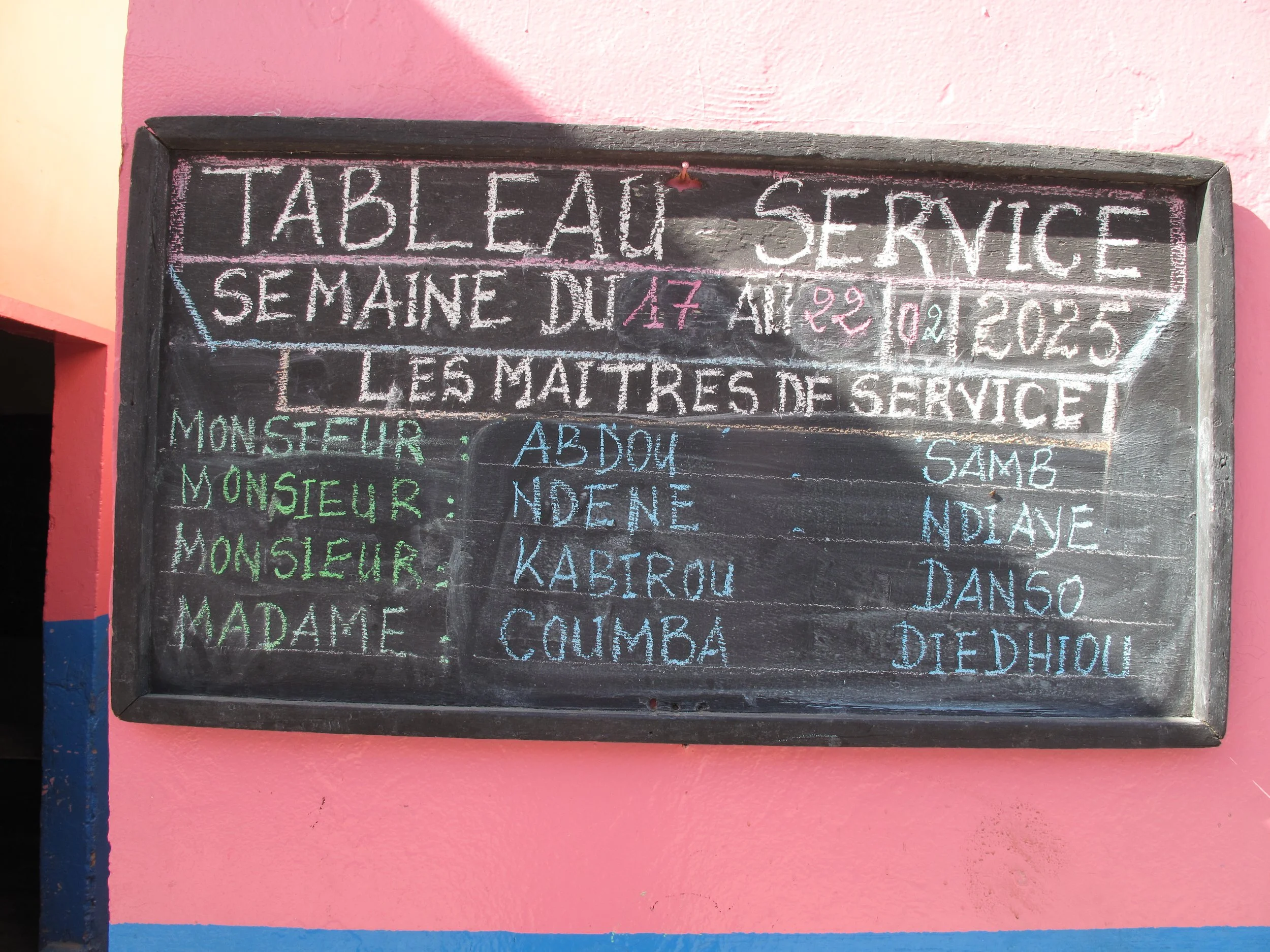
A chalkboard sits within the walls of a private school called Pape Maguette Diange in Saly. Each day, it’s updated in French with the schedule of who is teaching that day.
From what I have experienced in the United States, school districts often push their own perspectives into the curriculum. Private or religious schools may label their religious lessons as the most important, compared to other subjects. In Senegal, however, that was not the goal of education. Religion and language learning are treated as equally important as subjects like math or science, providing students with a holistic education.
At HLM 4B, a public school located within a district of Dakar, I saw this balance firsthand. In Classroom CMl within the French-based classroom system, the equivalent of fifth grade in the United States, I watched a boy volunteer to write out a math problem.
In fluent French, he wrote in chalk: “My mother went to the market and bought 3 bags of bananas for 6000 CFA each, and 2 bags of oranges for 5000 CFA each. She brings 40,000 CFA to the market. What is the total she spent?ˮ
A student raised her hand and walked to the front to work out the problem.
Inside the school of Pape Maguette Diange, located in Saly, the girls wore hijabs while they studied Arabic texts and the Qur'an. Their uniforms also included school-provided green vests. During lunchtime, children walked home in large groups, laughing together down the street. Bikes lined the inside walls, next to the small chalkboard placed outside, listing the class schedule and instructors for that day.
No matter the wealth or branch of Islam a family follows, all these schools attempt to treat the students equally and encourage education.
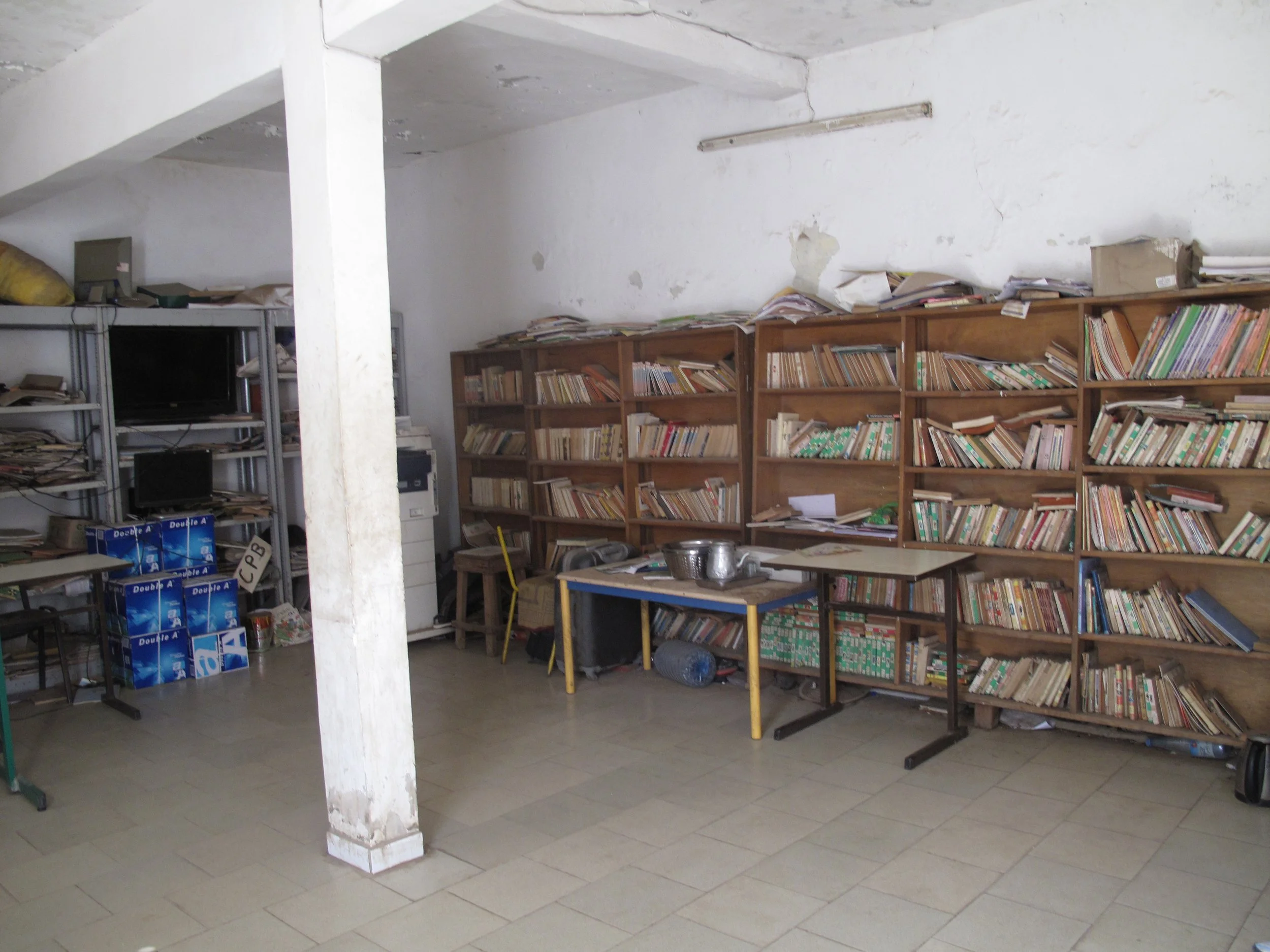
A classroom within HLM 4B stacks used books from previous years, all written in French. Each one carries the symbolic weight of French colonialism's legacy and financial struggles that impact the classroom. Students use them for the period, placing them back on the stack for the next class.
IT TAKES A VILLAGE
As the saying goes, "It takes a village," and in Senegal, they take it to heart. These schools are more than just places for education; they are community centers, reflecting the resilience of the Senegalese people and their culture.
Despite limited classroom resources, the attendance rates at all three schools I visited ranged from approximately 95% to nearly 100%. Parents often purchase school supplies themselves, and textbooks are reused carefully year after year. At some schools, students walk home during lunch because providing meals is not within the school's budget. Uniforms are also required in Senegal, though many families and schools struggle to afford them.
Within Senegal, the funding system is similar to that of the United States; federal funding is dispersed to the city and distributed to districts and schools. However, administrators at all three schools I visited explained that government funding has not reached them in the past four years.
Despite these financial challenges and lack of resources, the classrooms I observed told a different story. Senegalese students appeared to be working at levels comparable to or more advanced than similar grade levels in the United States.
That resilience is visible in the way history is handled. Gorée Island, once the most significant slave trading site on the African coast, is now home to one of the most highly renowned all-girls schools in the country. Topics such as the country’s history of French colonization, the slave trade and Gorée Island are not avoided; they are confronted.
Senegal's education system does not erase differences; it acknowledges them. By unifying within their communities, history and religious practices, the country has created a blended, coexisting relationship of language, because in Senegal, language is not just spoken. It is lived.