
Redefining how adaptive sailing is discussed on and off the water
The push to make sailing more inclusive in both practice and language for athletes with disabilities
Story by Cameron Riggers
Published April 7, 2026
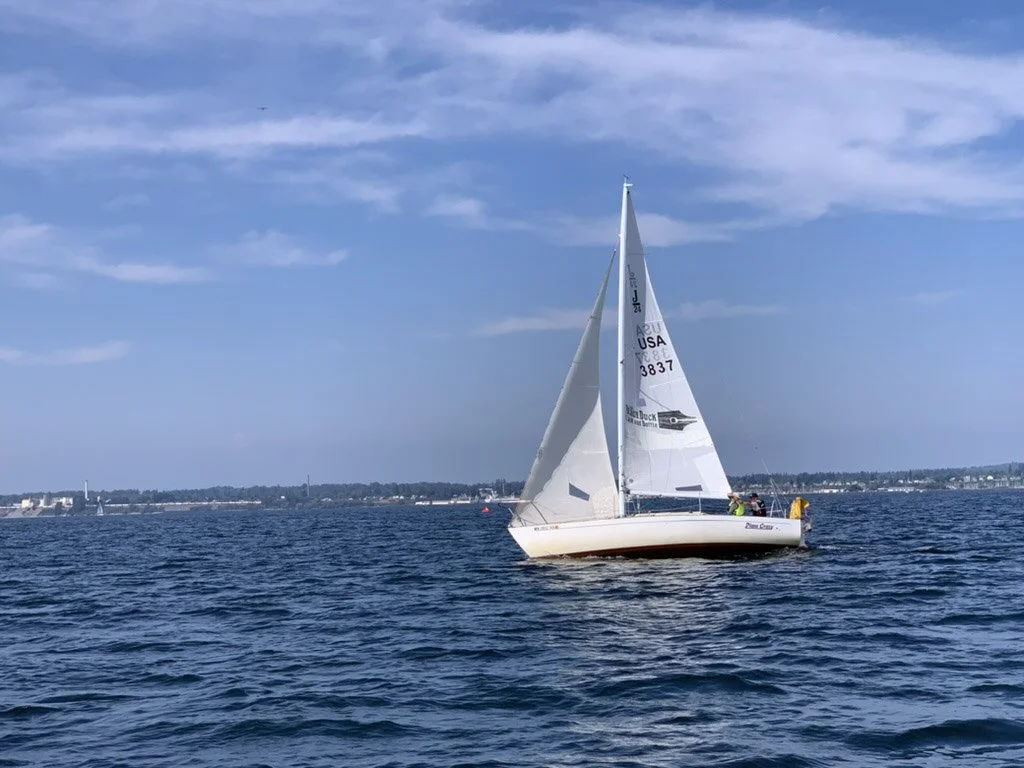
One of the Hansa boats on Bellingham Bay. These boats are used during the Community Boat Center’s Blind Sailing Clinic. // Photo by Bryan Rust, courtesy of the Community Boating Center
As trains and ferries rumble along the south side of Bellingham Bay, the Community Boating Center readies itself for another day of sailing and kayaking. Painted in hues of blue and orange, the facility houses a plethora of watercraft, inviting people of all ages and abilities to give boating a try.
An anchor in the community, CBC works to make boating more accessible for individuals with disabilities. Community Programs Manager Anna Morrow helps lead that effort, coordinating opportunities for individuals with disabilities to use adaptive boats and ensuring more people can experience what the water has to offer.
In addition to using adaptive boats, the programs also consider how communication on and off the water can be made more accessible to people with disabilities.
“In adaptive settings, clear communication is even more important,” Morrow said. “With blind sailing participants, for example, we spend a lot of time talking through and mapping out the boat before getting on the water, where everything is, and what to expect, so everyone has a base level of understanding.”
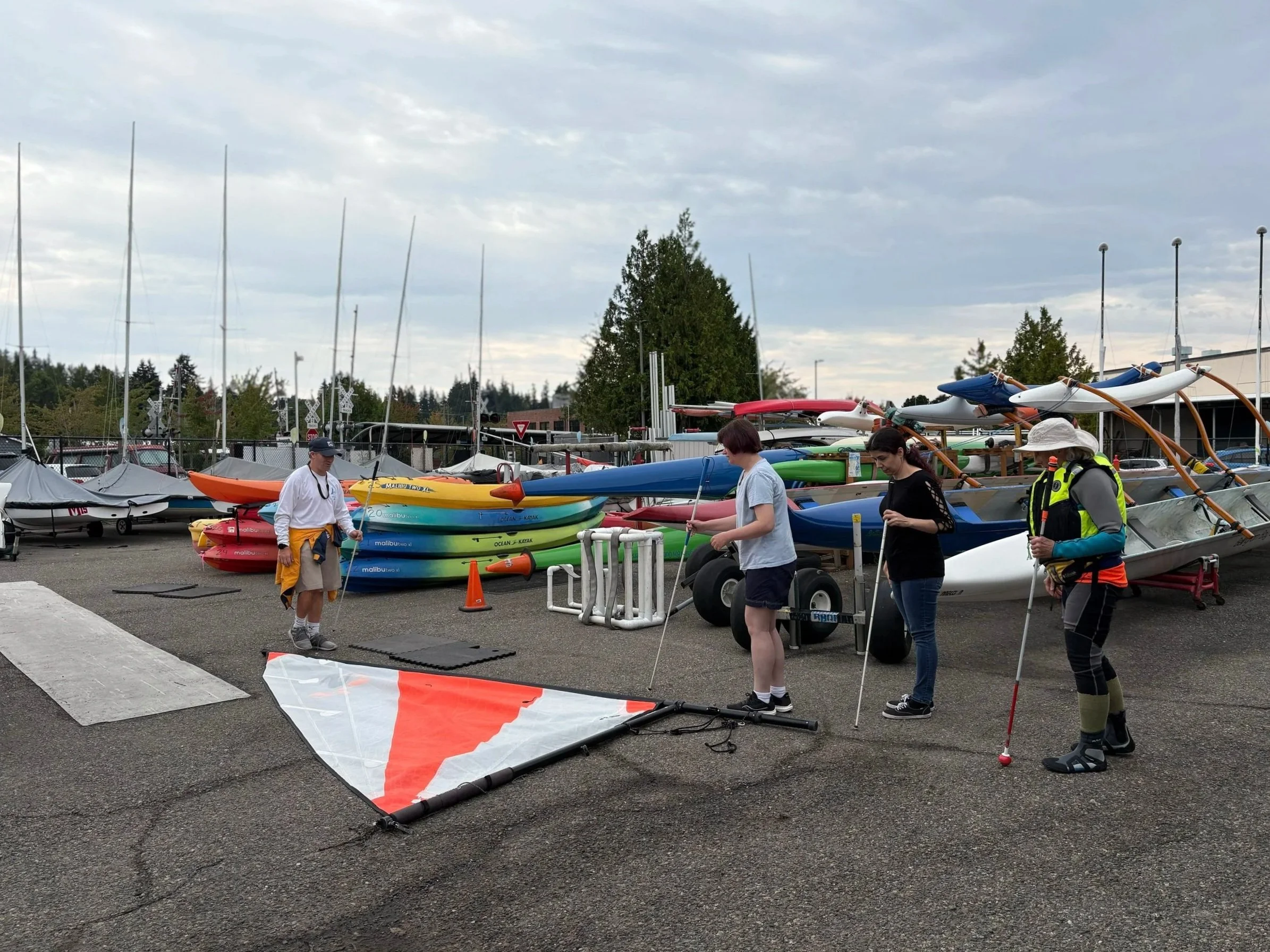
Members of the Blind Sailing Clinic gather around and inspect a hansa boat sail at the Community Boating Center in Bellingham, Wash. in summer 2025. These boats feature a high-stability, low center-of-gravity design, making them more accessible and tailorable to sailors with disabilities. // Photo by Bryan Rust, courtesy of the Community Boating Center
Natalie Charbonneau, who participates recreationally in the blind sailing clinic at CBC, can attest to this. Charbonneau went blind at age 8, making clear and precise language especially important for her and other sailors with vision impairments.
“One of the big barriers is that people use a lot of nonverbal communication, like gesturing, pointing, vague terms like ‘over there’ or ‘look here,’” Charbonneau said.
Alongside communication strategies, the CBC uses Hansa boats designed with accessibility in mind, allowing sailors with disabilities to get on the water for both competitive and recreational sailing. The boats feature a high-stability, low center-of-gravity design with weighted keels to reduce the risk of capsizing, as well as adaptive joysticks and supportive seating that can be tailored to each sailor’s needs.
“I think it’s certainly strengthened the community and brought people together who maybe wouldn’t have had the opportunity to sail otherwise,” Morrow said.
Daman Wandke has experienced this firsthand. Wandke participates recreationally and competitively in the CBC adaptive sailing program. He’s also a Woodring College of Education professor at Western Washington University and lives with cerebral palsy, a disability that affects movement, muscle tone and posture.
“At CBC, it’s not about my disability,” Wandke said. “It’s about working together and finding unique ways to get out on the water.”
Wandke uses a wheelchair for mobility on land and switches to a Hansa boat and adaptive skis on the water. Over the years, Wandke has intentionally tried as many para-sports as possible to see what each activity has to offer. Unlike an open gym, where people can move freely between activities, para-sport equipment requires time, instruction and practice to learn.
“My body works in a very unique way, and most people with disabilities’ bodies work differently,” Wandke said. “So I have to communicate that to my instructor or my coach while they’re taking that into consideration.”
In addition to adapting the equipment and communication, Wandke called for a change in the language and terminology used around adaptive sports. He referenced Stella Young’s 2014 TED Talk, “I'm not your inspiration, thank you very much,” in which the term “inspiration porn” was popularized.
In her talk, Young uses the term to refer to the objectification of people with disabilities for the benefit of nondisabled people. She said that “disability does not make you exceptional, but questioning what you think you know about it does.”
For Wandke, portraying athletes with disabilities is a matter of finding the right balance.
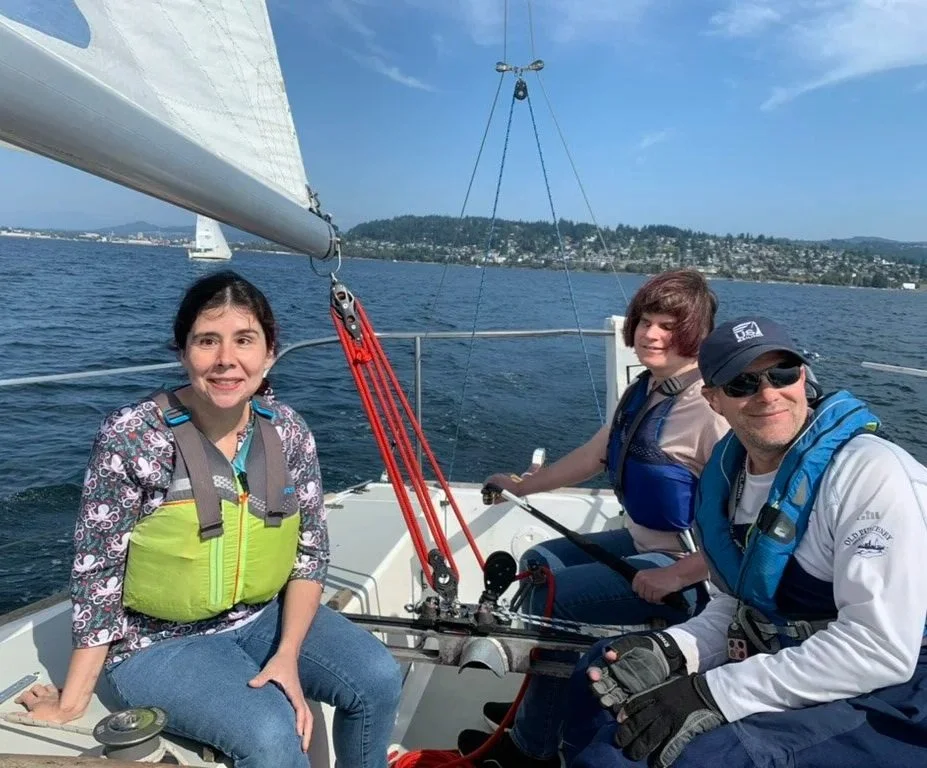
Members of the Blind Sailing Clinic at the Community Boating Center while out on Bellingham Bay in summer 2025. // Photo by Bryan Rust, courtesy of the Community Boating Center
“So it’s trying to find the line between, are you an inspiration because of your skill and ability? Or are people calling you an inspiration just for getting out of bed that day?” Wandke said.
That balance becomes even more complicated at the professional level, he added.
“It becomes difficult when you get to the highest level,” he said. “When is it okay to say someone’s inspirational, and when is it not okay?”
Charbonneau said this kind of language is important to consider when describing what athletes with disabilities do.
“When we say ‘participating’ instead of ‘competing,’ it can imply something is lesser, that accommodations make it easier or less competitive,” Charbonneau said. “That’s not true.”
Questions of terminology and representation are ones Jasmine Goodnow, a professor of Recreation Management and Leadership at Western, considers often. One of the classes she teaches is Inclusive Recreation Services, which encourages students to examine the historical discriminatory practices toward people with disabilities in the U.S.
“I catch myself saying 'able-bodied' instead of 'non-disabled,' which frames able-bodied as the norm,” Goodnow said.
She attributes this instinct to use one terminology over another to biases. “We all have implicit biases we’ve been socialized into,” she said. “If you look at movies and TV shows, how often is there a lead character who is disabled? And often they’re played by non-disabled actors.”
These biases, Goodnow says, have a direct impact on whose voices are heard when adaptive programs are formed.
“Representation matters, but so does decision-making power,” Goodnow said. “People with disabilities should be in the room, developing programs, shaping marketing, and making decisions. Implicit bias affects who gets hired and who gets heard.”