
Same story, different place
The nuances and necessity of literary translation
Story by Josh Hernandez
Illustration by Royce Alton
Published April 7, 2026
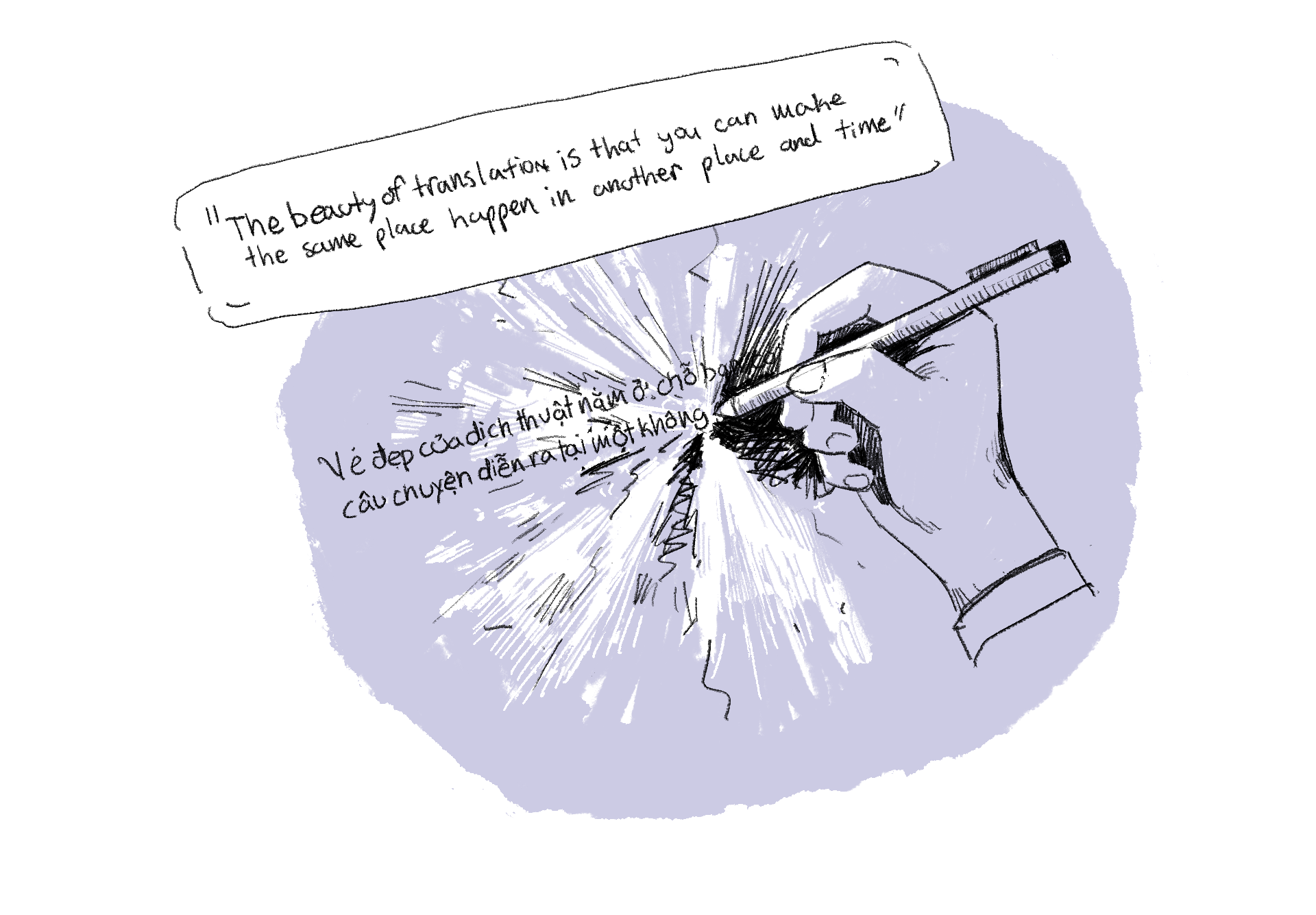
Pick up the text. Read it once. Re-read it a couple more times. Then, “make a really messy, free, rough draft,” Sarah Brownsberger, an Icelandic-English literary translator, said of her process.
The mission of literary translation is unique to each translator, but the practice itself dates back to at least the third century B.C., when the epic Babylonian poems of Genesis were translated into Greek for wider dissemination. Despite its historical use, it wasn’t until this century that literary translators began to gain recognition in academic and literary spaces.
For the majority of the field’s existence, translators’ names were either omitted entirely from the works they’ve produced or relegated to a corner, barely noticed, portraying them as secondary to the original authors.
Quan Manh Ha, professor of American literature and translator of Vietnamese literature, pushes back against that lack of recognition, insisting his name appear on the front cover. “I refuse to have my name appear in the back,” he said, “or just somewhere after the front page.”
Progress has been made. In 2018, the National Book Foundation established the first National Book Award for Translated Literature. Three years later, Mary Rasenburger wrote the first publishing contract model for literary translators, allowing for greater agency in the publishing process.
When the opportunity to teach at the University of Montana presented itself, Ha realized his goal was to make writing from Vietnamese-born and raised authors, alongside work from Vietnamese American immigrants and refugees, accessible in English.
“Whenever an American publisher wants to do something with Vietnamese literature, they’re obsessed with the Vietnam War,” Ha said. He has found beauty in narratives beyond the war. “If we don’t translate their voices into English,” Ha said, “then their voices are never heard.”
What is popular in literature in Ha’s home country of Vietnam, and in foreign countries generally, does not always receive a warm welcome from some of the larger U.S. publishers. According to the University of Rochester, “only about 3% of all books published in the United States are works in translation,” with translated literary fiction and poetry making up about 0.7% of all books published. This does not include translated classics that have long been in publication, like religious texts or “War and Peace.”
Despite a lack of representation in American publishing, English-speaking audiences do read translated literature from different cultures. In fact, encountering translation is a daily occurrence for most, especially since social media has made global communication much easier than it was 30 years ago.
“We are constantly interacting with translated literature, with translated media,” said Alex Dancu, a literature student at Western Washington University. “In being a person, I think you are translating yourself to others.” A person engages in translation when adapting language to different places and contexts.
Packed bookshelves line Western Associate Professor of English Stefania Heim’s office on the third floor of the Humanities Building. A small table with a colorful cloth sits in the corner, inviting passersby to sit and chat. Heim, who translates literature from Italian to English, always understood that translators didn’t do their work for fame or money, but rather for a reason larger than recognition.
Twenty years ago, while establishing “Circumference”, a journal of translated poetry, Heim and her co-editor Jennifer Kronovet approached renowned translators as “nobodies,” with no money to offer, and would still see poetry land in their inboxes. “I remember just being so struck then, and I’ve never stopped feeling this way, about how just generous and serious translators were,” Heim said.
Now, with two decades of experience, she said her first pass of a document is still a disaster. One look yields a slew of slashed words, underlined sentences and bolded phrases. Only two-thirds of the way through a project does she truly feel she’s entered into her full voice as a writer.
One challenge in translation is deciding when it’s appropriate to intervene in the original text. A single word in one language may require several in another to convey the same meaning. The alternative is leaving a direct translation untouched, which can sometimes make the meaning less clear. Because every language and genre raises unique questions, translators are constantly negotiating these choices with themselves throughout the process, Ha said.
Heim agrees that these choices are critical. Because Italian is a romance language, Heim explained, its verb and noun endings tell the relationship between the words and the sentence. In English, sentence meanings rely heavily on syntax — the arrangement of words and phrases in a sentence. In translating Italian painter Giorgio de Chirico’s writing, Heim explained she valued syntax, especially because de Chirico leans heavily on suspense and drama to guide the reader across a page.
Vietnamese, on the other hand, is a tonal language. It uses six tones that can change the meaning of a word depending on its pronunciation. If you don’t get the tones correctly in the translation, then the whole thing could be wrong, Ha said.
Brownsberger didn’t grow up speaking or writing Icelandic. At age 21, thanks to a Watson Fellowship allowing her to do a year-long independent study in Iceland, she worked hard to learn the language. Though she can’t say Icelandic-English literary translation has become easier for her, she believes, “If you love it, you will play with it, and it will become intuitive.”
“It’s the art of adopting someone else’s voice,” Brownsberger said about the process. “Getting into their head and saying what they were saying — only in another language.” Her goal is always to transfer the author’s voice and the text’s cultural context from one language to another. This philosophy also informs her original poetry, essays and novels.
Though Ha, Brownsberger and Heim each work with three distinct languages, they all take on multiple roles in translating: interpreter, editor and, often, refiner. It’s not a simple direct transfer of meaning from the original text to English. The translator carries the essence of the work over the gap between languages. In that sense, literary works are original in and of themselves.
“The beauty of translation is that you can make the same story happen in another place and time,” Brownsberger said. As the internet increases access to this world of writing, opportunities for global communication increase as well. And in principle, that is the purpose of translation.