
Speak in translation, listen with intention, act with care
Naming and acknowledging the land we’re on isn’t enough
Story by Brenna Witchey
Published April 7, 2026
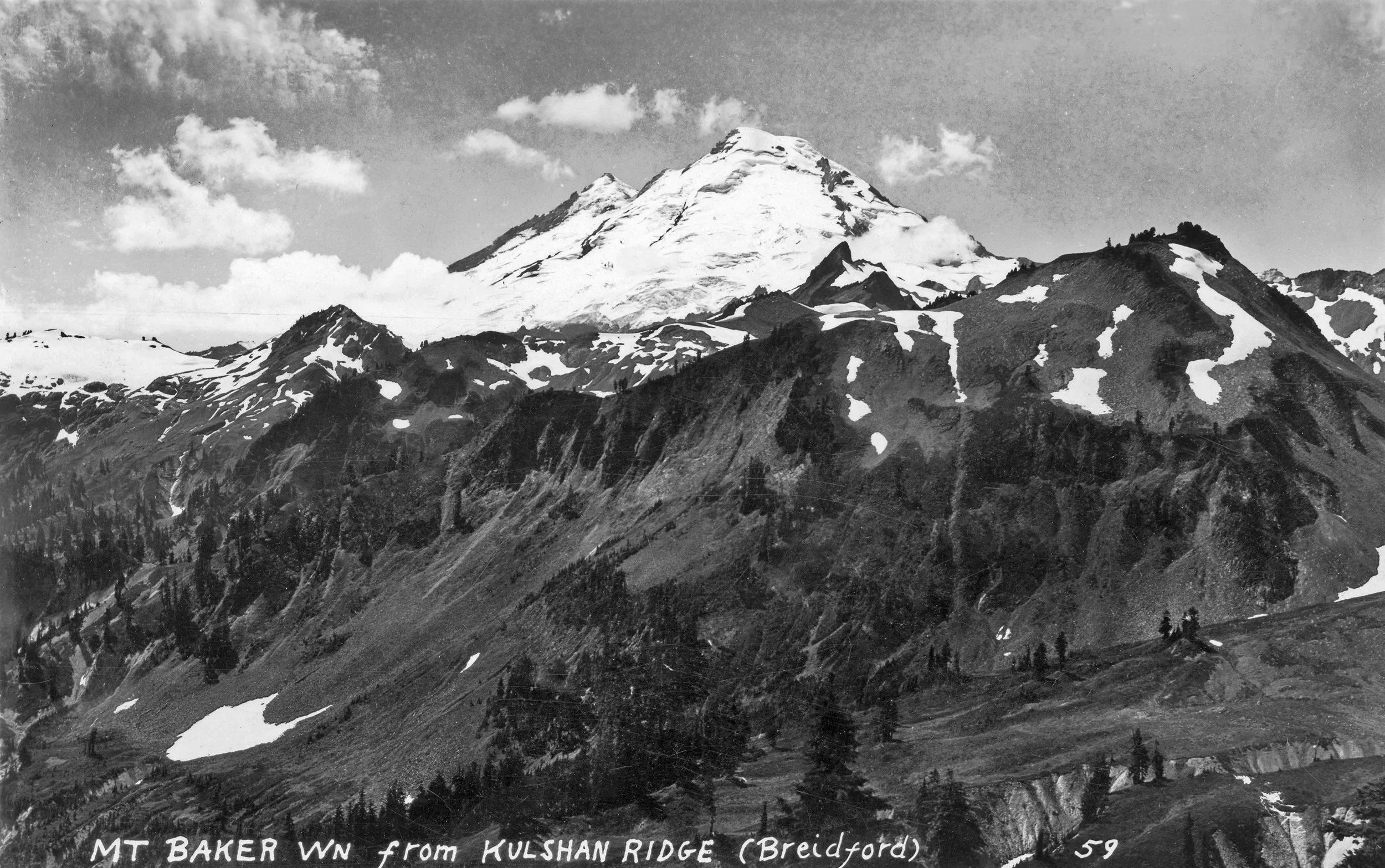
Photo of Kweq’ Smánit taken from Kulshan Ridge by Elias Breidford in 1959. // Photo courtesy of Whatcom Museum.
Kweq’ Smánit is hiding under a thick blanket today. Her shoulders are laden with snow, and on the blanket are little pests: creatures on their wooden and fiberglass boards sliding down and riding in a floating chair back up. Snow isn’t the only thing hiding Kweq’ Smánit. People call her name, but it sounds different now: “Baker.”
It was “Carmelo” too once, and some still seem to think it’s “Koma Kulshan.” For Nuxwsa’7aq (Nooksack) people, it’s “Kweq’ Smánit.” And its high prairies are “Kwelshán.” The name Baker is associated with Joseph Baker, who allegedly first saw the mountain in 1792 while on George Vancouver’s expedition to map the Pacific Northwest. But that’s all that connects him to a place that has been teeming with language since time immemorial.
Kweq’ Smánit and Kwelshán are words that hold definition and connection to place, its usage and history that a name like Baker can never offer. According to Samish Language Expert and Teacher Olive Brend, who is not Indigenous, “There are numerous names not only among the peoples of the area for a specific landmark, but also even for different parts of the land. And so to provide a single name for a single landmark is definitely a colonialist idea.”
daniseten Michael Vendiola, chief operating officer for Children of the Setting Sun Productions, added that Indigenous people have always had place names, and those names are often based on what is being harvested from a specific place and during a specific time. daniseten is an enrolled member of the Swinomish Indian Tribal Community with ancestry also from Lummi and Visayan (Philippines).
Kweq’ Smánit means white mountain, and Kwelshán is the word for the high open slopes of Kweq’ Smánit in Nooksack, according to its culture program website. This history and its definitions are steeped in thousands of years of context and cultural knowledge that cannot be summed up in a few short, easily digestible and clean sentences.
Proto-Salishan, which is what the Nooksack and Lummi languages descend from, originated in the 300-mile stretch between the Fraser River on Musqueam land and the Stillaguamish River on Stillaguamish land about 6,000 years ago. Over generations, these languages have traveled, blended and reshaped themselves as the needs of the people have changed.
The natural progression of these needs was disrupted by colonization and the imposition of English around the time of Vancouver's expedition. Now, as language revitalization projects are blooming in traditionally Salishan-speaking communities, the needs are shifting again. Brend has been in her position as Xws7ámeshqen (Samish language) teacher for six months and has been studying the Samish dialect for 2 ½ years. She works directly with Stómesh tse Sqwél'ten (language warriors), people who speak fluently and hold ancestral knowledge about the language in order to continue its diffusion and normalization.
Brend referenced Kcheyonkote Burton Warrington, executive director of Menominee University, when explaining that for a language to be normalized, it has to reach a state of everyday, organic use by the majority population. This is something that both Brend and Western Washington University professor of Indigenous literature Theresa Warburton agree cannot be achieved through the work of Indigenous people alone.
“When you talk about colonialism as an Indigenous person’s problem, it obscures the fact that actually that’s not who has the problem,” Warburton said. “It’s up to us (as non-Indigenous people) a lot of the time to talk to other non-Indigenous people and say, ‘Talk to me about your choice. What were you trying (to do)?’” referring to entities that are named after an Indigenous word.
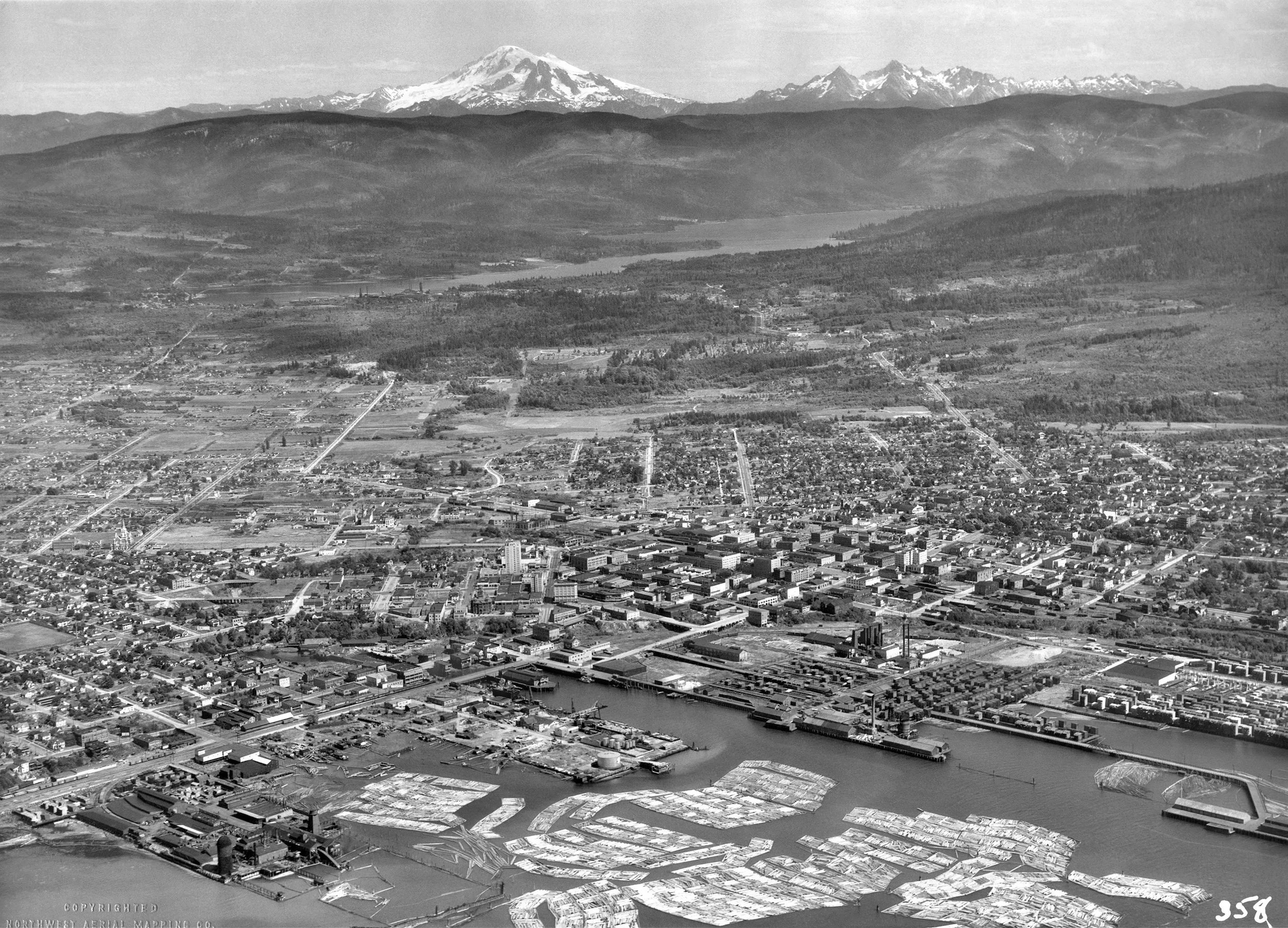
Kweq’ Smánit towers behind Bellingham in 1932. Photo taken by NW Aerial Mapping. // Photo courtesy of Whatcom Museum.
She brought up Coll Thrush’s book Native Seattle and a line from it that says, “Every American city is built on Indian land, but few advertise it like Seattle.”
That advertising, though, should come with a disclaimer. While non-Indigenous people’s perceived proximity to Indigenous language and culture is more abundant in Washington, the reality of support for Indigenous communities doesn’t meet the same standard.
daniseten explained that in connection with this gap is the historical lack of education on Indigenous history in Washington state schools. “In large part, people either think that Native people don’t exist or live in a pre-1900 context, because that’s what you learn about in your public education. And then what comes with that is stereotypes, mascots and all those kinds of things that inform society,” he said.
He referenced Sarah Shear’s research on social studies standards, stating that in her findings, social studies often erase or marginalize Indigenous peoples. Her study, Manifesting Destiny: Re/presentations of Indigenous Peoples in K–12 U.S. History Standards, found that 87% of references to Indigenous peoples in U.S. state standards depict them in a pre-1900 historical context.
In reality, Indigenous people and institutions contribute substantially to Washington’s economy, with tribes being one of the largest employers in the state. In 2025 alone, tribes employed 29,421 people.
“In Western Washington, we love to sort of be like ‘we have Indigenous place names,’ but does that mean that we actually have a good relationship here between settlers and Indigenous people?” Warburton asked.
daniseten walked it back to 1989: Washington was celebrating its 100th year as a state, but Indigenous people were not being considered. So former Governor Booth Gardner and 26 tribal leaders convened and discussed the contributions and relationships the state has with tribes. This resulted in the Centennial Accord, which serves as a regular reminder for Washington state officials and tribal leaders to be critical of the health of their relationships. Within this process, the opportunity emerged to call out systemic deficiencies, education on Indigenous history in public schools being one of those.
As institutions have begun to recognize these gaps, land acknowledgments and renaming of places have become more common. But it isn’t the fix that people think it is. Warburton said land acknowledgments are a good way to stay rooted and acknowledge the past and how that affects how people should be acting now.
“Do I think we’re honoring that practice totally? No. I don’t,” Warburton said. That dishonor appears in the way that Indigenous students have historically and still are not receiving the support they deserve. Of the five requests Western’s Native American Student Union made in its “Red Letter” to the president at the time in 2016, only two have been met. At the ground turning ceremony on April 11, 2024, for the Coast Salish style longhouse, one of the requests that is now met, President Sabah Randawha issued a formal apology for the past racist teachings of the university that occurred in the ‘70’s.
“It was good to acknowledge it,” daniseten said of Randawha’s apology. “But there has to be more repair.”
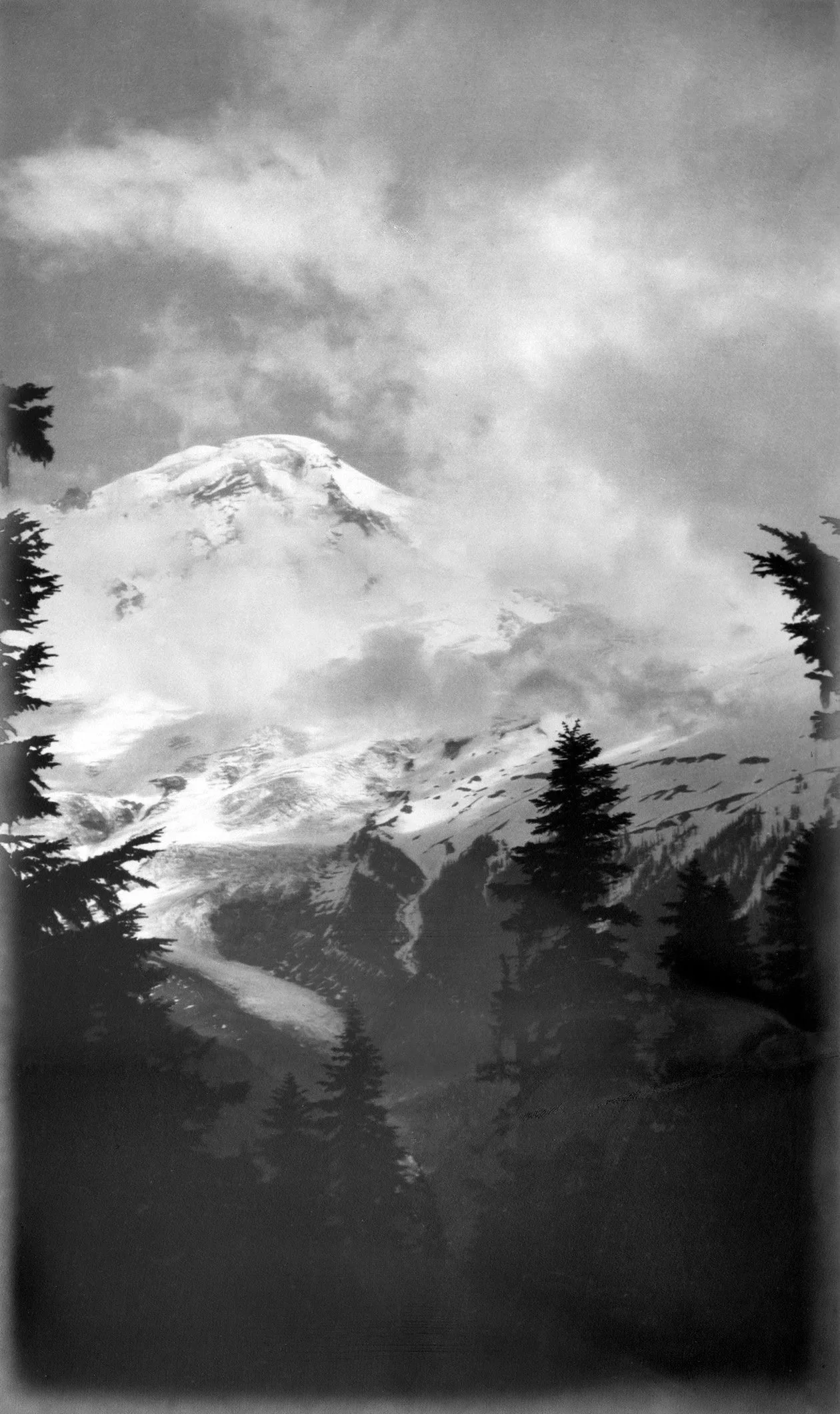
Photo titled “Mt. Baker or Kulshan” taken by J.W. Sandison in 1912. // Photo courtesy of the Whatcom Museum.
Of the letter, which his daughter helped to co-author, he said, “I think as Indigenous people we’re resilient and hopeful that people will do the right thing to make good on their word.” He applauded the efforts of those students who held a mirror up to the university and called leadership to the carpet.
On the topic of naming and renaming, he said, when people choose to embark on something like using or placing a name, there’s a cultural context that goes along with those words. “The point is the cultural consideration and the health of our relationship.”
He provided Whatcom County as an example. “It is a place name and is named after the creek that’s just right down the road from here,” he said. “On a personal level, I think that the history and the spirit of that place deserves that.”
But like a land acknowledgment, names carry the expectation of follow-through. “If we really chose to engage, like really understand what Whatcom means and the significance of it and what that place means, then that really changes the way that we probably would behave,” he said.
Brend recognized that while renaming is an action that does something, “In the end, does renaming help anyone? Does it change anything that has happened?” she asked. Sometimes, renaming can be harmful if it’s a mistranslation, miscommunication or a pure bastardization of the language.
Warburton emphasized that when places are misnamed with words that don’t properly describe the land, it’s a reflection of colonialism in that it removes the relationship of the people to the place and of the place to itself.
“The ultimate question is how would Nooksack, for instance, benefit from Mount Baker being officially named to Kulshan?” Brend asked. “I think a lot of times it comes down to education is the benefit. Is there going to be financial benefit or really anything that comes back to the Indigenous nations?”
She suggested that even if Baker were to be renamed to Kulshan, there would still need to be translation. But that isn’t a bad thing. Brend drew on a lecture by Arundhati Roy, asking, “What is the most morally correct language in which to speak and write? In the end, the answer is translation.” By that, Brend means that people should be making efforts to consider multiple languages in their daily lives and allow those languages to play with each other, regardless of a person’s first language. People should be compelled to think and operate in translation because the world exists with so many understandings of environment, action and emotion that reside within our language’s definitions.
“There is the greatest concentration of languages between B.C. and South Puget Sound because this is where Proto-Salishan arose. So we really are in a great place for translation here in Western Washington,” Brend said.
When it comes to something as big as renaming mountains or using a Salishan dialect in everyday life, Brend emphasized that the most important thing for non-Indigenous people to be mindful of is intention.
“Think about why you’re learning it and using it. Do you want to be the cool person at the store, at the family gathering, or at the party who can speak a little bit of the language? Or are you doing it because you genuinely want to try and take part in normalizing the culture? If you’re not willing to fight, like actually fight, then you shouldn’t be doing that,” she said.
Language normalization is among the many goals of Children of the Setting Sun Productions. “That is at the forefront of what we’re attempting,” daniseten said. “We’re trying to become a hub here within Coast Salish territory to bring Coast Salish ways of knowing to the community.”
There are many reasons to love Bellingham and Whatcom County. From skiing down Kweq’ Smánit’s shoulders to sailing on the Salish Sea. “I think our goal is to raise that love even more to a level of being caretakers, being really respectful of how we stay in this place,” daniseten said.
Brend emphasized that settlers are unwelcome guests. “It is up to the individuals and nations to decide in what way we take part,” she said.
When magazines and businesses use Indigenous place names, they hold the weight of representing a culture and identity that might not belong to them. daniseten carries an ancestral name passed down from his mother danisia hugulitza. “So if I’m on here saying really rude or inappropriate things, it represents her,” he said. In the same way, without building healthy relationships before, during and after naming a project, place or business, that entity can become a false representation of the culture it aligns itself with.
“It’s more about the intention of what a phrase means and the cultural significance of that, that really gives it the meaning that it needs or deserves,” he said. “I think that’s what we’re trying to do as well here at Children of the Setting Sun Productions, is to tell these stories that offer a path forward or remind us of paths that we’ve held for thousands of years and how we’re trying to retain that and be able to live in a way that’s careful and respectful.”