
The loss of language
Stories around the impacts of aphasia and the resilience of those who face it
Story by Quincy Koch
Illustration by Royce Alton
Published April 7, 2026
Rick Nash sat next to his wife of 50 years, Ann Bodle Nash, and quietly nodded as she spoke about him. “Rick was a dentist for 40 years, and his stroke ended that,” Ann said. “We didn't know anyone with aphasia. I'd never heard that word before. Then, his stroke, and suddenly there we were.”
It can be easy to take the capabilities of our bodies and minds for granted. The things we rely on every day feel permanent — until they aren’t. It’s hard to imagine that in an instant, our way of living could change completely, and something as fundamental as speech could be lost.
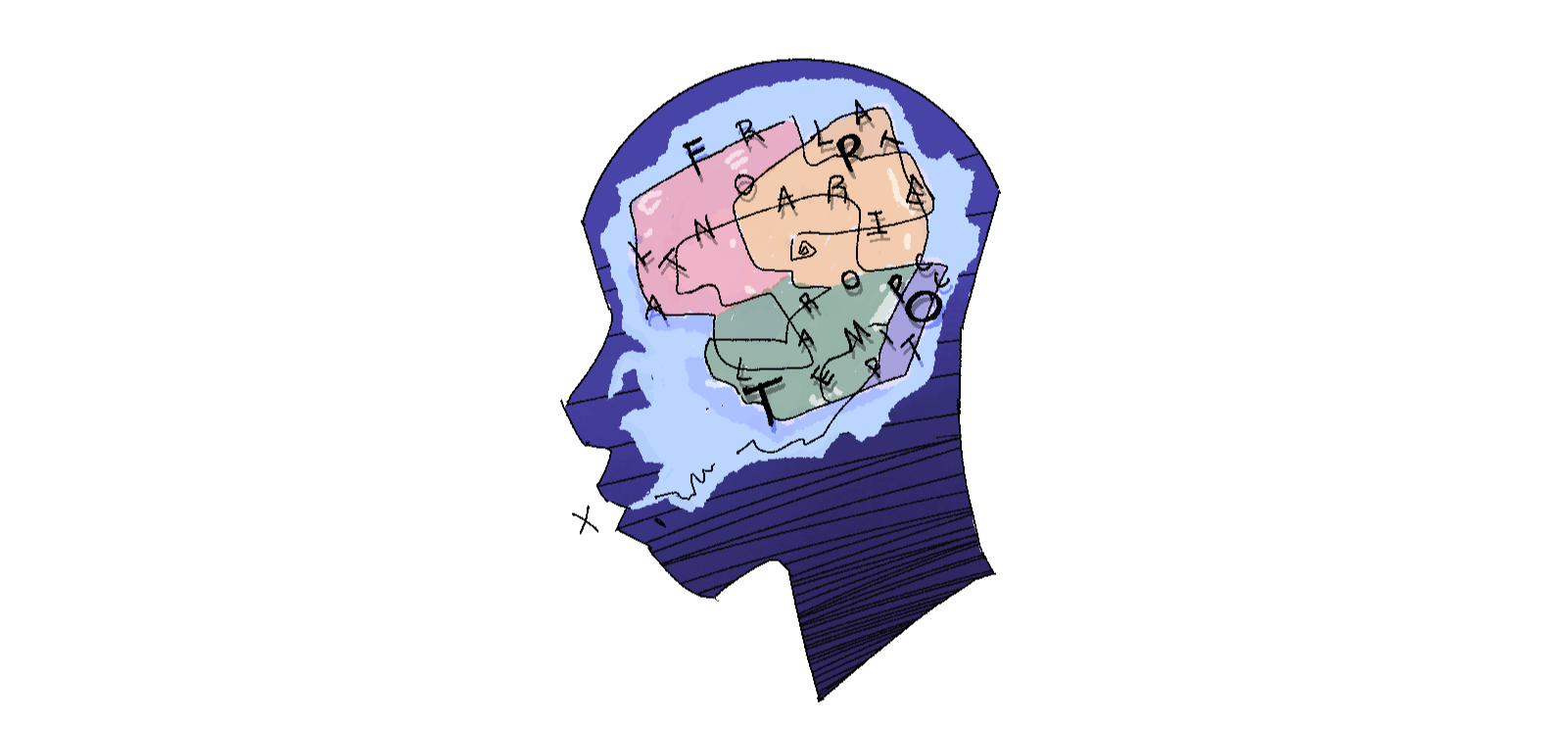
Aphasia is a disorder caused by damage to areas of the brain responsible for language, according to the National Institute of Health. It commonly affects the left side of the brain and can impair the ability to express and understand language, as well as read and write. About two million people in the United States are living with aphasia, according to the National Aphasia Association.
“Rick lost his abilities, at one time, to read, to write, to speak well,” Ann said. “ I mean, right after the stroke, he could only say three words: yes, no and maybe. That was it for a while.”
Engaging, funny and an avid skier, Rick Nash now functions with less verbal communication since his stroke.
“Names and numbers, hard for me. But I try to get better,” Rick said.
While many people in the U.S. have the language disorder, almost 85% of Americans say they’re not familiar with the term aphasia, according to the Regional Neurological Association.
“People are unfamiliar with the word aphasia and have no concept of what it means,” Ann said. “If (someone has) aphasia following a stroke, everybody's aphasia is different, and their strokes are all different.”
Hillary Edwards is a clinical educator and speech-language pathologist who works in the Speech, Language and Hearing Sciences department at Western Washington University. Edwards also runs an aphasia support group through the Speech-Language Clinic on campus. She described what can lead to aphasia and how the disorder affects language.
“Aphasia is typically caused by some type of brain injury,” Edwards said. “So, whether it is a stroke or a traumatic brain injury, or sometimes a tumor, it's an acquired language disorder.”
Edwards explained that the clinical features of aphasia can differ by person, but also occur simultaneously. Areas of language affected can include speech, comprehension, reading and writing. She highlighted that aphasia presents differently in every person, and its impact on communication can vary, depending on the location and extent of the injury; it’s not a one-size-fits-all disorder.
Steven Ortiz, a retired sociology professor, is another individual who is impacted by aphasia. Previously quite articulate, he now finds it hard to translate his thoughts into words due to the language disorder. For Ortiz, the hardest part of his aphasia is the day-to-day frustration it can introduce.
“You want to speak better. You want to get out there so you can speak all the time, but sometimes it doesn't happen that quickly,” Ortiz said. “It's hard to understand aphasia, and the speaking part. It’s frustrating.”
According to the Regional Neurological Association, aphasia is an umbrella term for eight variations of the disorder. Broca’s and Wernicke's aphasia are the two types discussed here.
“Broca’s aphasia is the non-fluent aphasia,” Edwards said. “That’s typically where their understanding is stronger, but their speech is more impaired.” While Broca’s aphasia impairs an individual's ability to communicate with words, Wernicke's aphasia presents with receptive impairments, leading to its common name of “fluent aphasia,” according to Edwards.
“Wernicke's typically presents as more of a receptive deficit, so more difficulty understanding, but they may have fluent speech,” she said. “They may be able to talk in full sentences, but it may not necessarily make sense.”
Edwards also noted how people who are unfamiliar with aphasia make assumptions about people who have the language disorder.
“The common misconception is that people's intellect is affected. It's important to know that their intellect is intact,” Edwards said. When speaking with individuals with aphasia, Edwards suggests modifying your communication. Things like talking slower, rephrasing or simplifying what you're saying, asking yes or no questions, and writing down key words can be useful. She emphasized the importance of practicing patience and meeting the person where they are at.
Faith Burton, a Western graduate who studied communication sciences and disorders, researched aphasia for her senior project. She created a documentary called Transmute: Finding Pathways Through Aphasia, which focused on the mental health impacts of the disorder and featured stories from those affected. She highlighted that grief was a big part of dealing with an aphasia diagnosis.
“There's a lot of frustration, and it can be very isolating because they're no longer able to express themselves,” Burton said.
Ann highlighted how, as a partner to someone with aphasia, she also experiences feeling separated from life before the aphasia, and the importance of community.
Rick and Ann have been part of the aphasia support group that meets at Western’s Speech-Language Clinic for eight and a half years. Every week, Rick meets and interacts with other people who have aphasia, and Ann gets to connect with other caregivers. “You feel really isolated from your regular communities,” Ann said. “So to meet every week with people who are facing some of the same challenges, it's really helpful.”
Ortiz is also part of the group and said it was difficult at first, but joining the group has been beneficial and provides a community and a space to continue improving his language skills.
“That was a really good starting point,” Ortiz said. “I've gotten better.” Ortiz shared how, in his experience, the people he’s interacted with who have knowledge of aphasia at the clinical level are the ones who make him feel the most heard when communicating.
“They'll understand you, and they'll be patient with you,” Ortiz said. While he struggled to find some of his words, Ortiz made clear that he is still the same old person and that he continues to work hard to communicate to the best of his ability, as his speech continues to improve.
“After I went through retirement, I had to redo things, like writing and reading,” Ortiz said. “That's still a long way to go. But it's there. It's there, and you just have to keep pushing.”