
Don’t catch a ‘crab’, just keep rowing
How the language of rowing drives more than the boat
Story and photos by Bodey Mitchell
Published April 7, 2026
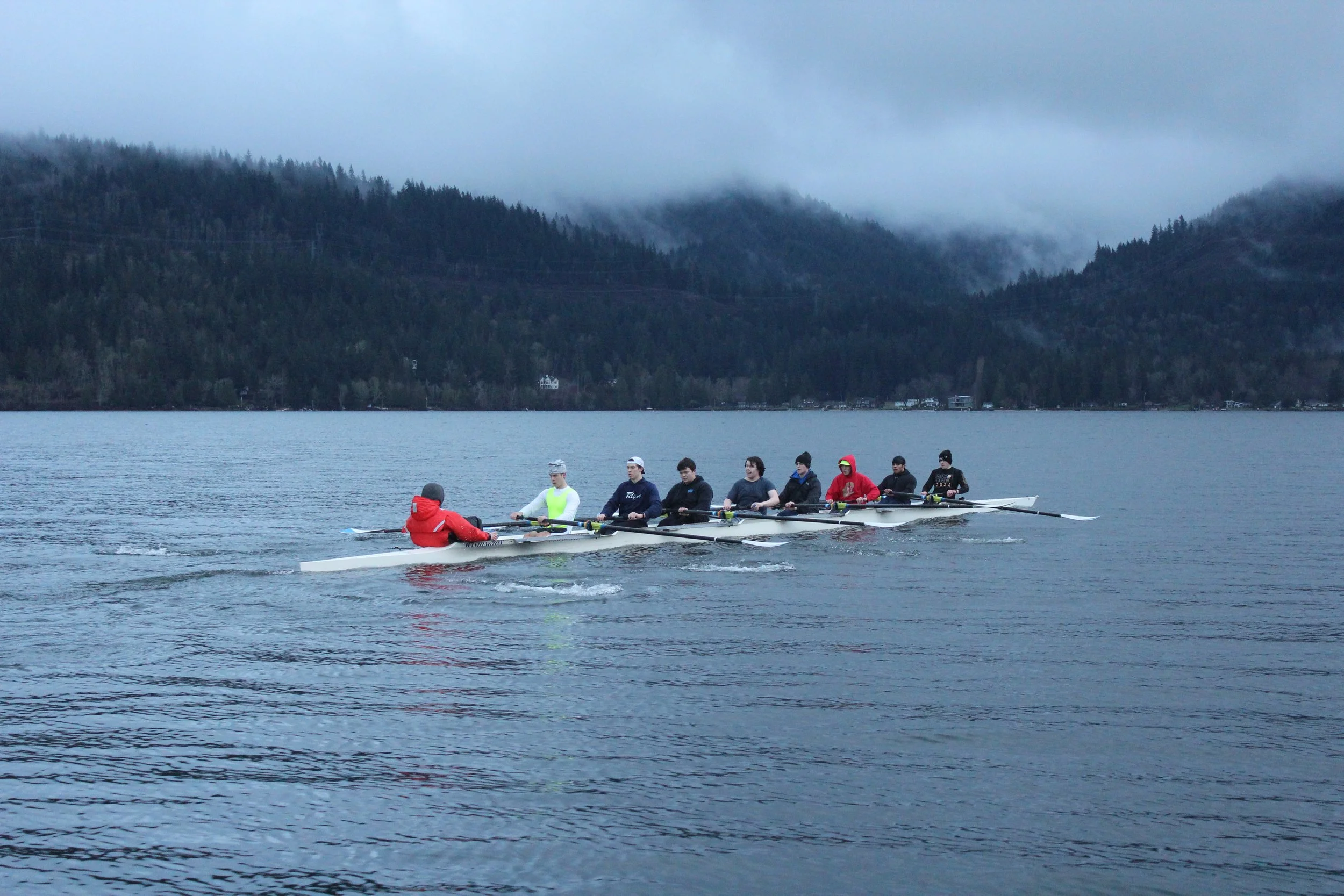
The varsity eight-person boat on the waters of Lake Whatcom early Saturday morning. Rowing is a demanding sport with practices from 5 a.m. to 7 a.m. on weekdays and 7 a.m. to 9 a.m. on Saturdays.
Rain dimples the surface of Lake Whatcom on a cold February morning. At 7 a.m., the sun is shrouded by clouds as the Western Washington University men’s rowing team carries its shells to the water and begins another Saturday practice.
The team's Head Coach and Western rowing alumna, Genevieve Carrillo, methodically places popsicle sticks on a wooden board, each one indicating where a rower will sit and whether they’ll row on the port or starboard side. Once the decision is made, the rowers walk to the racks holding their boats.
As they prepare to move the boat down to the lake, the coxswain, who is in charge of the boat, ensures the crew is distributed evenly along its length. With some boats, stretching 55 to 62 feet long and weighing upwards of 200 pounds, the team relies on the coxswain's precise language to guide them when they pull the boats off the rack.
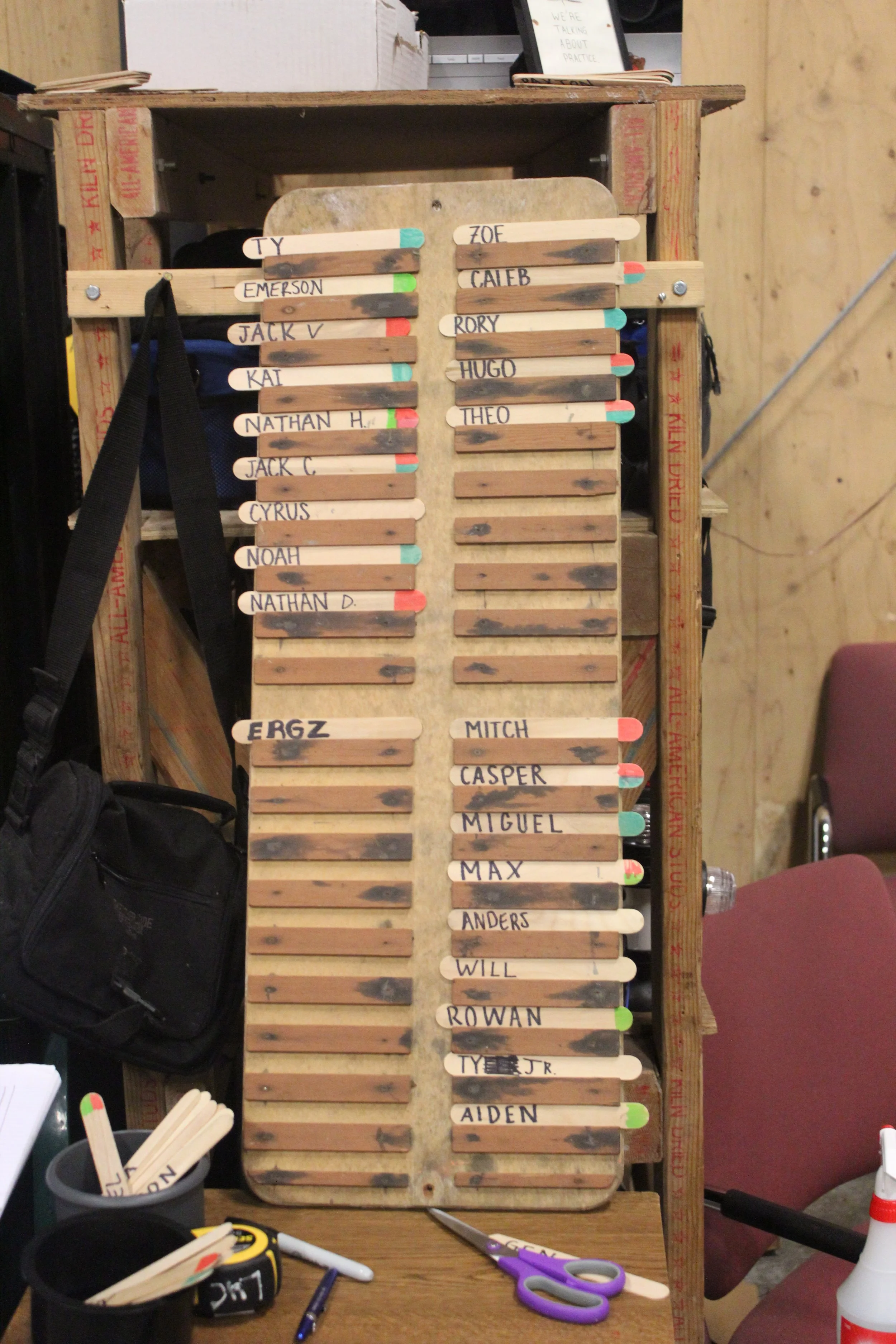
Before heading out onto the water, Carrillo and the other coaches place popsicle sticks showing where each rower will sit on the boat and who their coxswain will be.
“Hands on,” the coxswain calls out.
The crew grips the shell, ready to lift it from the cold metal racks.
“Ready to lift,” the coxswain says. “And up.”
The crew lifts in unison, raising the shell just above the rack before sliding it free.
Another command follows.
“Up to waist” is followed by “up over heads” and a “ready up,” signaling the rowers to extend their arms and position the shell overhead.
“Roll it to shoulders. Ready, down.”
The rowers tilt the shell toward their side until it rests across their shoulders, steadying the long boat as they begin the walk toward the cold, gray lake.
This strict regimen depends on clear communication between the coxswain and their rowers, something essential both in and out of the water.
Once the crew reaches the dock, the coxswain focuses in. This is the most delicate part of instruction, to prevent the boat from being dropped or rowers getting injured.
The crew shifts their feet to the edge of the dock, and once again, the coxswain instructs them to lift the boat above their heads.
“To the water. Ready, down.” The crew lowers the boat to waist height.
“Roll it in.” The rowers then lean over and gently rest the boat in the water.
With that, the crew works together to keep the boat against the dock and set up their oars.
Coxswains have to be quick and ready to make changes on the fly during a race. While the rowers have their backs to the finish line, the coxswain eyes it the entire time.
“The way the language is designed is to be short and simple,” said Theo Newcomb, a varsity rower on Western’s men's rowing team. “That just helps us be safe on the water, because it's easy to convey.”
For an eight-person boat, coxswains typically sit in the stern of the shell, facing the rowers and finish. From there, they are responsible for being an on-the-water coach, steering the boat and coordinating the rowers’ power and rhythm.
“What the coaches have always told us when we're rowing is we shouldn't be thinking,” said Ayden Hurley, a varsity rower on the men’s rowing team. “The coxswain is the one thinking for us.”
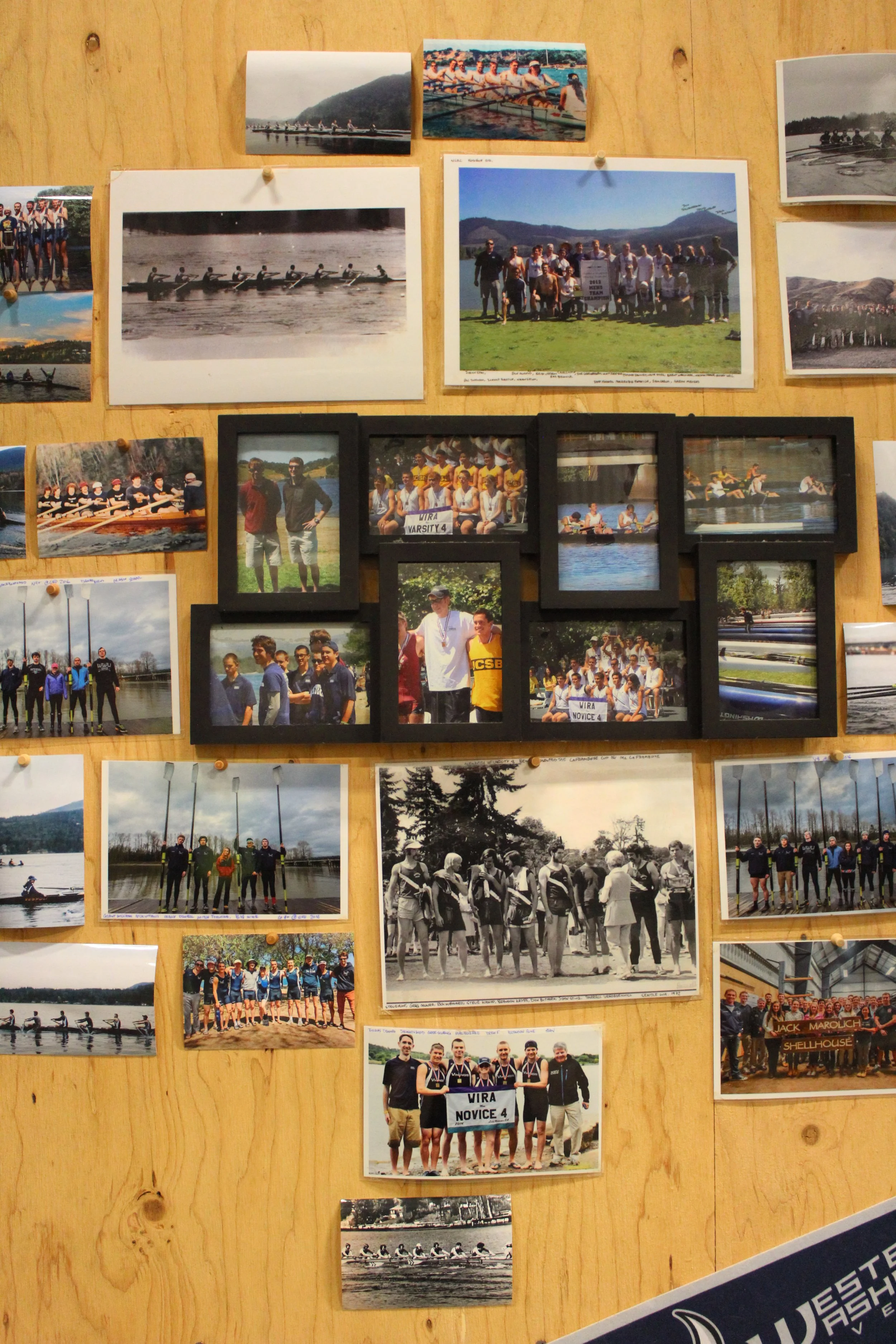
Portraits of the past. Pictures of previous rowing teams hang up on the wall inside the Jack Marolich shellhouse on Lake Whatcom.
While communicating on the water, coxswains use terms like “hold this 32, don’t climb” or “we’re on a 34, in two, up two beats” to change the pace of the stroke. For example, the rowers are holding a pace of 34 strokes per minute, and in two beats — meaning two strokes — increase the pace to 36 strokes per minute. When the coxswains want the crew to pass another boat or to maintain a lead in front of another boat, they’ll call out “power 10 for the move.” This instructs the crew to pull harder for the next 10 strokes.
These terms, which have been around since the sport’s inception, are geared toward one thing: keeping the boat synchronized and on pace.
“A lot of the terminology is quite traditional,” said John Alberti, an 81-year-old University of Washington alumnus and rower. “We still pretty much refer to things like they used to in the early 20th century or even late 19th century.”
The language is universal too, with coxswains and their rowers from other countries using the same calls to communicate while on the water.
“English is pretty commonly used,” Alberti said. “I've rowed in European crews, and they do speak their local language too. But I think that the things the coxswain does, like handling the boat, they're pretty much the same everywhere.”
Alberti, who has competed internationally, noted that there are some differences in language between other countries. While rowing with a group of Belgians at a regatta, Alberti recalled a mix-up.
“I was used to the idea that when somebody called my name or my number, it was because they wanted me to row harder,” Alberti said. “They said something in French, and all I knew is that they were talking to me, so I thought I should row harder.”
In reality, the coxswain was shouting his name to tell him to slow down. Alberti was pulling harder and faster than the other rower, throwing off the rhythm of the boat’s stroke.
While the terminology used in rowing hasn’t evolved much since the sport’s beginnings, the way coxswains communicate with their rowers has evolved with technology. Carrillo highlighted the new “cox boxes” that coxswains can use on the water to measure time, stroke rate, meters per stroke and GPS for general distance.
“Now, coxswains have so much more data at their hands, and it's so cool, because you can even go in after practice and see what they did, and you can even set up a workout,” Carrillo explained. “I feel like now coxswains can diagnose even more.”
Coxswains do more than serve as the eyes of the boat. They’re also the crew's hype person, pushing the team towards the finish line.
“Anytime you go out on the water, they're warming you up, coaching you, calling you out and being very specific about everything,” Hurley said. “But the moment it really needs to matter (is when) you're trying to pass that other boat. It's just the ultimate hype that I've never experienced from any other sport.”
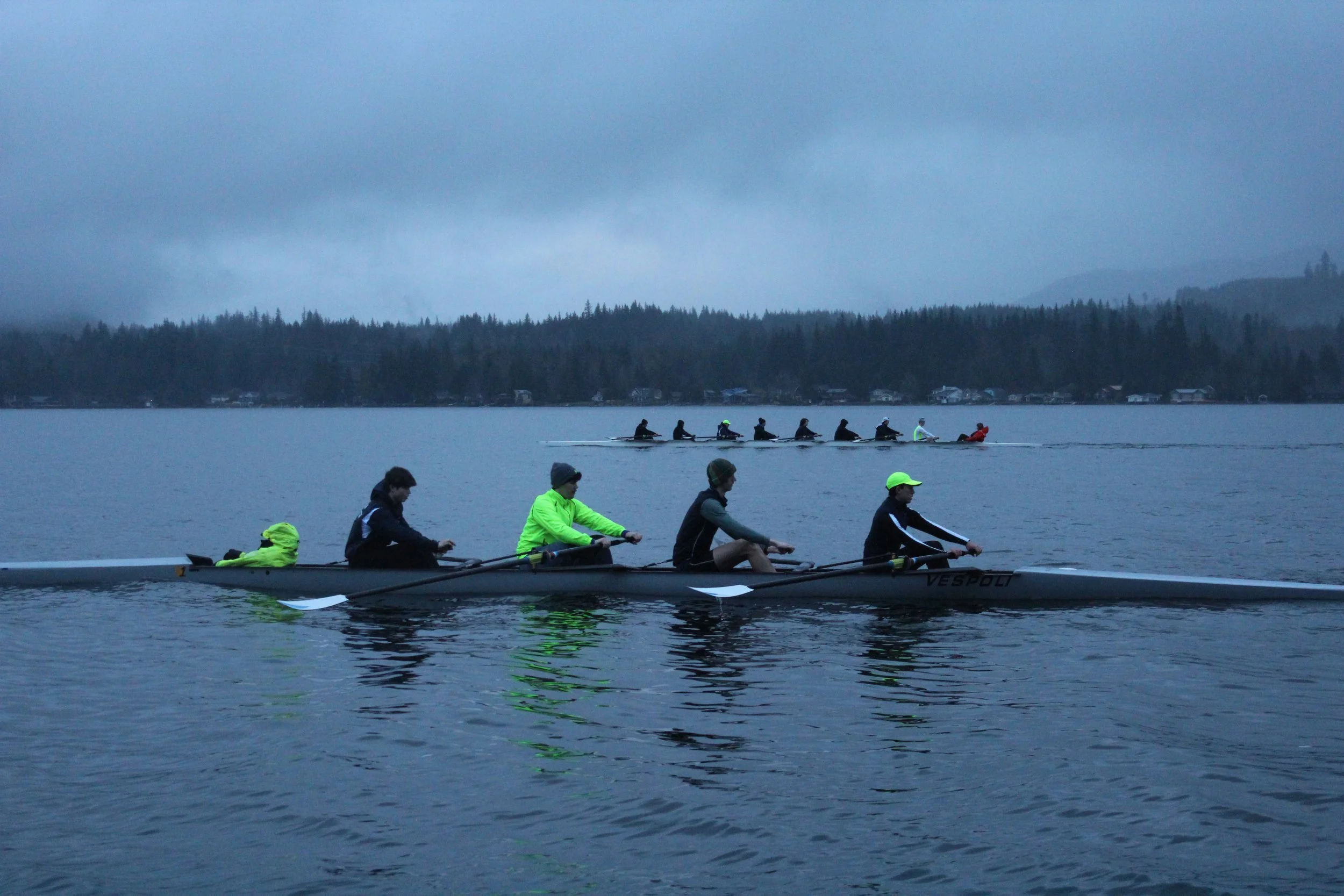
Both varsity boats practicing on Lake Whatcom in Bellingham, Wash., in the winter. In four-person boats, the coxswain sits in the front, while the coxswain sits in the back on an eight-person boat.
A coxswain has a unique call for different sections of the race. For instance, Zoe Develle, a coxswain on the Western men’s varsity team, tells their crew to “go balls to the walls” during the final sprint when they are approaching the finish line.
Develle uses different tones to communicate with their crew throughout the race. While the boat maintains a steady pace, Develle will speak in a low, aggressive tone to help the crew stay focused. During a sprint or “power 10”, Develle’s voice rises, signaling urgency and speed to the crew.
Coxswains use unique terminology off the water. For instance, before a race, a coxswain may say, “Don’t catch any crabs, and if you do, keep rowing.” Newcomb explained that a “crab” happens when a rower catches the water incorrectly, throwing off the stroke. It’s a mistake everyone dreads and tries to avoid. But Newcomb also sees the phrase as a metaphor for life: when things go wrong, the only option is to keep moving forward.
Coxswains and their crews have a unique relationship developed through dedication and camaraderie. When working out as a team, coxswains don’t have to work out since they don’t row, but a good coxswain, according to Carrillo, is there in support of their crew regardless.
“People aren't going to want to work with somebody who's a dictator and condescending, or someone who only shows up to one practice a week,” Carrillo said. “Even though you're not doing every single workout with the team, being a good teammate and still showing up is important.”
Each rower has a different way to motivate themselves during a race, and it’s up to the coxswain to tailor their calls for the rower and the crew.
During a race, Hurley always appreciates it when coxswains use specific language to tell the crew how much distance they're gaining on a competing team.
“As you're rowing, the coxswain will be like, ‘I'm at their cox, and I'm at their eighth seat,’ as we're slowly passing them,” he said. “That's a very empowering feeling because you're actively hearing the progress that you're making.”
Having coxed for Western from 2012 to 2016, it’s these qualities that helped Carrillo transition from rower to head coach of the team 14 years ago.
“I have a joke about how salmon go back to their birthplace to die, and how I keep coming back to WWU men’s rowing,” Carrillo said. “I would love to continue coaching this team, because I just want to see how much better we can get. I'm so competitive, and I love seeing these guys push themselves. It’s a treat every single day.”