
To manufacture a terrorist
A discussion about political rhetoric and the tactics of the Trump administration
Story and photos by Jae Ranney
Published April 7, 2026
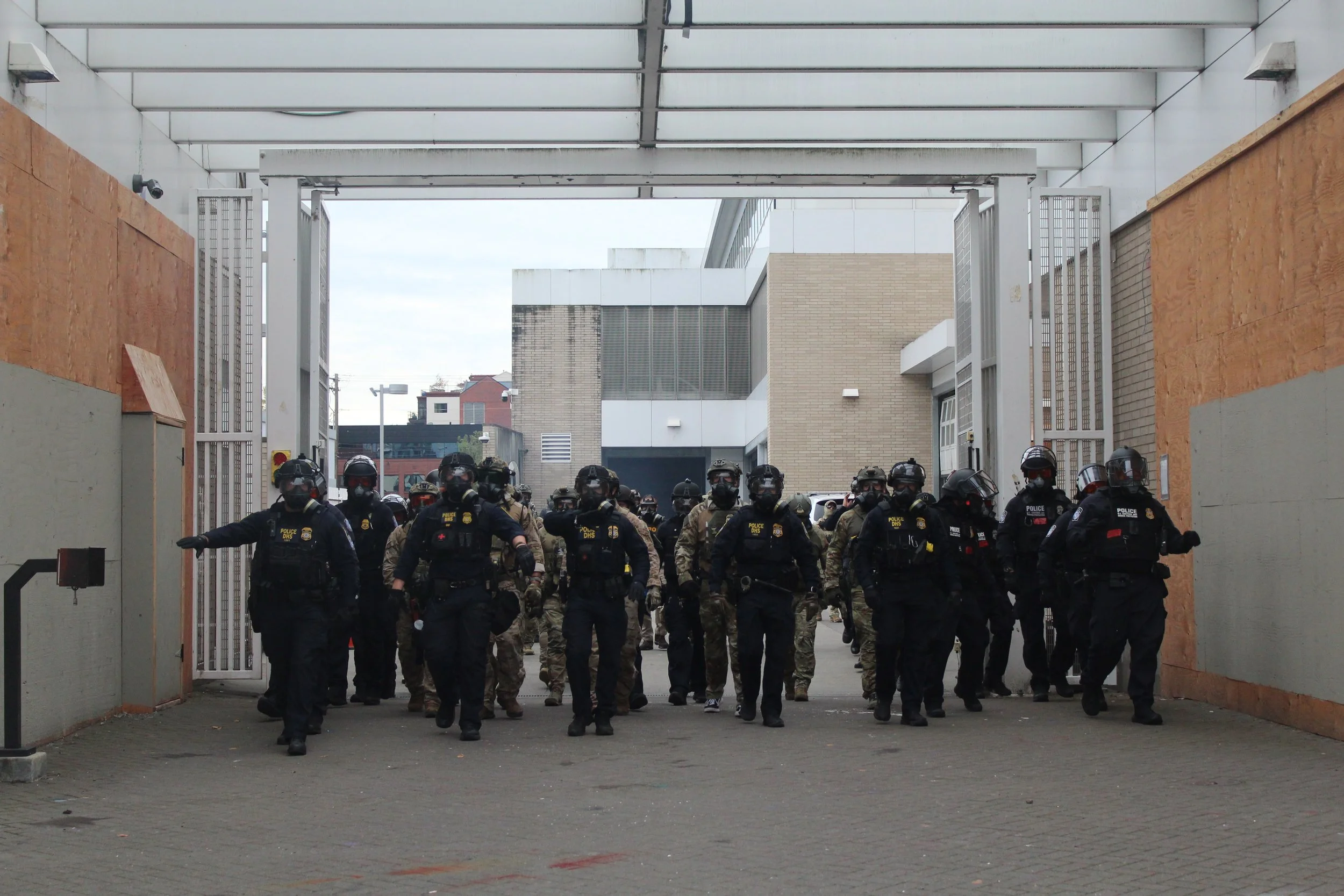
DHS officers exit the ICE facility at 4310 S. Macadam Ave. in Portland, Ore., on Oct. 18, 2025. Following their exit, the officers clad in camo gear arrested an individual on the sidewalk and escorted them back inside the facility.
Western Washington University Associate Professor Michael Wolff leaned back slightly in his chair in contemplation. “I remember after Sept. 11, 2001 … ” He paused. “Within a few weeks, we were already launching a war on terror.”
Wolff, who holds a doctorate in political science, saw how the political rhetoric used during the aftermath of 9/11 helped perpetuate Islamophobia in the U.S. This era marked the beginning of his unease with the framing tactics of the federal government.
“I was absolutely terrified about what the implications, long-term, would be to denote any type of ‘enemy of the state’ as a ‘terrorist,’” Wolff said.
Nearly two and a half decades later, on Sept. 25, 2025, the Trump administration broadened the definition of domestic terrorism.
In a National Security Presidential Memorandum (NSPM-7) published in September 2025, Donald Trump stated that the “‘anti-fascist’ lie has become the organizing rallying cry used by domestic terrorists to wage a violent assault against democratic institutions, constitutional rights, and fundamental American liberties.” The statement described “extremism on migration, race and gender,” as well as “hostility towards those who hold traditional American views on family, religion and morality,” as being common threads of domestic terrorism and called for the disbanding and investigation of all those involved.
In reading NSPM-7, Wolff said he found Trump’s framing of political violence to be alarming.
“It’s a strategy that, in effect, has been working for him really well, and it appears to me to be extremely dangerous,” Wolff said. “Because the way this memorandum works is it’s using a specific type of rhetoric to give his supporters the impression that there is an organized, violent movement, bent on the assassination of people associated with his administration.”
Whether it be a snowball aimed at an ICE agent or the assassination of Charlie Kirk — the motivation for which is still debated — Wolff said the NSPM-7 frames actions like these as part of a systematized and nefarious effort to commit acts of violence, which he finds inaccurate.
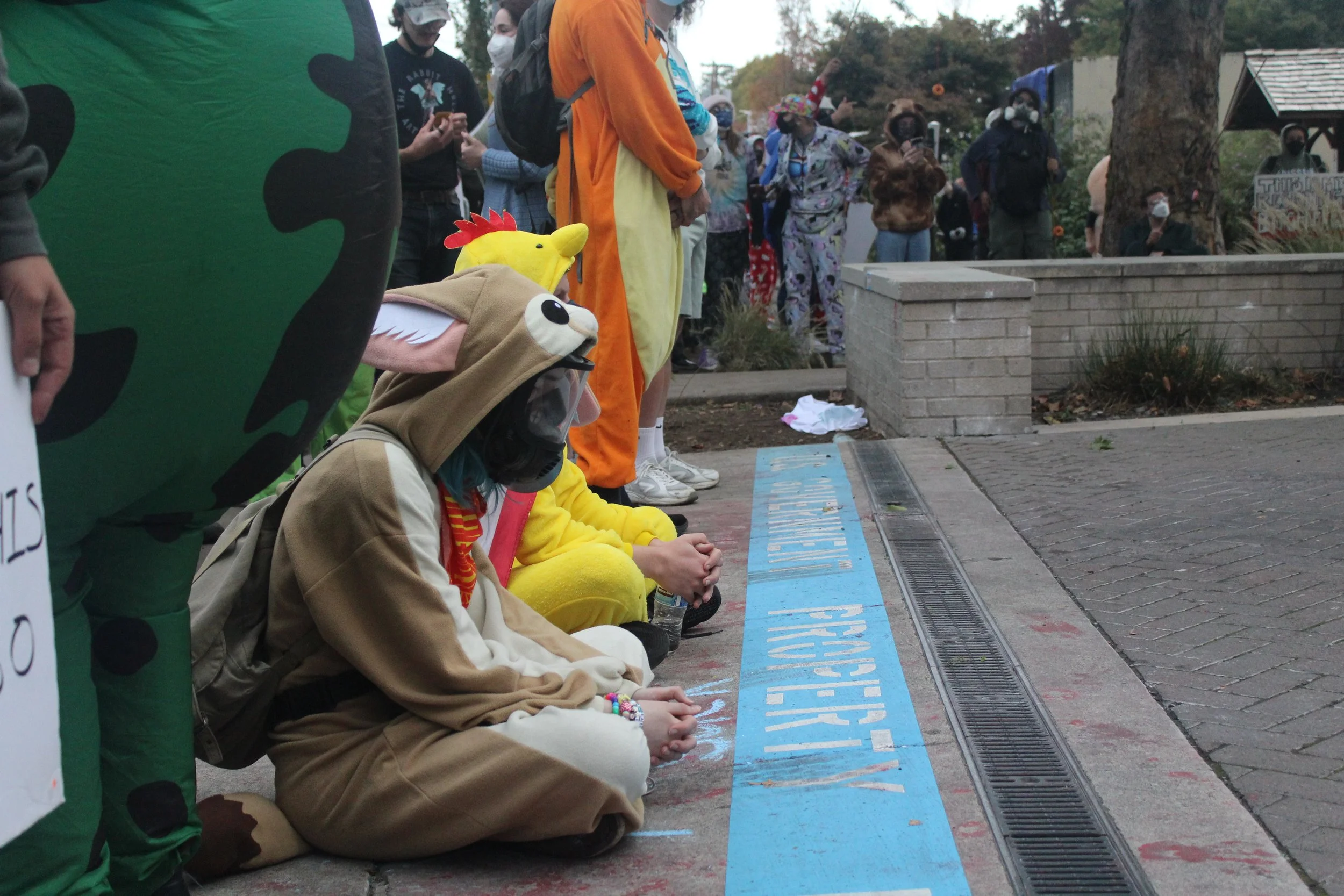
A protester wearing a gas mask and animal pajamas joins others sitting solemnly along the blue line that marks the property border of the ICE facility at 4310 S. Macadam Ave. in Portland, Ore., on Oct. 18, 2025. Red handprints are painted along the driveway.
The release of NSPM-7 followed Trump’s executive order on Sept. 22, 2025. Through this order, the Trump administration designated “Antifa” as a domestic terrorist organization, labeling it an “organized,” “militaristic, anarchist enterprise.” Antifa, short for “Anti-Fascist,” is not an organization but rather a political movement based in opposition to fascist ideologies that can be found across a range of sometimes conflicting viewpoints.
Despite this, the executive order called for the disruption and dismantling of “all illegal operations — especially those involving terrorist actions — conducted by Antifa or any person claiming to act on behalf of Antifa.” This drew criticism from organizations like the American Civil Liberties Union, which viewed the order as a potential excuse to target left-wing individuals and groups, some of whom identify as anti-fascist.
“Totally unrealistic,” Wolff said, referring to NSPM-7’s framing tactics. “But rhetoric doesn’t need to reflect reality, and the most successful politicians know that rule all too well.”
Western Professor Shirin Deylami, who holds a PhD in political science, said the broadening of these definitions is already leading to direct harm.
“If you can frame a group as disorderly, as violent, as challenging the social order, then you can utilize all sorts of forms of violence against them,” Deylami said. “That’s exactly what we’re seeing, I think, in Minneapolis right now,” pointing to the December 2025 partnership between Immigration and Customs Enforcement and Customs and Border Protection to conduct Operation Metro Surge.
Described by the Department of Homeland Security as the “largest DHS operation ever,” Operation Metro Surge culminated in the unlawful detainment of U.S. citizens, the arrests of more than 3,000 people, and the deaths of Victor Manuel Diaz, Renee Good and Alex Pretti. The operation also led to an intense spike in anti-ICE protests in Minneapolis. On Jan. 23, 2026, organizers estimated that 50,000 people protested in the streets of the city, although these numbers have yet to be confirmed.
“The narrative from people like Kristi Noem and Trump is ‘This is a violent mob.’ And then you’re like, ‘These people are just whistling and taking photos of you,’” Deylami said, referencing protest tactics like video documentation and using whistles to alert nearby people to ICE’s presence. “But (this narrative) allows ICE agents to use violence with impunity. Or, at least, it gives them justification.”
About three and a half hours after Alex Pretti’s killing in Minnesota, White House Deputy Chief of Staff Stephen Miller labeled Pretti as an “assassin” and ”terrorist” on social media, which contradicted firsthand accounts and video documentation of the shooting later analyzed by The New York Times. These framing choices echoed the statements of officials like the former Secretary of Homeland Security Kristi Noem, who described Pretti’s actions as “domestic terrorism,” and Assistant Homeland Security Secretary Tricia McLaughlin, who claimed that Pretti apparently planned to “massacre law enforcement.”
Although the DHS has since conceded some of its original claims regarding Pretti and others, the Trump administration’s initial choice of language in these situations has remained consistent with the terminology found in NPSM-7.
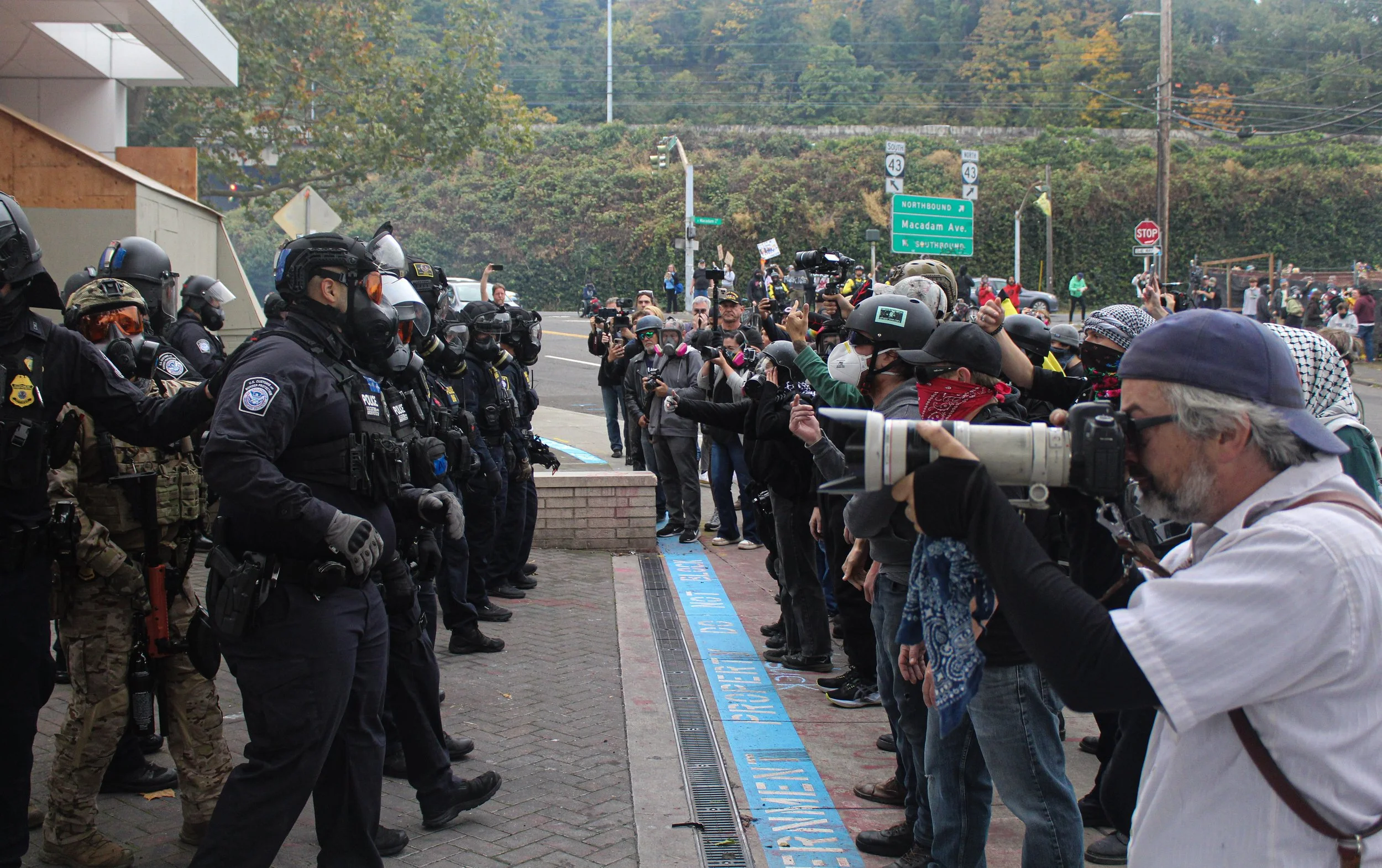
DHS officers step backward in formation into the ICE facility while facing protestors and journalists standing behind the blue line that marks the federal property line at 4310 S. Macadam Ave. in Portland, Ore., on Oct. 18, 2025. Those who cross this line without authorization may be subject to charges of trespassing.
Joanne Lisosky, a professor emerita of communications and journalism at Pacific Lutheran University, agreed that these terms were dangerous, but felt they were more effective at rallying the Trump administration’s supporters than intimidating its critics.
“While the administration thinks that creating those labels may have a chilling effect on other people who plan to speak out against the administration, I think it has the opposite effect,” Lisosky said. “I think it’s going to empower more people to rise up and say ‘No, this is wrong. Not on my watch.’”
Regardless of who is in office, Wolff, Deylami and Lisosky all agree: Disinformation can be a powerful weapon, and the best defense is being media literate. To begin, look to credible news outlets, practice critical thinking and reject the allure of accepting information at face value.
“You have to reject that, because it’s really easy to fall down that rabbit hole and then it spreads like wildfire,” Deylami said. “We have a lot of emotions right now, and rightfully so; we want to be vindicated for our opinions. But we have to be accurate.”
Wolff suggested that to gain perspective, you should look to your community. Fostering engagement, interdependence and dialogue with those around you is an effective way to stay informed and stay safe.
“I think that community — that’s local and face-to-face — is the greatest bulwark against what feels like the spectre of authoritarianism,” Wolff said. “There’s many reasons why that’s a powerful thing, but one of the greatest ones is that when one of your neighbors disappears, everybody feels it as if it was their brother or sister.”