
Between two voices
For Black and African-descendant communities, code-switching is more than a language; it’s a tool for navigating space, preserving heritage and expressing identity
Story by Mabaindu Mbawa
Illustration by Royce Alton
Published April 7, 2026
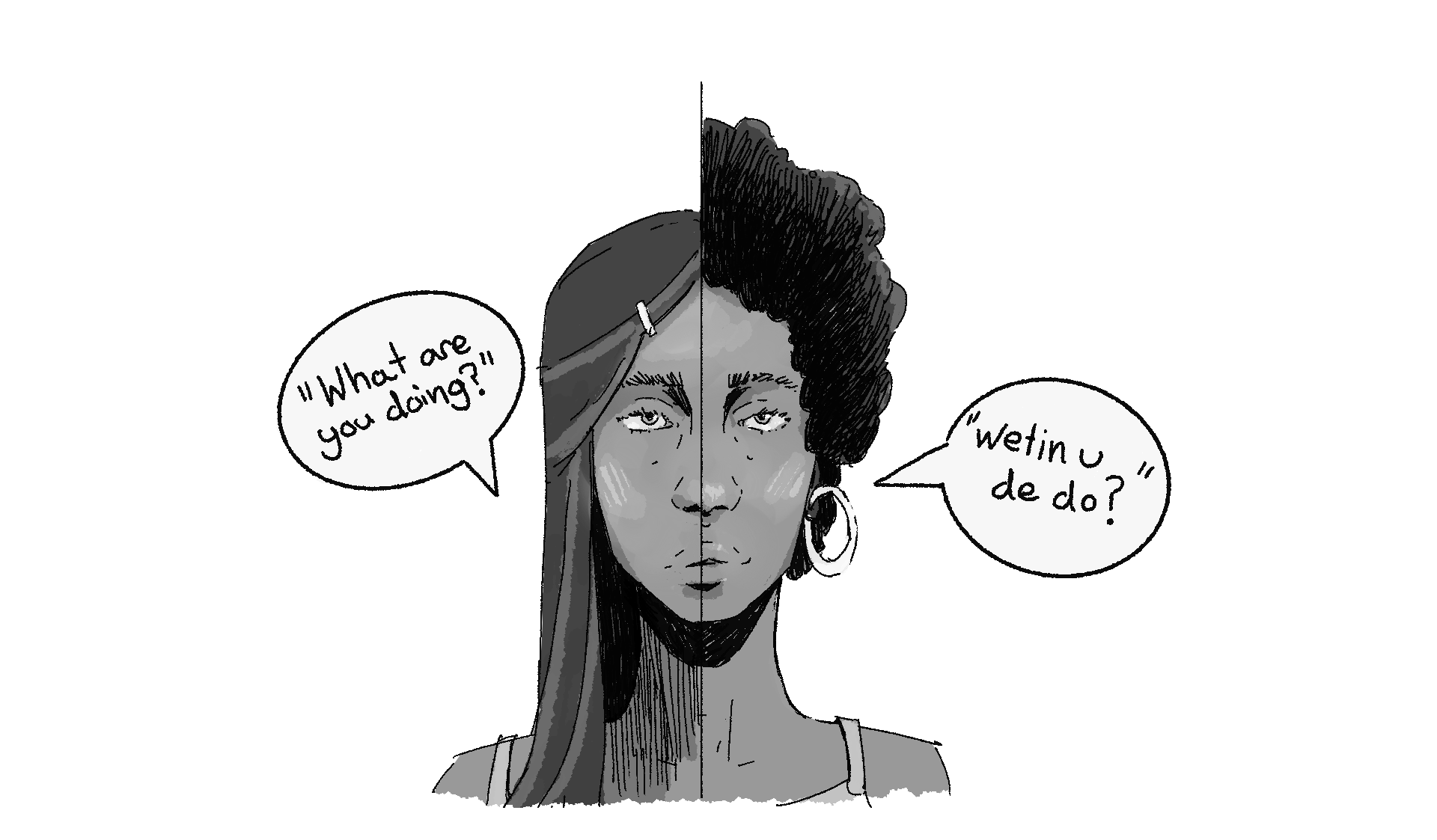
As Yvette Osei listens to preaching at her Ghanaian church in Shoreline, Washington, her hands move in rhythm with the music as praise and worship begin. Around her, voices rise in familiar accents, and laughter dances through the air as the sounds she grew up with fill the room. However, when she returns to her life on campus at Western Washington University, something is different. In the classroom, her voice shifts. Her humor changes. Her accent fades. Her words rearrange themselves to fit a world that doesn’t always understand her.
“When I'm just around people who are from here, I’m obviously that version of myself,” Osei said. “It’s like the U.S. version of Yvette.”
In class, Osei straightens slightly before speaking. Her accent soothes at the edges. Jokes that would land easily at church, with family and community, remain unspoken. She chooses her words carefully, swapping out cultural references that would need explanation for phrases her classmates will immediately understand.
Osei is participating in code-switching, which the National Library of Medicine defines as the spontaneous shift from one language to another during a single communicative event. It’s a strategy often used by bilingual speakers not just for communication but to signal group identity and social relationships. Research shows these shifts are tied to how speakers manage social identity and stylistic norms in different settings.
Even a single word can hold different meanings, Osei explained. In Ghana, saying “Ei” can signal shock, disbelief or playful accusations depending on tone and context. In the United States, the same sound — often spelled “Aye” — might simply be interpreted as encouragement or hype.
In studying how linguistic varieties are valued or dismissed, scholars have examined code-switching not merely as an individual speech behavior but as a socially structured phenomenon. In her foundational book, “Code-Switching,” linguist Penelope Gardner-Chloros situates the practices within broader linguistic theory. She argues that speakers routinely alternate between languages, dialects and speech forms depending on context, audience and social meaning.
Gardner-Chloros’ work draws on sociolinguistic, psycholinguistic and conversational evidence to show that code-switching reflects deep cultural and cognitive processes, challenging simplistic views of dialects as slang or inferior.
Osei is not alone in the balancing act.
After recently relocating to her Bellingham apartment with her husband, Quaniqua Williams, the 34-year-old African American with Sierra Leonean ancestral roots reflects on the seven years she spent on Lopez Island. For much of that time, she was the only Black woman in the community, a reality that made her hyperaware of how she spoke, presented herself and how her words might be received. In rooms where no one shared her cultural background, her voice often carried more than just conversation; it carried representation.
Williams’ voice carried the nostalgia of her childhood in southeast Georgia; she reminisced about the musicality and expressiveness of her family’s language, Gullah-Geechee, which had shaped her voice in similarly personal ways.
She recalled the conformity her teachers enforced by correcting her words, slowing her speech and insisting she use standard English instead of her Gullah-Geechee-influenced English. Each demand distanced her natural voice from the world outside her home.
Yet her family’s sayings and playful warnings still anchor her identity. Though Williams did not frequently speak Gullah-Geechee growing up, she said the language shaped the way her family spoke English. “If my family is gonna talk about teeth, we don’t say ‘teeth’, we say ‘teet,’” she said with a laugh. “If you cough, my family says, ‘You need to put some shoes on your feet because you barkin’ like a dog.’”
This humor — a subtle, coded way to correct or tease — shaped her voice, highlighting the gap between the lively expressions of home and the more restrained language she uses in public.
Outside the island, particularly in predominantly white spaces, Williams became increasingly aware of how often she was code-switching. After moving to Lopez Island, she relied on that awareness to navigate the island’s white-dominated environment.
“Literally every day of my life that I’m out here, I have to focus on every word that I say, because I know you’re paying attention,” Williams said, referring to people who are trying to fit their interpretation of what professionalism looks like.
Every interaction required careful navigation, a mental balancing act between staying true to herself and making her voice comprehensible to the surrounding community.
“Even within Black communities here, I notice myself adjusting to be understood,” Williams said. “When I’m relaxed, I talk like my family. But outside, I measure every word.”
For Williams, code-switching isn’t just a survival mechanism; it’s a bridge between the world she inhabits and the one she comes from, a skill that allows her to navigate an environment that may not always understand her linguistic heritage.
“People don’t realize that code-switching is a thing we have to do to not be placed in a box that doesn’t fit who we are as people,” Williams said.
Adaptation and navigation of different tones of English, mannerisms and social contexts to African Americans’ speech — particularly African American Vernacular English — reflect deeply systemic, historically rooted and culturally meaningful patterns. In an article published by the Proceedings of the Linguistic Society of America, researcher John McCullough argues that varieties such as Gullah-Geechee and other African-rooted dialects use stylized linguistic resources to signal group belonging and cultural authenticity. He also challenges dismissive assumptions about their legitimacy as fully structured language systems.
Williams isn’t the only one measuring every word and inflection. Having grown up in a Liberian household, Laura Free understands that kind of constant vigilance. Free was exposed to Koloqua as a child, which is an English-based creole native to Liberian people, and she still carries the cultural imprints of that heritage in her sense of self. Though English has become her dominant language, she tries to connect with others who share her cultural background to keep her ancestral voice alive, a subtle but important influence on how she navigates language and identity. At the same time, Free noted how her speech shifts in different spaces, a practice that has become second nature as a student at a predominantly white institution (PWI).
“It really depends if I am in an all-white space, especially at a PWI,” Free said. “The way I speak, some people will see it as so-called vulgar. I have to adjust my tone, my words, just to be understood.”
Free’s experience of code-switching — balancing the traces of her heritage with the expectations of professional and academic environments — reflects a common thread across voices: a negotiation of self. Matrit Coe, an Afro-Latina trans woman, describes it as both a survival and an expression of her own linguistic landscape.
From the moment she started speaking, Matrit Coe's voice came through clear and steady, confident but deliberate, navigating multiple words at once. It was clear how much thought she put into her words, depending on who’s listening.
“I wasn’t really familiar with code-switching until the end of high school and into college,” Coe said. “But I realized that it’s a tool people of color have to use to survive. You have to switch sometimes to pay bills, to get a job, to be presentable in spaces dominated by white expectations.”
Her tone is distinctively American, yet layered with cultural flows of the communities she carries with her. Coe described how different parts of her identity shaped the way she spoke in each space. Around her chosen family, friends and partners, she relaxes into her natural patterns: African American Vernacular English slang and expressions learned in queer ballroom culture. Words like “sister,” “honey” and “the tea” all flow easily, a language rich with history and coded meanings.
“That’s how we connect,” she said.
In professional or academic settings, the switch is unavoidable as she adapts to environmental and social expectations.
“Some instances where I feel like I’ve code-switched myself are going into a professional setting,” Coe suggests. “Which is surrounded by the basis and foundation of white supremacy, like timing, the way that my hair looks, the way that I am addressing and talking to higher-ups. That hierarchy of power really forces a sort of switch to be able to be presentable to white people.”
In her Latin community, she navigates Spanglish, balancing English and Spanish in ways that foster connection even as she admits she isn’t fluent in Spanish. For Coe, code-switching is instinctive, a skill honed from necessity but also a way to protect and express herself.
In “Spoken Soul: The Story of Black English,” authors John Rockford and Russell Rickford emphasize that judgments about “proper” English often reflect social power rather than linguistic logic. When one variety becomes institutionalized in schools, media and government, it gains authority not because it is structurally superior, but because it is socially dominant. Shifting the conversation from whether certain speech is correct to who gets to define correctness in the first place.
As she spoke, Sophia Eakins, a visiting assistant professor in linguistics at Western, leaned forward slightly in her chair, emphasizing that linguistic judgment often happens unconsciously. “We all change how we speak depending on who is listening, depending on the setting, our identity or what identity we want to communicate and how comfortable we feel,” she said. The real question, she suggested, is not whether someone’s speech is correct, but why certain voices are automatically granted credibility while others must work harder to be heard.
“Code switching is not violent; it’s not a tool used that can damage people of color, but it’s an instinct and a survival tool,” Coe said.