
¡El pueblo unido, jamás será vencido! The people united will never be defeated
La Resistencia fights to shut down the Northwest ICE Processing Center in Tacoma with Solidarity Days
Story and photos by Malia Fraser
Published Feb. 16, 2026
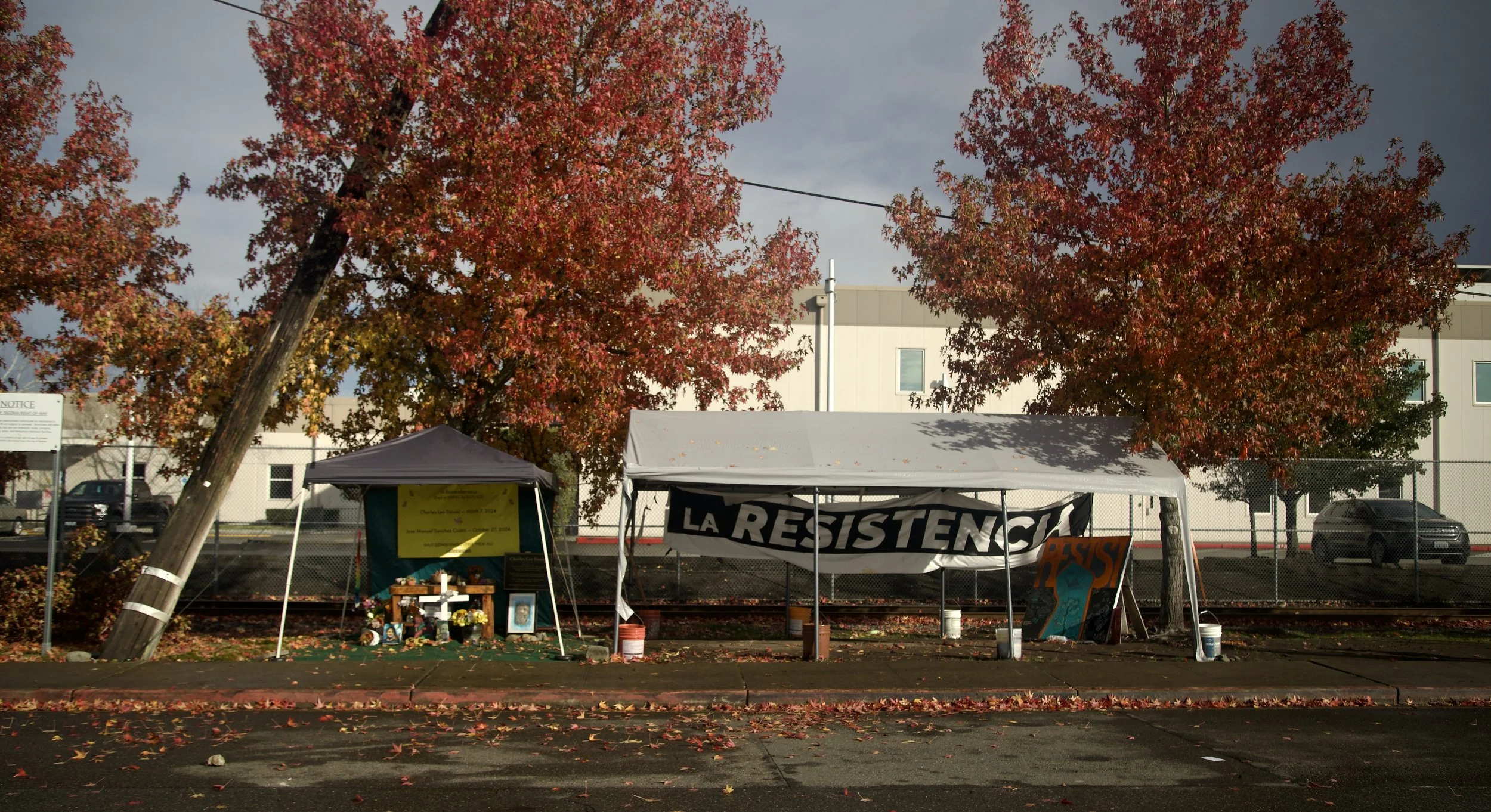
La Resistencia’s tent shelters an altar in honor of the two men who died in the Northwest ICE Processing Center in 2024, José Manuel Sánchez-Castro and Charles Leo Daniel.
A growing crowd equipped with raincoats and knit hats shares laughter and tears as they wait. Protesters dressed as a frog and a Statue of Liberty watch a band of drummers hit bright orange buckets hung around their necks as they sing rallying songs.
Gusts of wind blow flyers down the sidewalk and rain falls sideways. Still, people gather outside the Northwest ICE Processing Center (NWIPC) in Tacoma, as they have at least every month — rain or shine — since La Resistencia was founded in 2014. On this particular Solidarity Day, about 70 people huddle under three canopies as they listen to speeches describing the mistreatment of NWIPC detainees.
La Resistencia is an organization started by undocumented migrant women working to end deportations and the detention of immigrants in Washington state. During the past year, La Resistencia saw an influx of attendees at its Solidarity Days. This summer, they were outside the detention center nearly every week, singing and chanting things like “¡No estan solo! You are not alone!” to those freshly detained as they passed by in white buses with tinted windows. Josefina Mora-Cheung, the group’s organizing director and daughter of La Resistencia’s founder, thinks that extreme measures happening at a national level have piqued the interest of the public. She says the treatment of detainees has always been bad, but with the federal government giving a green light to ICE, people are becoming more interested in what is happening at the local level.
“With the current administration, I think what we're seeing now is a really blatant mistreatment out in the open,” Mora-Cheung said.
Mora-Cheung learned what community organizing looked like early on. Experiencing their mom going through deportation proceedings fueled their appetite for advocacy work. They went to Fairhaven College for American Cultural Studies and recently became La Resistencia’s full-time organizing director after volunteering for 11 years.
“People are really understanding now,” said Erin Shigaki, one of the many speakers that Saturday. “Maybe because there are these crazy militarized sweeps of cities and we're seeing people getting taken out of immigration court.”
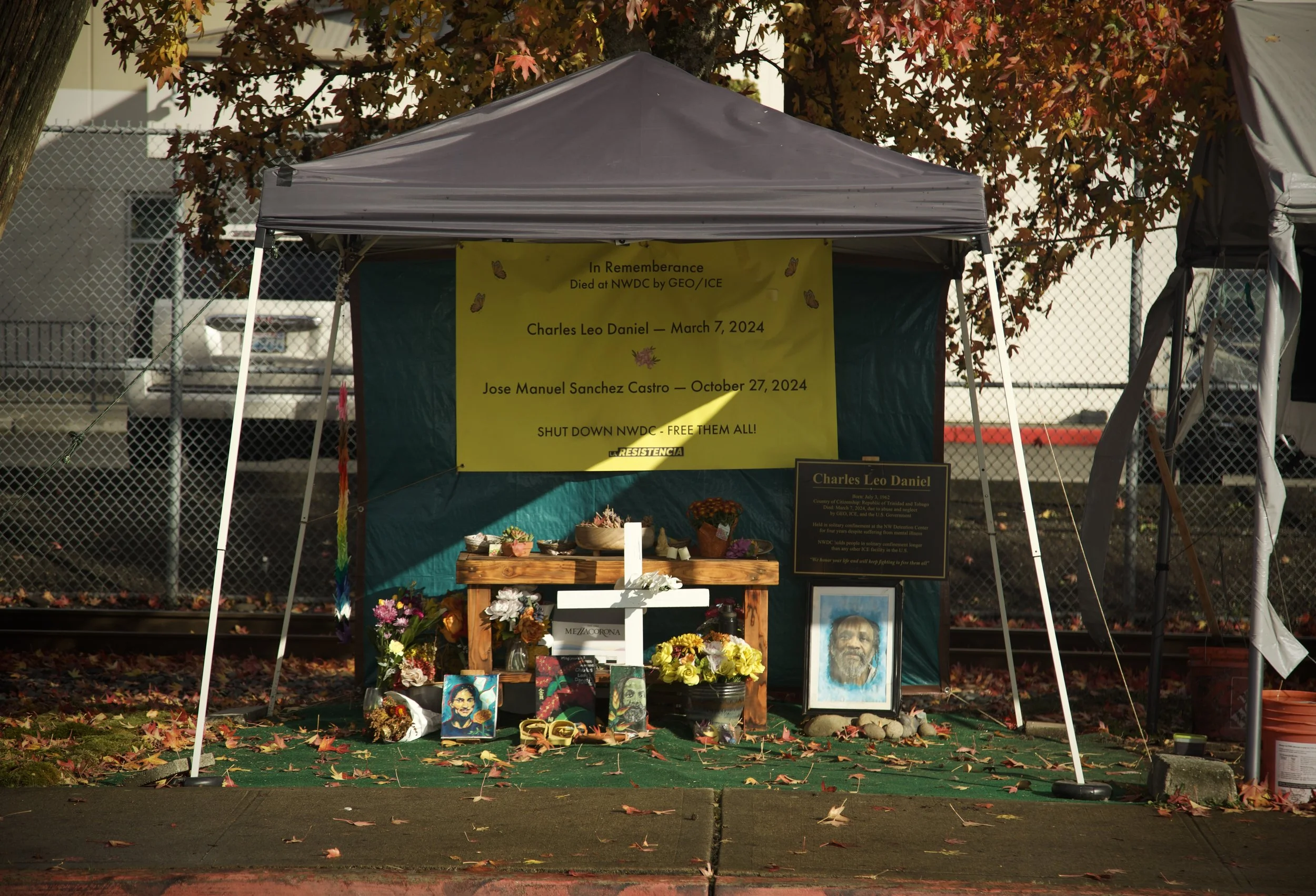
Next to La Resistencia’s tent stands an altar honoring the two detainees who died in the Northwest ICE Processing Center in 2024. Charles Leo Daniel died after being in solitary confinement for 1,244 days, and José Manuel Sánchez-Castro died five days after being sent to the NWIPC.
Shigaki has been involved with one of La Resistencia’s partner groups, Tsuru for Solidarity, since it formed in 2019. Tsuru for Solidarity was started by World War II Japanese American incarceration camp survivors and their descendants.
“Now we’re seeing 50, 75, 100 — hundreds of people sometimes — come out to our Solidarity Days,” Mora-Cheung said. “People are realizing that things haven't been okay, and they’ve continued to be really horrible for people, and life-threatening.”
The past few years have seen a sharp increase in deaths in ICE custody nationwide. According to ICE detainee death reports, in fiscal year 2022, there were three deaths; in 2023, there were four. In 2024, that number tripled to 12.
That number only continues to climb. In fiscal year 2025, 18 people died in ICE custody.
In 2024, two of those deaths happened in the NWIPC. Charles Leo Daniel died after being in solitary confinement for 1,244 days, while José Manuel Sánchez-Castro died five days after being sent to the NWIPC, according to their ICE detainee death reports. Next to La Resistencia’s tent stands an altar honoring the two who passed. Candles, bouquets of yellow, orange and fuchsia flowers, paper cranes and a pair of sandals surround a cross and paintings of the two men.
“It's just a matter of time before people die, and that's why we're out here,” Lynda Joko said. “We don’t want one more person to die at the hands of ICE or GEO.” Like Shigaki, Joko has been involved in Tsuru for Solidarity since its start. Joko does a lot of background work for the organizations, including supporting La Resistencia in monitoring and observing ICE flights in and out of the King County International Airport. Counts are regularly posted on La Resistencia’s Facebook and Instagram accounts. “It’s traumatizing to witness detainees being frisked and then having to climb metal stairs while in hand and ankle shackles,” Joko said.
The NWIPC opened in Tacoma’s manufacturing industrial center in 2004, and has a holding capacity of 1,575. Of 221 facilities that hold detainees in the United States, the NWIPC has the 9th largest average daily population, according to November 2025 data derived from TRAC Reports Inc. The NWIPC is operated by GEO Group Inc., a Florida-based contractor that invests in private prisons and mental health facilities worldwide.
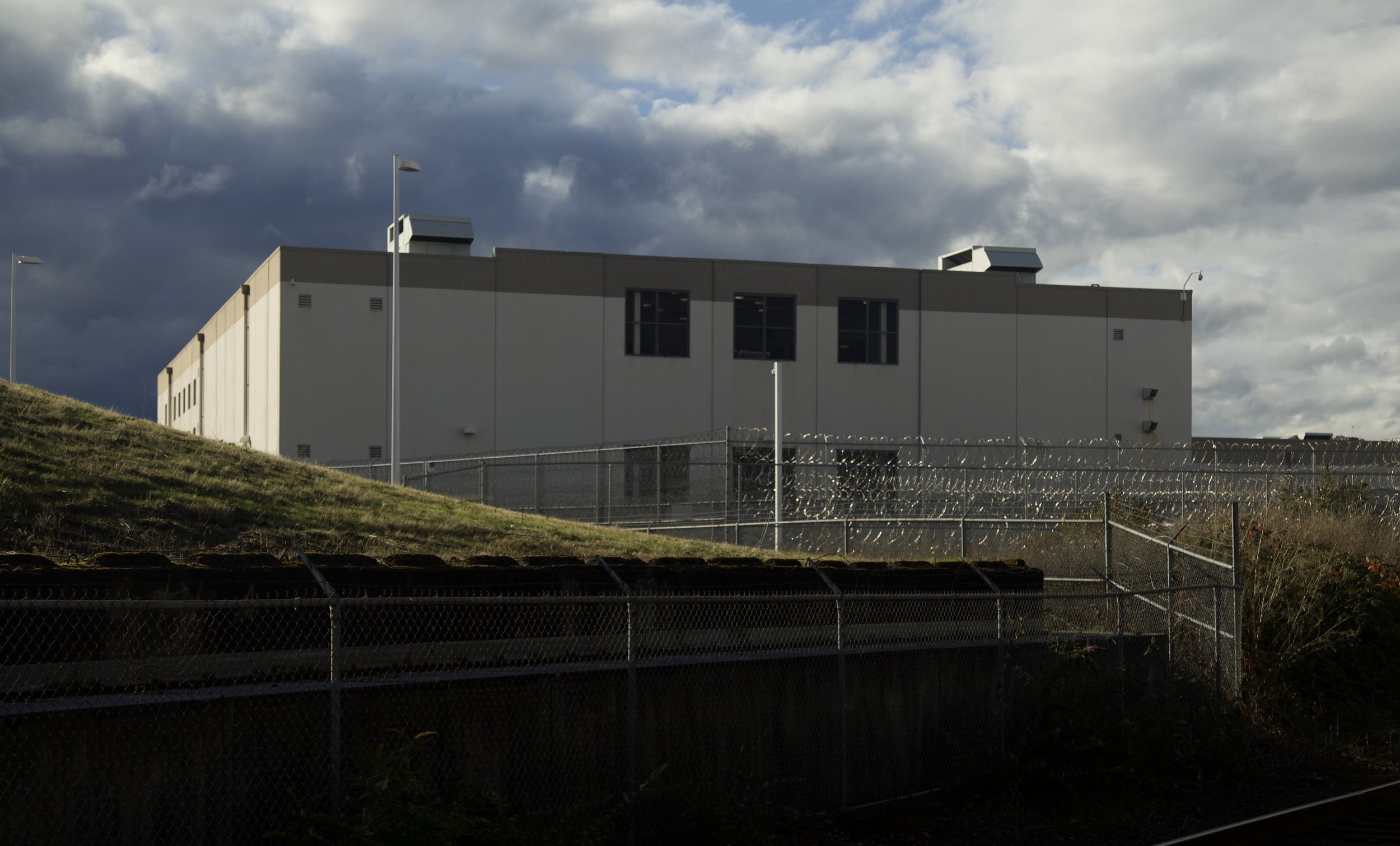
The Northwest ICE Processing Center was opened in Tacoma’s manufacturing industrial center in 2004, and has a holding capacity of 1,575.
“When they get out, most of them say that they were treated like animals,” Joko recounted.
During Solidarity Days, detainees share about the conditions inside the NWIPC through video calls. A La Resistencia leader holds a laptop close and translates for protesters. The detainees share how they receive most of their meals late, and their dinners are often available only in the late hours of the night. Even then, their food may still be frozen. They have been fed raw and bloody chicken. Their laundry comes back dirtier than before, smelling of gas and a feces-like stench has drifted from the air vents for months. The eyes of those listening wander past the speakers as they imagine what goes on inside. Behind tall chain-link fences looms the NWIPC, which gives a stark contrast to the bunch filled with spirit. The white, boxy concrete building has dark windows that are few and far between.
Mora-Cheung says part of their advocacy work is to put different pressure points on the GEO Group Inc. to make it harder for them to operate. “One of those pressure points that we're really proud of, and is also still in the courts, is House Bill 1470, which essentially mandates that the Department of Health of Washington should be able to go in and inspect the facility,” Mora-Cheung said. “It is a private business just like any restaurant or nail salon.”
As of September 2025, the Washington State Department of Health has been denied entry. To stay optimistic, Mora-Cheung says La Resistencia takes each small victory as a big win. Though the One Big Beautiful Bill Act, signed on July 4, 2025, allotted $45 billion for increased detention capacity until Sept. 30, 2029, Washington state has not seen expansion of its detention sites, unlike other parts of the country. More-Cheung believes this is in part owed to La Resistencia’s steadfast presence.
“Even today, we saw three people released from detention, which has been really rare over the past 10 months, especially when we’re out here,” Mora-Cheung said. “That helps us maintain the hope that we will eventually see this place close.”
As the Solidarity Day neared its end, a black van emerged from the detention center’s gates. As the van drew closer, three passengers became visible through the tinted glass. Protesters cheered and hit their bucket-turned-drums as the van holding the released detainees waved back on their way home.
“Even in this escalated climate of fear, we think it’s really important to push back against narratives of the good immigrants versus the bad immigrant, and who deserves to stay,” Mora-Cheung said. “We support everyone in detention — no matter what their history is — because we believe everyone deserves to be with their community, even through their immigration process.”
La Resistencia’s founder and Mora-Cheung’s mother, Maru Mora-Villalpando, went through deportation proceedings herself, but was not put in detention. Mora-Cheung suspects this might be a strategic move to prevent leaders from organizing from the inside. During Mora-Villalpando’s first preliminary hearing in 2017, hundreds of people came to rally for her support.
“They know that if they go after certain community members, the community will fight back,” Mora-Cheung said.
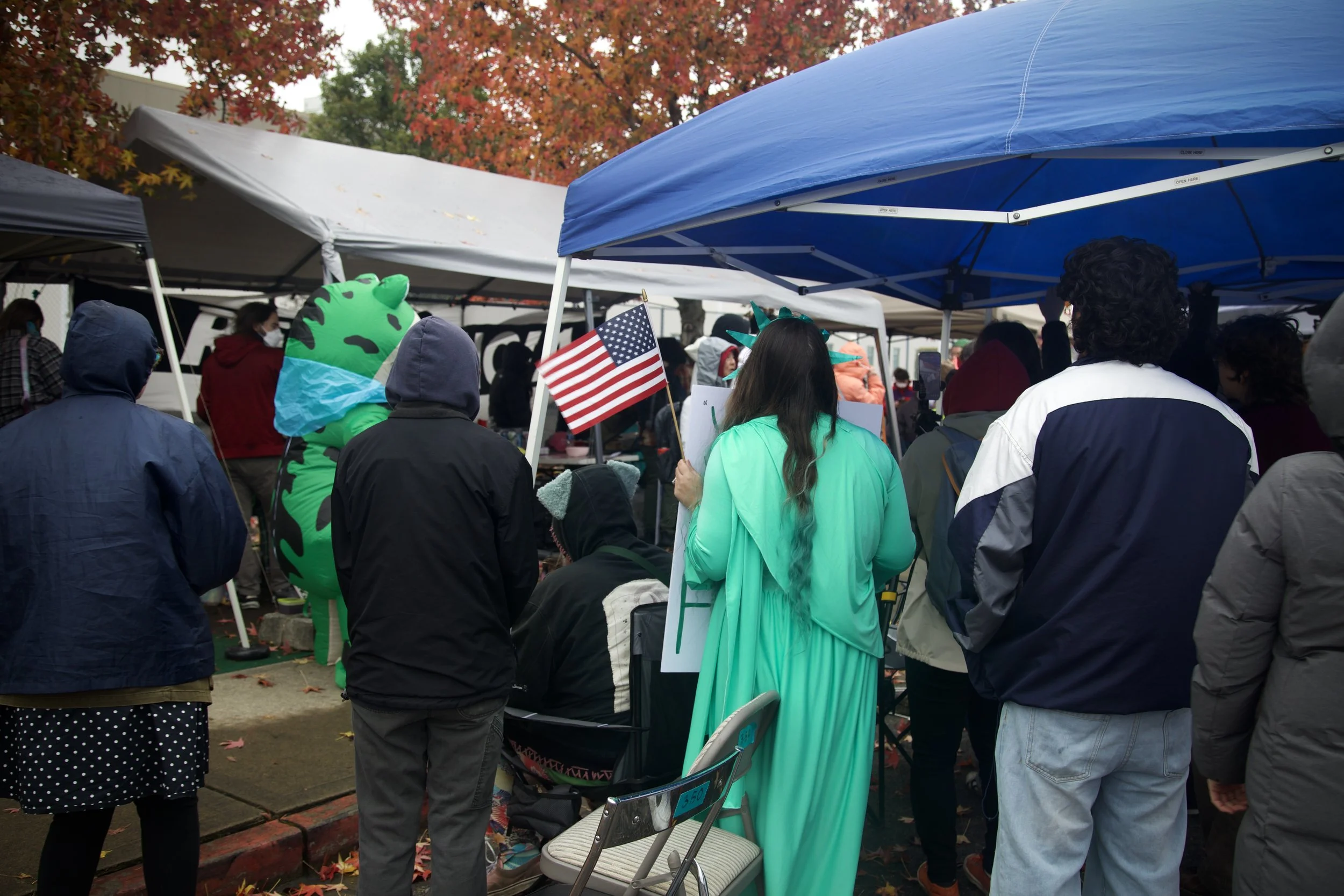
An individual dressed as the Statue of Liberty holds a United States flag among about 70 other protesters as they listen to a speaker from one of La Resistencia’s partner organizations, Tsuru for Solidarity.
Communities like Tsuru for Solidarity are fighting back. Tsuru for Solidarity held a civil disobedience action in February 2024, when they stood in front of the Seattle federal building to protest the NWIPC. Feb. 19 marked 82 years since the signing of Executive Order 9066, which authorized the mass incarceration of Japanese Americans on the West Coast. Throughout that week, Tsuru for Solidarity held a series of actions demanding to shut down the NWIPC. The organization protested family separation, poor sanitation and food and the inadequate healthcare that occurs in the NWIPC — conditions that mirror those of the incarceration camps that their parents and grandparents experienced.
“Although it was really hard for them as individuals,” Mora-Cheung said, “they were ready to take that next step in order to protest detention and be in solidarity with the folks of La Resistencia that can’t do those actions.”
Shigaki, one of the Solidarity Day speakers from Tsuru for Solidarity, said their dad was born in camp and their mom was born right after her family was released. Her great-grandparents lived in the incarceration camps, and her aunts and uncles and great-aunts and uncles were young camp children.
Shigaki’s family history draws her to join La Resistencia’s Solidarity Days.
“I understand that not everyone is able to,” Shigaki said, “but I'm going to put my life on the line for it because I'm able. I'm a citizen and there's so much that my ancestors dealt with before me — so I will stand up.”
La Resistencia stays hopeful that pressure from the state government and from the public will eventually lead to the closure of the detention center.
“One thing is showing up to an action … Another is sacrificing something of your privilege in order to help our work move forward,” Mora-Cheung said. “We believe that it's an important time to push back against narratives that divide our community and keep us apart.”
The crowd chants again, loud enough for the detainees to hear: “¡El pueblo unido, jamás será vencido! The people united will never be defeated!”