
Youngest member of the crew
How a childhood at sea shaped my sense of belonging
Story and photos by Mary d’Arcy
Published Feb. 16, 2026
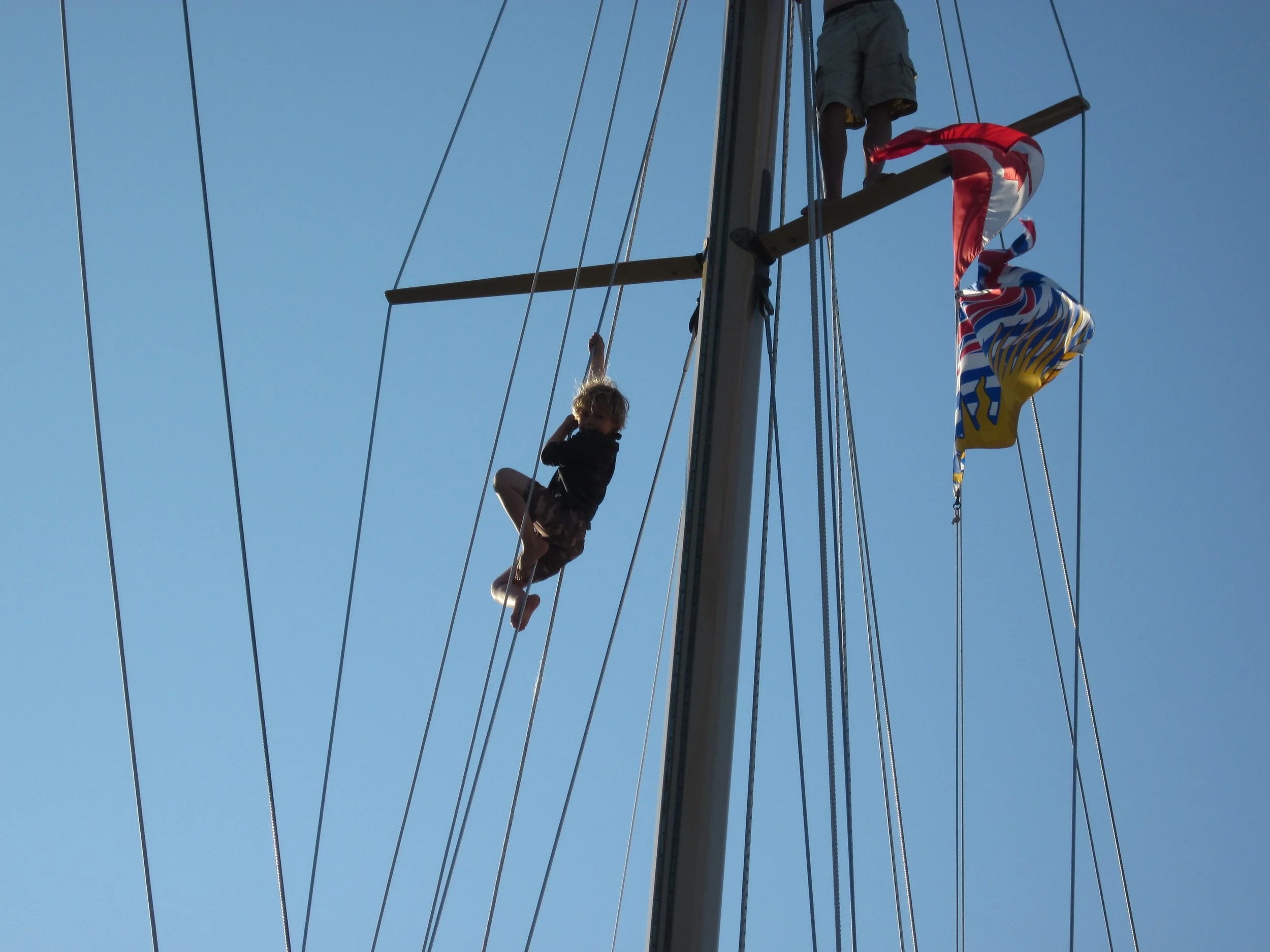
When I was 8 years old, I climbed into the rigging on the boat while in British Columbia. I was allowed to free climb (no harness), but I had to ask permission to climb above 10 feet. On this day, I was allowed to climb to 35 feet after proving I could safely climb to that height.
The hum of the diesel engine filled my ears. The kind of noise that had been happening for so long that you would only notice it once it stopped. The damp, salty air stuck to my eyelashes, leaving shiny droplets on my knit hat and sweater.
“Red, flashing every three seconds,” I said. “Red, flashing every three seconds,” my mom replied.
“Bearing three-two-seven,” I added. “Bearing three-two-seven,” she echoed.
I ran down the ladder again, little feet scampering, almost tripping over myself. I placed the handheld compass on the table, my eyes darting to the chart spread out before me. We were on hour 12, navigating through the Canadian Gulf Islands. We timed our travel north with the current and located colored channel markers and buoys to guide us through the narrow, turbulent passes.
I was three weeks old the first time I was aboard a boat. My parents recalled that it was a stormy mid-May day on coastal Washington. Winter still clung to the air despite what the calendar had to say. My dad, probably wearing his faded grey Patagonia beanie, rowed us in a little wooden boat, while my mom, wrapped in a large wool jacket, held me close to her chest. They paddled to the 84-foot sailboat tied to a mooring buoy. The sailing season was about to start, and an infant did not change the fact that work had to be done.
The summer that followed was a whirlwind. Each week, six new teens were dropped off at the interisland ferry. My parents drove their 1991, faded red Eurovan to the Orcas Island ferry landing to collect the group, and the van, packed with the new-trainee teens and one baby, took off toward another week of expeditions, restarting the cycle.
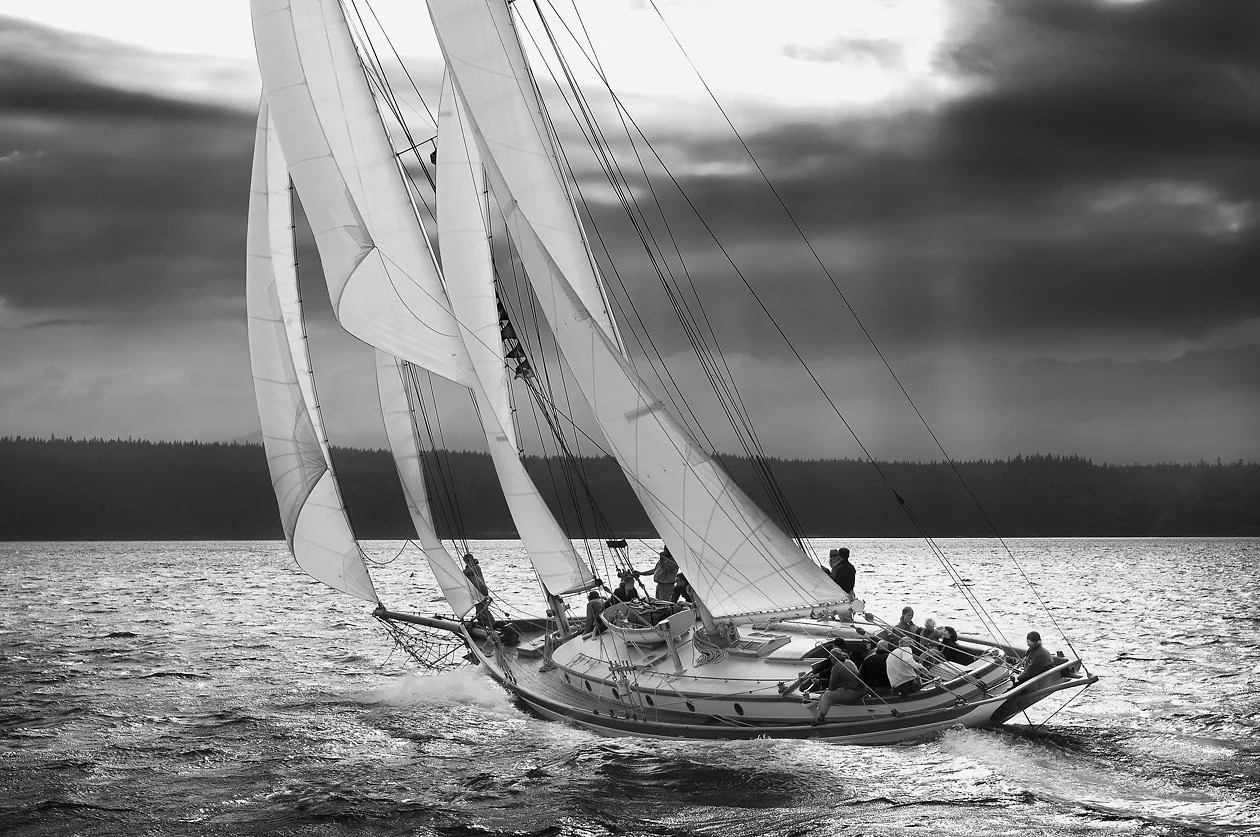
The Schooner Martha under sail in 2007. Photo by Michael Berman.
The community extended far past sailing in the summer. During the winter, it was time to “buckle down,” which meant putting our shoes back on, donning heavy work jackets and spending our winters in the boatyard. My parents would work, and I would do my best to help – or, on a good day, I would take off and explore. Climbing what felt like Everest-sized mountains of lumber, I splashed in puddles that contained enough heavy metals to last me a lifetime.
My parents worked for the Schooner Martha Foundation, a nonprofit with the goal of keeping an old wooden boat built in 1907 alive. With only eight board members and no real employees, a full restoration and running a sail training operation was no small task.
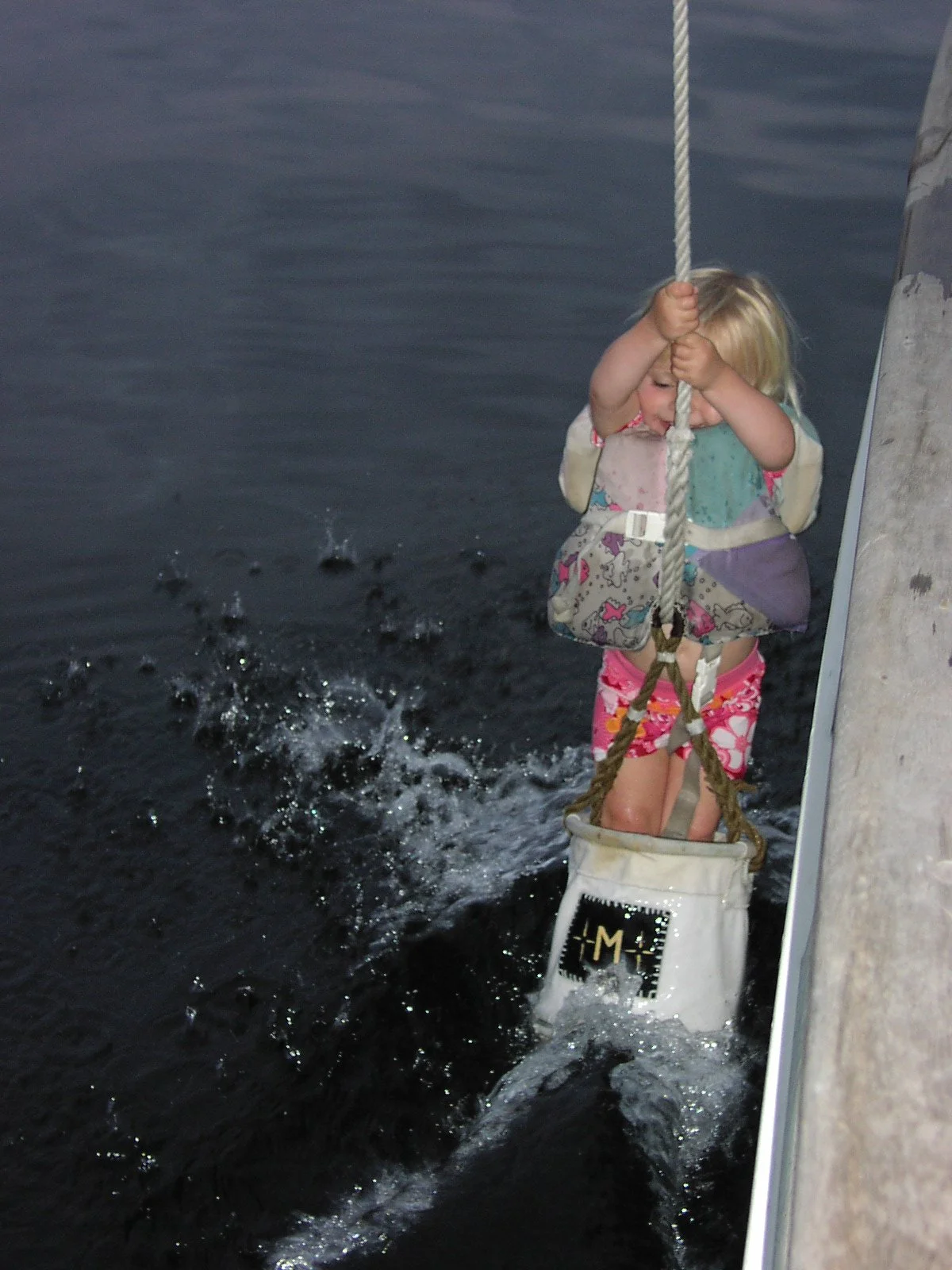
One of my favorite games was to get dunked in the water while standing in a bucket. I loved playing in the water, and like any kid, I was always eager to create a game or adventure out of my surroundings.
Schooner Martha was designed and built as a private racing yacht, and became the prized possession of a Bay Area wealthy lumber baron, John Ryder Hanify. She was named after his wife, Martha Fitzmaurice Hanify, a prominent women’s rights activist who founded a shelter for widowed women after their husbands were lost at sea.
After John Hanify died in a yachting accident in 1921, the boat was sold and passed through many owners over the years. Eventually, in 1968, Martha ended up at a summer camp in the San Juan Islands. Martha lived there for years, her crew teaching children to sail; an icon of the camp. At a camp reunion years later, one woman told us a story of stowing away on the boat after she wasn’t selected for a trip with the rest of her friends. A man shared that his first teenage kiss took place on the bow.
In the spring of 1976, after years of adventures, Martha was in drydock for maintenance when the lift holding her failed in the middle of the night. The boat crashed down, and large metal screws tore through her side. Martha was condemned and set to be auctioned off for scrap. Hate mail from campers flooded into the boatyard manager after teens and preteens had their sailing dreams flooded in one night.
Del Edgebert, an amateur sailor, heard of the beautiful local schooner being auctioned off for scrap and had an idea — one that would change the trajectory of his life forever. Edgebert, having no affiliation with the boat prior to this point, posed as a scrap dealer. Dressed in overalls, clipboard in hand, he showed up at the auction, bid for the boat, but fell short as the second-highest bid.
Then by some miracle, the winning bidder never showed up, and in a moment of triumph, ownership of the wrecked schooner went to Edgebert. He never revealed how much he paid for the boat, but before he died, he told my father that he had just finished paying off the last of his debts to his friends. “It was enough to save her,” Edgebert told my father.
Though he had no real maintenance experience himself, Edgebert was able to lean on his friends for support. They patched the boat up with plywood and towed her to Olympia, Washington, where he used his friend’s railway to remove her from the water and began learning how to make the necessary repairs.
With his wife, Paulette, Edgebert took Martha from a dying relic to a home. They raised their children aboard and built a life around the old wooden boat. As time moved on, they realized it was time for Martha to move on as well, which led to the formation of the Schooner Martha Foundation in 1996.
The foundation's sole purpose was to continue to restore Martha and keep her in the hands of the community. Classic yachts like Martha are almost always in the hands of wealthy men, sailed for sport and kept under lock and key. The goal of the foundation was to restore Martha and show that classic yachts could be for everyday people, too.
At first, the project was funded by the little money my father and his shipwright friends could spare. “We’d buy paint, we’d buy lumber, we’d buy fastenings,” said my father. “And then, there were some people that heard about the project and really liked what we were doing, so they’d come by and write a check.” The project only built momentum from there, which grew into donated shop space, bigger donors and grants.
Over time, I learned that our daily norm wasn’t everyone’s. The adventures I was on as a small child were sometimes labeled reckless by others. The nontraditional approach to raising a child on a boat posed dangers, but it also posed opportunities to grow and learn hands-on skills. My parents decided that the risk of having a child on an active job site was worth the trade-off for my learning how to use tools and staying out of danger around heavy machinery. The danger of climbing in the rig was calculated because I was learning risk assessment and physical self-awareness.
“I don’t think it was reckless; it was an adventure,” my father recalled, his smirk evident even over the phone. “I’d say driving down the highway at 60 miles per hour is reckless, but we do that all the time.” That was the sentiment maintained throughout my childhood.
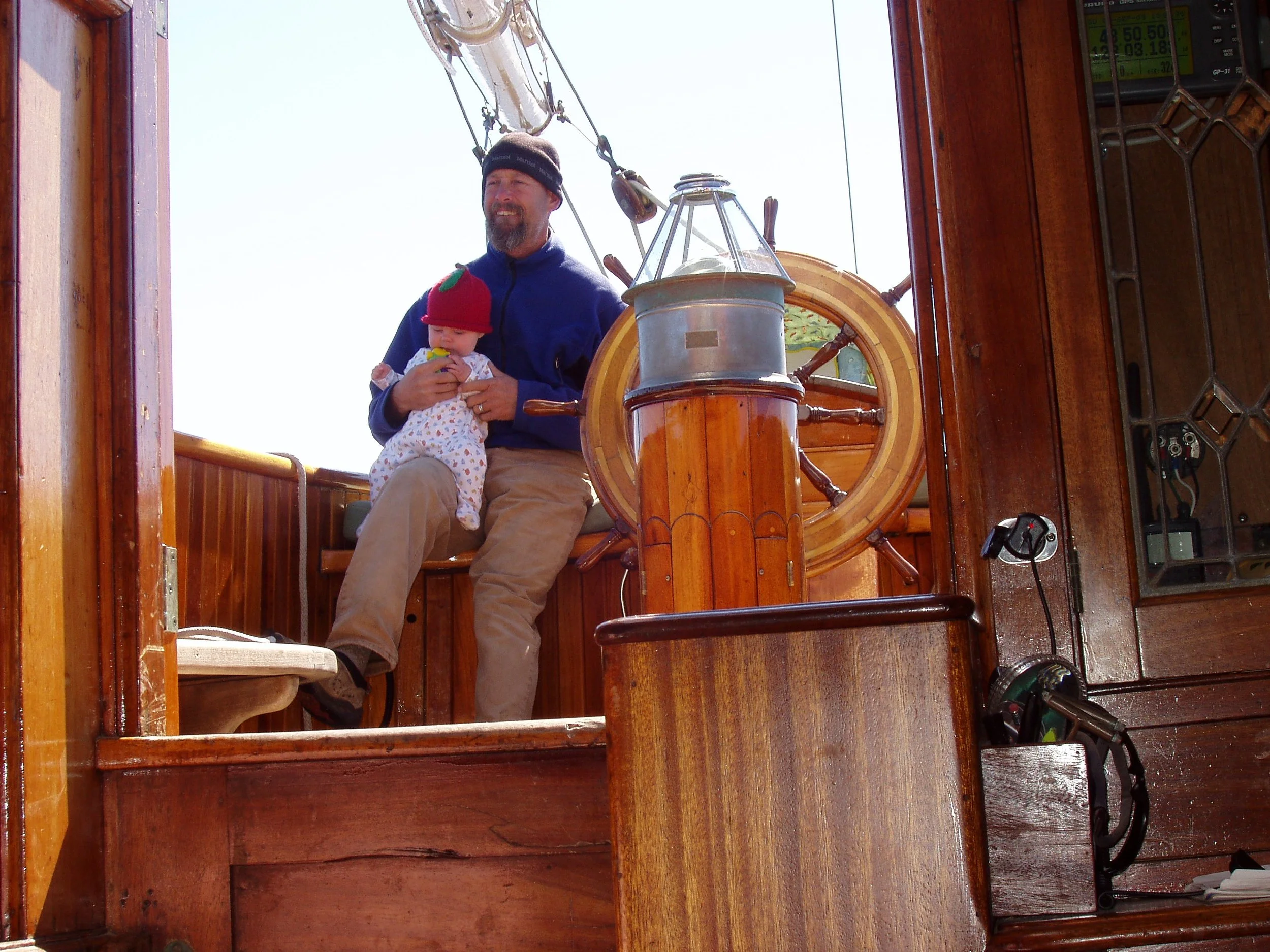
In 2003, my dad sat at the wheel of the boat, holding me while we sailed along.
When I was 2 years old, my parents signed on as crew on a friend's boat, a different schooner, and we took off for Baja, Mexico. We crossed the equator not long before I turned 3 on Moorea, Tahiti, and spent months at sea alone in our bubble of 10 or so people until we would make landfall. We went offshore again when I was 11. This time, on Martha, traveling down the coast of California, through Baja, and out to Hawaii. And so, my childhood was structured around being barefoot and salty rather than school and sports. Though I still had the occasional meltdown over homeschooled math.
Life at sea takes on a new form. The world is no longer organized by a 9-to-5; instead, it's built around tasks and responsibilities. If you fail to check the chart properly, your boat will run aground and sink. If you do not tie a sail up properly, it could hurt someone or get damaged. Suddenly, you become one large family. There’s no such thing as privacy, so you trade some of your dignity for pods of dolphins leaping under your bow, for tropical storms being your first shower in two weeks, and for nine stalks of fresh bananas you traded for the last time on land.
People always assume being at sea is lonely. The idea that there is no land in sight, only an open blue horizon, seems isolating, yet that couldn’t be further from the truth. You get to know yourself and your crewmates in a special way. The crew, many of whom were strangers before setting foot on the boat, leave with bonds and memories to last a lifetime.
When you’re waking every six hours for weeks on end, the act of waking up — or trying not to — becomes a sort of game. Cold hands down the back of someone's neck or a headlamp in the face are all tools used to rip the innocent from their cozy sleep. It may seem cruel, but it created cohesion.
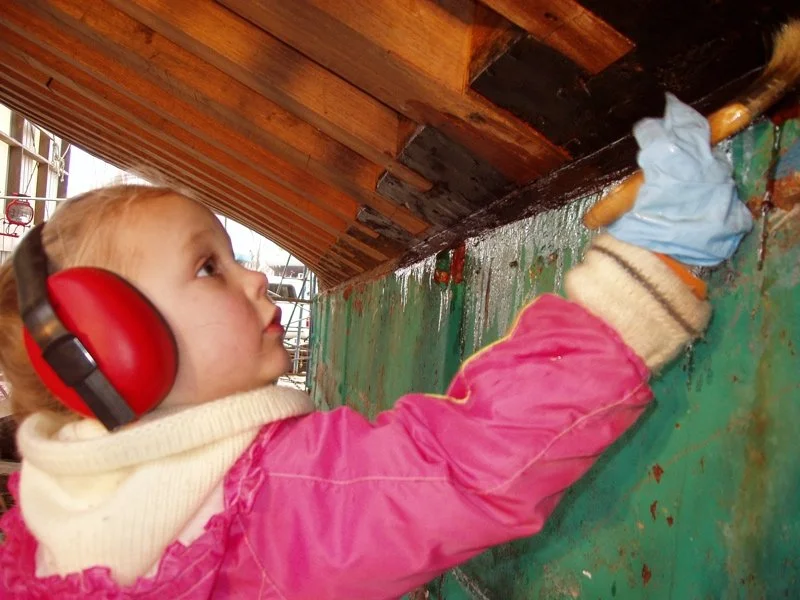
Growing up, I often helped my parents work on the boat. When I was younger, I was given simple tasks so I could safely learn skills. On this day, in 2008, I worked on oiling the wood while the boat was being replanked (replacing the outer wood of the boat).
Once you’re up, the game becomes one of entertainment. There is nothing real to see at night when you are in the middle of the ocean. It’s quiet except for the sound of the wind and water. Singing songs, creating horrendous food combos and sharing wild stories becomes the 1 a.m. norm.
One time, while sailing home from Hawaii, the crew got so tired of getting our dry gear soaked through during a daily sail change that we started stripping to our underwear to do the task. I’ll let you paint that picture: five or so people, near naked, wearing safety harnesses, getting fully submerged under mid-ocean waves, like clockwork once a day.
The reality of boat life is often far less glamorous than any movie or TV show may suggest. Daily life was no more or less exciting than what my peers were experiencing at home, just slightly askew. I had a horrible fear of pirates from an early age. On one occasion, I fully lost all the composure a 5-year-old could possess after seeing a boat that resembled Pirates of the Caribbean near where we were going.
While many of my friends said they envied me, I was so used to boats that the idea of the sea felt almost boring. I dreamed of normality. The thought of a school bus was enthralling, and I was shocked to learn that my friend’s parents didn’t have to warm their clothes up in the diesel oven before school because it was so cold.
I live in an apartment now. l don’t buy groceries in bulk for 12 and I no longer have salt stains on my clothes, but when I go home, it all floods back. My parents, now in their late 60s, still get up every morning and drive to the shop, waving at their friends who run the local marine supply store. They still work in the marine trades, but sail less than they once did. Their small-town world keeps spinning even when it feels as if the rest of the world is about to stop. The Schooner Martha still sits in her slip on Linear Dock, a piece of history preserved through the perseverance and sacrifice of a community.