
Reclaiming the body
Providing insights needed to live in synchrony with our hormones
Story by Lynn Piefer
Published Feb. 17, 2026
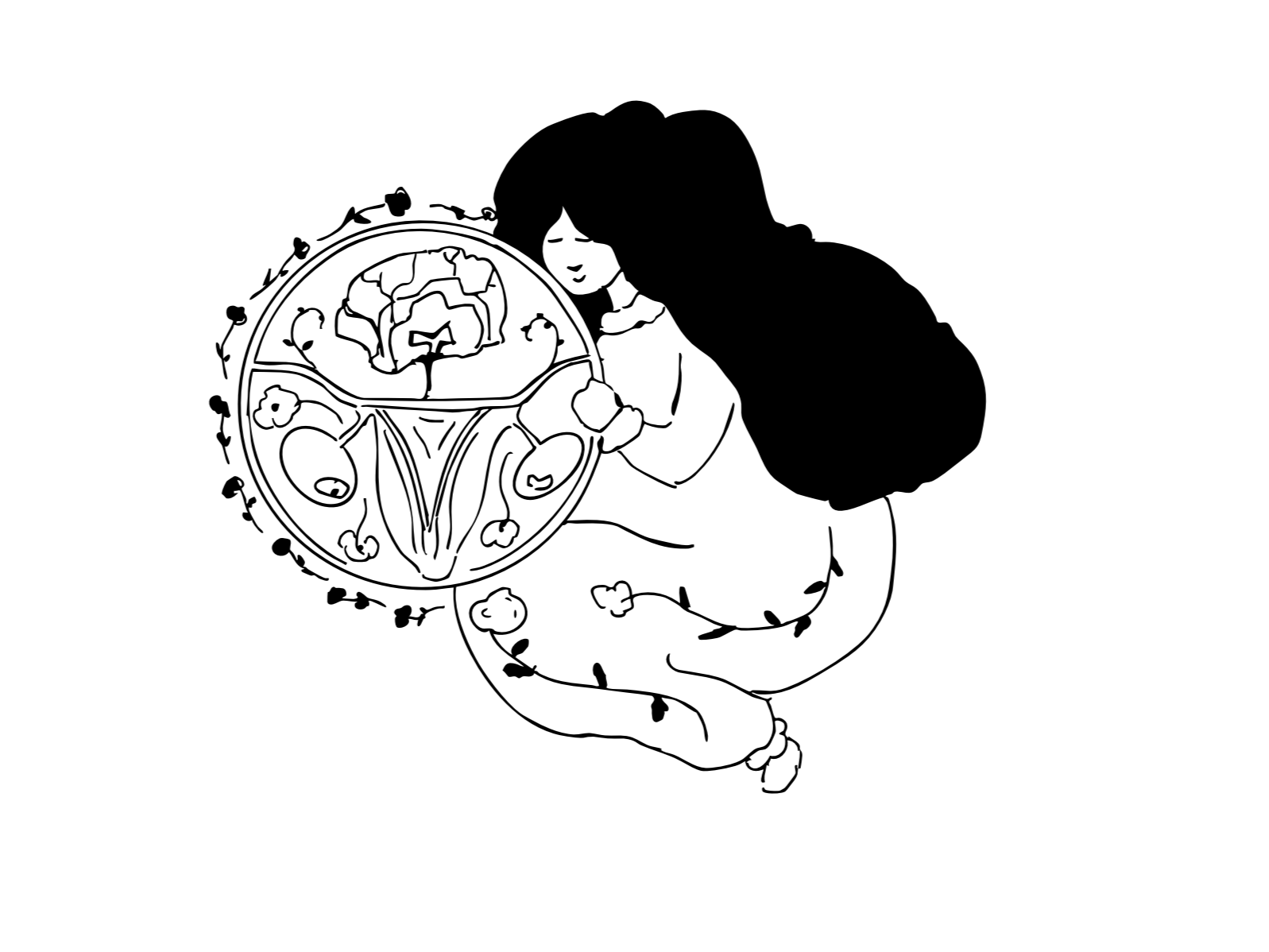
Illustration by Royce Alton.
Editorial note: For the purpose of this article, I will mainly be using the word “woman” to encompass those with female anatomy or who take or possess female hormones, though it may not be the case that all women experience these issues or possess female anatomy/hormones. All the same, I will primarily be using the term “man” to encompass those with male anatomy and/or hormones.
When Augusta Søndergaard hears the phrase "You're so hormonal," her immediate reflex is to respond with "Yes, I am, and so are you." And it's the truth. Everyone's well-being is dictated and directed by their hormones. Despite this, hormonal conversations primarily revolve around women during menstruation.
Hormones are chemical messengers that affect many processes throughout the body, including growth and development, metabolism, sexual function, reproduction and mood, according to the National Library of Medicine.
Three out of four people who menstruate experience some form of premenstrual syndrome (PMS), according to the Mayo Clinic. PMS is essentially the medical term for "you're so hormonal." Symptoms encompass anything from depression to food cravings, fatigue or insomnia, and include an expansive list of physical and mental disturbances. However, according to Søndergaard, signs like these are indicators of sex hormone imbalance, not a symptom of hormone cycles themselves.
Søndergaard is a registered nurse in Copenhagen, Denmark, focusing on reproductive, maternal, women's and menstrual health. According to Søndergaard, PMS is a bandage diagnosis for issues and symptoms are unnaturally occurring in the first place. "It does not make sense to me, knowing the things I know about biology and evolution, that we would have a biological system that would create that uncomfortability,” she said.
Søndergaard suggests that other mammals are better able to cope with similar hormone cycles because they listen to the body's needs and movements. They rest when tired and eat when hungry, with survival the primary responsibility. As humans, that intuition is often rejected in the name of adhering to the system and structure of modern-day life. "We are much more on the go, and we are adapting to this male circadian rhythm, which is every 24 hours," Søndergaard said. "But we are cyclical in a different way. The same fluctuations that males have in 24 hours, we have in 28 days."
The primary male sex hormone, testosterone, reaches peak levels each morning and slowly declines throughout the day. The hormone is essentially "recharged" during sleep, according to the Marion Gluck Clinic, a London medical center that focuses on bioidentical hormone treatments for both men and women.
On the other hand, the primary female hormones, estrogen and progesterone, fluctuate in levels on an average 28-day cycle. This process takes the body through different phases due to the rise and fall of each hormone, including the menstrual, follicular, ovulatory and luteal phases, as outlined by the Cleveland Clinic.
As hormone levels shift throughout each phase, the body's capacity for social and physical activity fluctuates alongside it. Much like how testosterone can cause men to feel more sluggish or fatigued later in the day, according to Dartmouth Health, female hormones experience ebbs and flows throughout the four distinct phases of the cycle. However, due to a busy routine that follows a disparate schedule, many women often lack time to prioritize their hormone health.
This is certainly the case for Whitman College student Masha Aghabekyan. Due to complications with her period, she spent a lot of time in gynecology offices throughout middle school. Here she learned about progesterone and estrogen, the primary female sex hormones, their effects on the body, and how she can support them. But today, Aghabekyan doesn't feel she can even apply this learning to her relationship with her hormones.
"I don't even keep track of my period," Aghabekyan said. "I probably should do it, but I don't really have the time to be worried about that. The speed of life is such that it doesn't really leave much room to wiggle. You just have to keep going, and it's hard to pay attention to that stuff when you have shit going on."
Structuring life around the needs of the 28-day cycle is not conducive in a world that holds fast to the 24-hour schedule. On top of this, many who participate in intense athletic training, follow specific diets or restricted eating, face additional issues caused by stress or low dietary fat that lead to hormonal imbalances, resulting in further damage to the body.
Holly Kays was a college rower for Oregon State University from 1982 to 1985. After college, she joined the U.S. national team in 1987, 1989 and 1990, training at a high intensity for several years. In her mid-20s, she had to cut weight for her team. Then, Kays was lucky if she got her period once a year.
"At that time in my life, I was fine with it because it made life easier not having a menstrual cycle," she said. "There wasn't a concern that it would have long-term consequences, and that brings up the whole question of if I had known, would I have chosen differently?"
Kays expected her cycle to regulate as soon as she was done training. In reality, it took about five years before she started having even semi-regular menstrual cycles again.
What Kays didn't realize was that the hormone imbalance she experienced over those years was significantly impacting her bone density. Now, in her early 60s, she has low bone density, which puts her at greater risk for breaks and fractures. "I was never told of the high connection between estrogen and your bones' ability to store calcium and maintain it," Kays said.
Kays' and Aghabekyan's experiences aren't unique to their individual circumstances. In a world that adheres to rigid living conditions, ignoring the body's signals has become the norm. Limiting essential fats forces the body to choose which hormones to support, and creates a hormone hierarchy, Søndergaard explained. In situations of high-intensity weight-cutting, disordered eating, restrictive diets or high mental or environmental stress, the body will choose to support the stress hormones over reproductive hormones. The logic here is that the body will prioritize staying alive over maintaining reproductive abilities. This can lead to hormonal imbalances and, in some cases, the loss of a regular cycle.
Kays emphasizes the importance of listening to your body and recognizing the stress it may be experiencing.
"The body is so capable and so wise on its own," Kays said. "Be active, do everything you want to do, but at the same time follow the wiseness of your body."
Finding balance in the nervous system is key to this process, Søndergaard maintains. She emphasizes the importance of providing the nervous system with what it needs to be more elastic in the chaos of life. This can look like mindfulness, being present and relieving stress. Starting here allows the body to understand that some stressors will not determine life-or-death, and that it can and should support both stress and sex hormones.
"We have to consider our cycle. We have to consider it an ally and not an enemy." Søndergaard said. "My clients simply ease their PMS symptoms by allowing their cycle to be there, not trying to work against it." Self-solidarity can look like everything from listening to and providing what your body is asking for, resting when your body is tired, nourishing your body when it's hungry and respecting your social battery.
"It is quite simple, but it is not necessarily easy to wrap your head around, especially if you've never heard anything about it before," Søndergaard said.