
Washington’s surf frontier
Cold waves and the locals that guard them
Story by Jonah Billings
Published Jan. 24, 2026
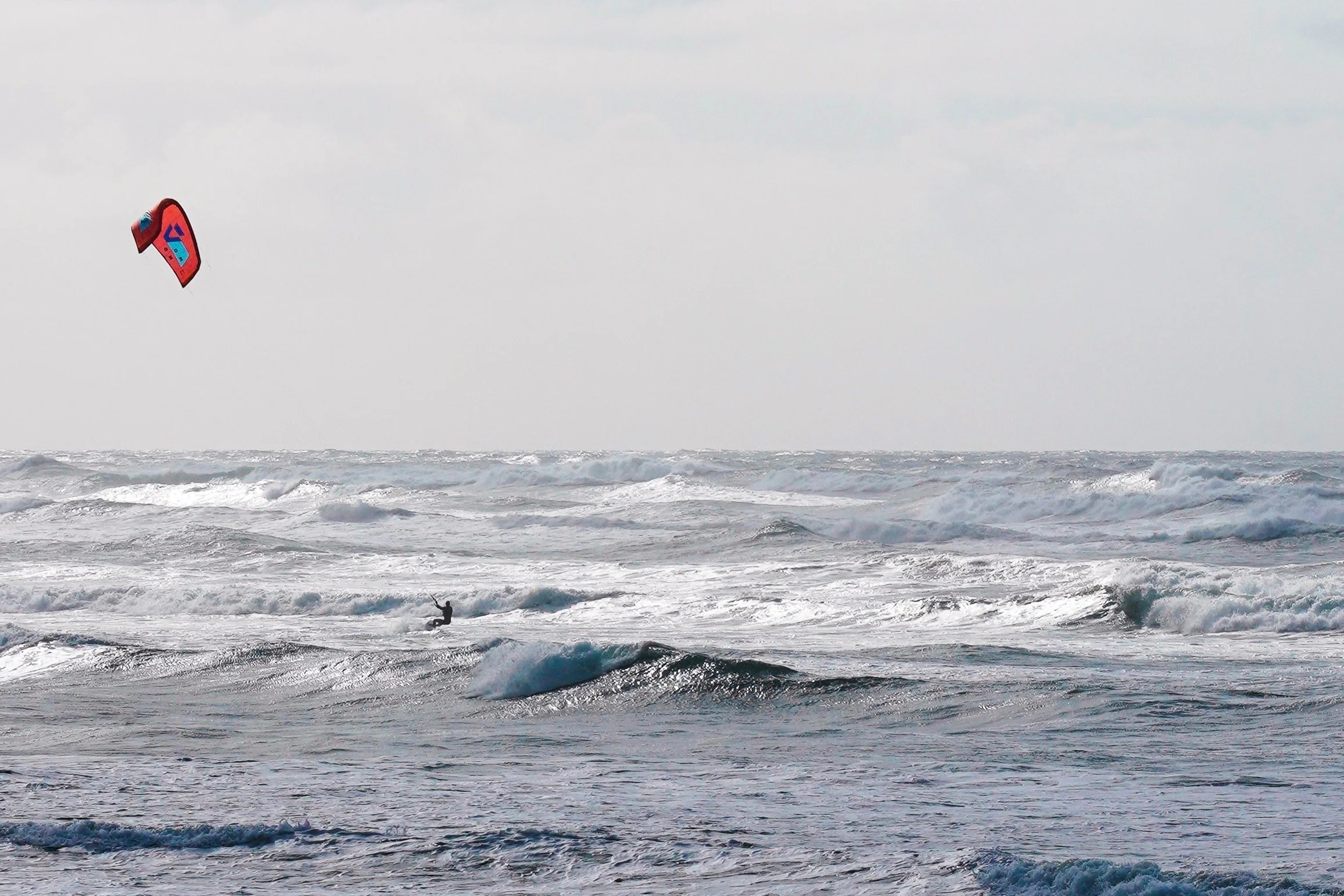
A kite surfer takes advantage of windy conditions in Westport, Wash. Westport is perhaps the most prominent destination in the state for beginners and seasoned surfers alike, and is home to Washington’s first-ever surf shop, which opened its doors in 1986. // Photo by Jonah Bloom
“You can surf there?”
It’s a fair question. The spot is pleasant but unremarkable, situated on a small point at Birch Bay State Park, less than an hour north of Bellingham. As the sun creeps towards the horizon, couples sit and eat at wooden picnic tables placed in the grassy waterfront park, and I can hear a young boy chasing his little sister in frantic circles around the playground across the road.
Out by the water, ankle-high waves lap at the shoreline, more comparable in size to ripples on a lake than to the blue barreling beasts of a surfer’s dream. So, can someone actually surf here?
The answer, while surprising, applies to countless other surf spots across Washington state: “Yeah, sometimes.”
As someone who grew up surfing in Southern California, perhaps the most stereotypical sun-and-surf destination in the world, the fact that Washington harbors its own surf scene caught me off guard. The rocky, unforgiving coastline does not give off the impression of encouraging a thriving surfing environment. On top of that, there’s the frigid winter temperatures, near-constant winds and seemingly never-ending rain.
Yet for the area’s dedicated locals, winter means bigger swells — a series of waves brought by coastal weather systems — and better waves: it’s surf season in the Pacific Northwest.
As you might guess, wetsuits are a must. Not just any wetsuit, but thick, blubber-esque 5/4 and 4/3 models, layers of warmth-trapping neoprene so substantial that they almost act as flotation devices. Next on the Washington surfer’s checklist are: hoods, booties and gloves. Only the face is left vulnerable to the chilly bite of the wind and waves.
Once outfitted, most surfers head to a few major spots that serve as hubs for the region’s surf community. Although I wasn’t able to get a hold of anyone in the well-known and beginner-friendly Westport surfing community, it’s home to Washington state’s first surf shop and two surf schools. The Olympic Peninsula hosts countless other little surf breaks, tucked here and there along the coast into the Strait of Juan de Fuca. Lucky surfers can find waves as far from the open Pacific Ocean as Whidbey Island.
The further north and away from the open ocean, the harder it is to find waves. All the way up here at this quiet spot in Birch Bay State Park, nobody really even thinks to look. Usually, it’s just David, a local who started surfing here with some friends in 2008.
“We found out that if you get wind out of the Northwest down the Strait of Georgia … it creates a swell,” David, who requested his last name be omitted due to a recent identity theft, told me. “I started surfing it more often and realized that it would actually break pretty often.”
Sure enough, a quick look at the Birch Bay Surf Club page on Facebook confirms there are occasionally surfable waves. David created the page to alert others to the nearly impossible-to-predict surf conditions, which he can check from his house. The feed is primarily populated by videos from a GoPro on the front of his board, documenting his enjoyment of what he calls “arguably the northernmost surf spot in the contiguous United States.”
Birch Bay is too far from the ocean to get the real swells that a surfer would usually look for. The waves are exclusively powered by wind, which needs to be at least 25 miles per hour to create surfable conditions. This makes it more of a “novelty wave,” or a wave known for a unique one-off behavior, than a legitimate surf break. Surfers looking for more traditional waves must head south, and it’s not an easy quest.
There’s no question that it's difficult to be a regular surfer in most parts of Washington. Outside of Westport, most spots are inconsistent, weather-beaten and tough to reach. Not to mention well-protected.
After our conversation, David warned me that if I was going to write about some of the other surf spots in Washington, I should be prepared for a certain amount of secretiveness from the locals who frequent them. Sure enough, multiple other sources I talked with requested I not mention certain places in this piece.
The Washington surf community is tight-knit, almost to a fault — it’s impossible to escape the issue of localism on the region’s surf breaks.
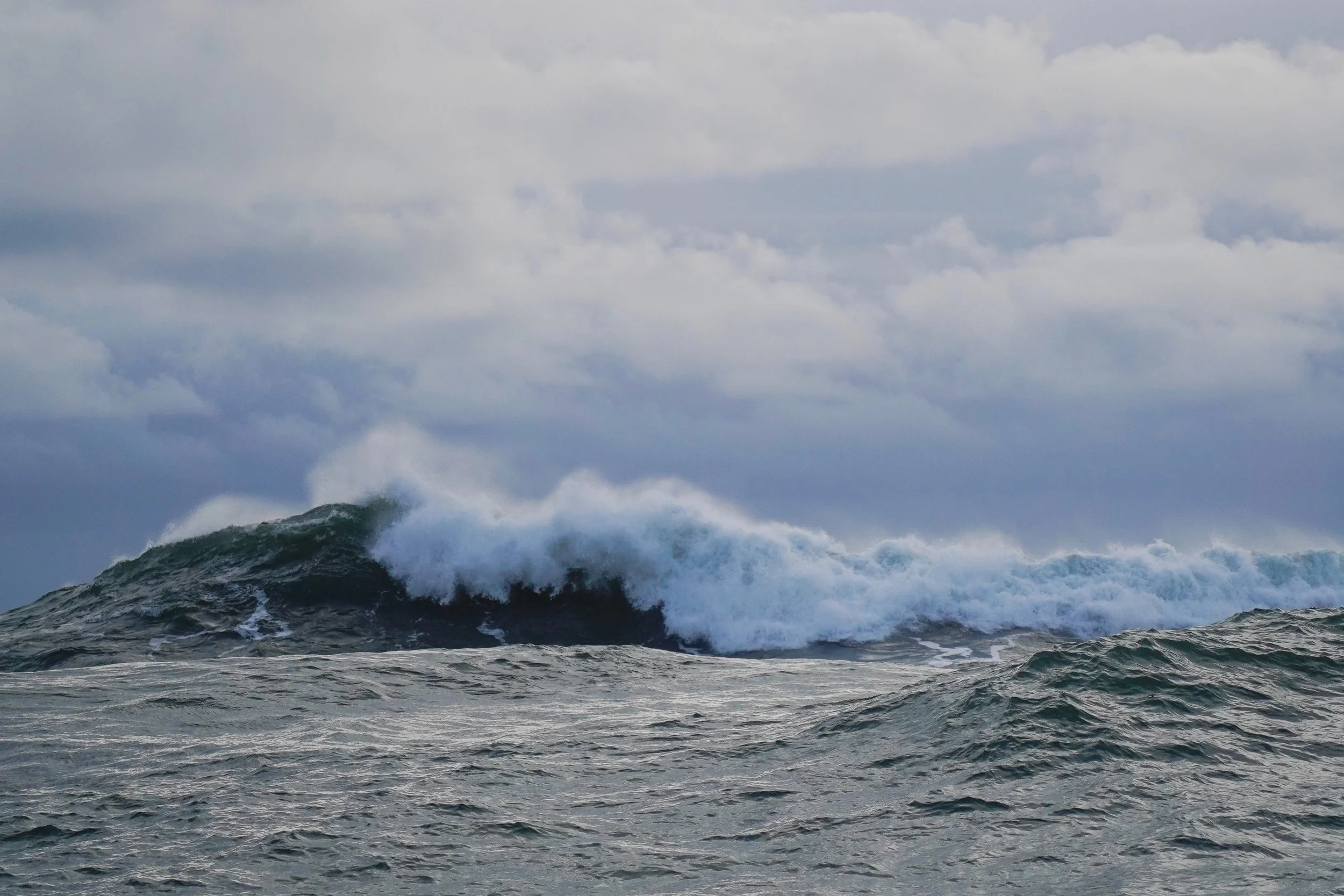
Like this one off Westport, Wash., the waves in the Pacific Northwest can loom large, ominous and unpredictable. Cold temperatures and rocky coastlines add to potential hazards that surfers must stay aware of. // Photo by Jonah Bloom
Western Washington University student Adam Haunreiter, 20, is no stranger to the challenges of a regular surfer in the PNW. His Instagram bio reads “Always in search of waves,” a fitting tagline for someone who grew up on the Oregon Coast and started surfing it at the age of eight.
Despite the limited surfing options in the immediate Bellingham area, Haunreiter doesn’t regret his choice to move up here for college.
“I think it’s a hidden gem because, compared with the rest of the world, I feel like we have some of the last secret spots left that are undercrowded,” he said. “(The waves) break really good and it’s kind of kept a secret, which is nice.”
These “secret spots” are kept quiet by their local surfers with some help from the elements and the distance required to reach them.
I squeezed in a conversation with Haunreiter just hours before he departed for the Olympic Peninsula on his next surf adventure. It’s a 3-plus-hour trip familiar to many surfers on Washington’s northwest coast, but by no means a convenient one. When I attempted to make the trek, I drove 90 minutes to catch a ferry that promptly broke down when I arrived. Just making it to the waves is an adventure of its own.
“The thing about Washington is pretty much everything is harder to get to, which might be part of the reason why it’s less crowded,” Haunreiter said. “But I think it also kind of adds to the beauty aspect of it. It takes more travel time and (surf spots) are harder to find, but I think it makes it more worth it.”
Haunreiter is something of a local now, but he’s no stranger to the community’s general unfriendliness towards outsiders.
“I’ve definitely met a lot of nice people, but there definitely is some localism,” Haunreiter said. He offered some justification as to why this might be the case, citing an October 2025 fatality on an Oregon beach where a sudden strong current pulled a woman out to sea. “A lot of the spots up here are pretty rocky. It’s about having respect for the breaks.”
For some, there’s a more pessimistic assessment: not enough waves, not enough parking spots.
Tahlia Muro, another student at Western, has surfed waves from Florida to Mexico to Vancouver Island, but claims Washington is unlike anywhere else she’s paddled out to due to the area’s rugged beauty. However, she’s seen firsthand how hostile certain locals can be.
“I had some friends who were surfing in Ocean Shores who got rocks thrown at them,” Muro told me.
Male surfers have been particularly difficult to deal with, and though Muro has mostly avoided altercations, it’s been enough for her to confirm reports of localism.
“The people here aren’t the most welcoming to beginners. They’re really serious about it,” she said. “They definitely care about appearances.”
Like most outdoor activities, surfing saw an uptick in interest during the COVID-19 pandemic. Seattleites looking to drive a few hours up to the Strait of Juan de Fuca in search of waves have been the main targets of local exclusivity.
“Twenty years ago, there were definitely less people. You might see 20 people out on the water, 30 people on a really busy day,” David told me. “Now, on a really busy day, there could be 100 people out in the water in Westport in the summertime.”
The more people who get involved, the better for Washington’s surf industry. But the sport’s rising popularity certainly isn’t easing tensions on the region’s increasingly crowded breaks.
Having a background in surfing myself, I was familiar with localism and the ever-present animosity towards transplants and “kooks,” a term used to describe clueless, disruptive or otherwise inexperienced surfers. Honestly, though, I thought the idea of a secret spot was more myth than reality in the era of online surf guides and forecasting apps.
Washington showed me how wrong I was.
The region has more of a thriving surf scene than I had previously anticipated. In a lot of ways, it’s American surfing’s last frontier; a cold, challenging coastline in the northernmost reaches of the contiguous U.S. that keeps its cards close to its chest.
Localism certainly exists — thrives, even. However, nobody who surfs here denies the natural beauty and allure of a cold, rainy PNW surf break.
Safety and environmental concerns aside, part of me concedes, who would want to share?