
Mapping Bellingham’s former fallout shelters
Story by Ethan Blanchard
Photos by Miranda Grogger
Illustrations by Grace Matson
Published October 3, 2025
Most people walk by Western Washington University’s Old Main without a second thought. Sure, it’s a cool piece of living history, but most of what it has to offer is already well-known and proudly displayed on the university’s website. Originally constructed in 1896 as a state-funded teacher training center, it earned a spot on the National Register of Historic Places in 1976.
During the height of the Cold War, however, Old Main served as an entry point for an underground nuclear evacuation site. Sitting just under the walkways spanning across campus is an extensive system of steam and maintenance corridors, the deepest parts lying over 20 feet below ground level. According to a 1969 Civil Defense Plan approved by the Whatcom County Board of Commissioners, they were assigned to act as places of refuge for students and staff should the Pacific Northwest face a full-scale ballistic missile attack.
Old Main is far from the only example on university grounds. Other major buildings on campus, such as the Fine Arts Building, act as an alternative means of entering this tunnel network-turned-safe haven.
“The WWU steam tunnels at the time were going to be utilized as fallout shelters, complete with emergency supplies,” said John Fauver, the director for WWU’s Environmental Health & Safety Department. “Other WWU buildings listed on the fallout shelter maps are not actual ‘shelters’ but access points to the tunnels.”
Several time-honored structures around Bellingham’s downtown area are also marked on the Civil Defense Plan’s map, at one point each possessed similarly stocked basements with supplies and provisions in preparation for the apocalypse. The National Guard Armory Building on 525 N State St., for example, first opened in 1910, and has since been used for a variety of purposes. This includes a convention hall, roller-skating rink, supply warehouse and a national guard depot, before its modern-day stint as a pickleball court — all of which make its use as a nuclear safehouse for a short time feel only natural.
Kristen Murdock, a real estate manager for the company currently owning the building, DCI Properties, stated she believes visitors — especially pickleball club patrons — would be happy to know more of the venue’s past.
“I think they would be enthralled and intrigued, and in my opinion, the response would be overwhelmingly positive,” Murdock said. “People in Bellingham, especially those who frequented the armory while it was a roller rink, love the building and hold those memories dear.”

Several other nearby locations, such as the YMCA and Kulshan Apartment Complex, are mapped as evacuation zones in case of a tactical strike. Local historians state that the amount of toxic material produced by nuclear warheads would have rendered widespread efforts geared toward surviving a nearby detonation largely futile.
And yet, the prevalence of facilities created for this purpose begs the question of why authorities were so adamant in pursuing a tactic that likely would have only delayed the demise of citizens as opposed to preventing their ultimate fate.
The historic fire station at 201 Prospect St. is designated in the Civil Defense Plan as a location that contained a fallout shelter and currently houses the Whatcom Museum’s photo archives. It is also the workplace of historian Jeff Jewell, who was able to grant substantial insight into the rationale behind the Civil Defense Plan. He explained it as a means of calming the public as opposed to an attempt to outlive any radiation lingering after the initial explosion.
“In my mind, at least, it comes down to being a little cynical about what people will believe and do, since there wasn’t really a way to survive this,” Jewell said. “But that’s not the official line; you can’t just do nothing, so the idea is to perform a public function of allowing people that fantasy.”
Beyond the metal pipes and aging basements lies a vivid look at the past feelings of fear and hope, all below the floors and walkways of our public spaces.
To this day, these feelings are well-remembered by those who experienced them. For those who came after, they are hidden but still discoverable so long as people are willing to look beyond what is immediately visible.
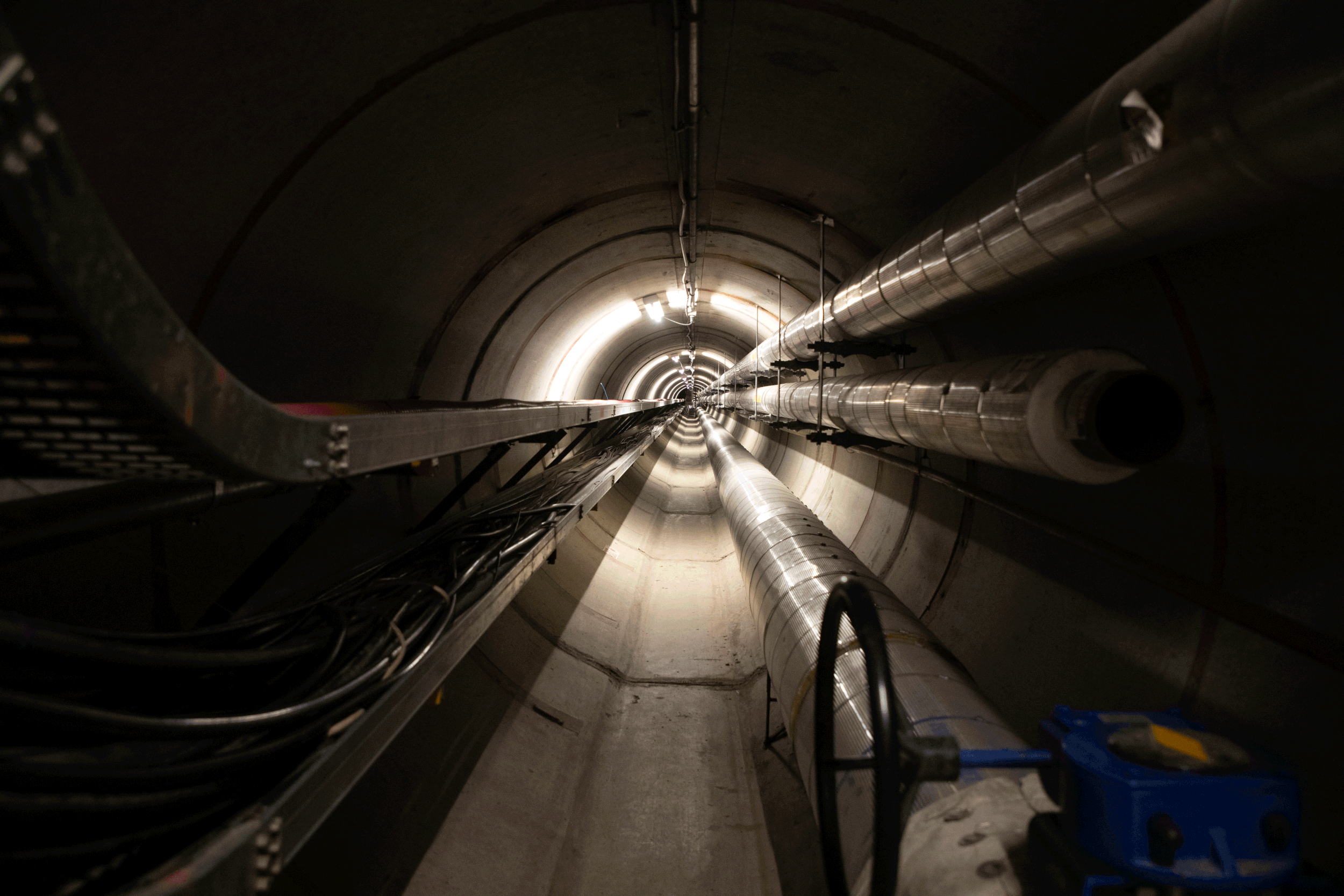
The WWU underground is host to many long pathways, but they are far from uniform in construction. Some might be straight-edged, however, others are cylindrical, much like the steam and ventilation pipes they’re built around. According to John Kingsford-Smith, the air pumps for these tunnels were not designed to filter out radioactive material, which may have complicated their effectiveness as a nuclear evacuation site in the long term.