
Changing attitudes toward what makes the perfect smile
Story by Allie Van Parys
Illustrations by Grace Matson
Published October 3, 2025
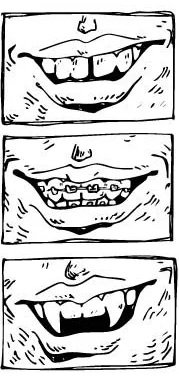
I was born missing four of my permanent teeth. In middle school, my four baby teeth were pulled and I got braces to keep the spaces open for future tooth implants. The dentist and orthodontist both said that if I didn’t get these gaps fixed, my mouth would degrade and my other teeth would sink into my jaw. I didn’t understand, but it scared me.
As any stubborn eighth-grader would, I neglected to wear my retainer after I got my braces off; I always thought I could worry about it later.
A dental hygienist asked me after my freshman year of college, “So when are you getting braces?”
My heart sank. I had braces. Twice.
The dental hygienist loomed over me like a storm cloud blocking the sun, waiting for my answer. There was no later — I had to worry about it now.
I have braces for a third time and I will not be getting them off until I am 21 years old. While my teeth are straight, the braces are pushing my existing teeth together to close the gaps. Accepting this was tough. How many adults do you see with braces?
I feel like I am stuck in an awkward middle point of maturity. I am constantly worried that people notice my teeth, simply because less people my age have braces. I associate the memory of having braces with adolescence, along with the insecurity and self-doubt that came with it. Wearing them now, as an adult, feels like I am dragging that feeling into a point of my life that is supposed to feel put-together.

According to Motivation, Perception and Behavior of the Adult Orthodontic Patient: A Survey Analysis, around 28% of people who have braces are adults. This is a high number, but many of these patients opt for Invisalign or similar “invisible” braces. My experience did not allow for this type of orthodontic treatment because of how intensely my teeth had to be moved. I felt out of control. I had to have metal in my mouth.
Fitting into the criteria of a “perfect smile” is a game of luck. The journey to straight, white teeth is expensive and time-consuming. It is the standard in America.
Anijah Polo, a third-year student at Western Washington University, discussed the setbacks she faced to get a smile she felt confident in.
“You know what you have in common with Dracula?” said a high school classmate. “People also run and hide when they see your teeth.”
Polo’s teeth grew in twisted, some behind others, with her front teeth at different angles. Her smile was not only cosmetically “imperfect,” but also caused physical pain. At night, her teeth would grind together and it was difficult to eat.
Braces, for Polo, were deemed a medical necessity by the board of orthodontics in the state of Washington. Her teeth hindered needed actions like chewing, which led to the decision to have her braces covered by state insurance rather than relying on her own insurance.
“Any of the dentists that have really good reviews in Bellingham do not take my insurance,” Polo said.
Polo’s difficulty in getting braces forced her to have them through late high school and into college. This made things difficult, as she had to travel from Bellingham to Fredrickson-Graham, close to Tacoma, every month when her braces needed adjustment.
I have to get my braces adjusted each month at my orthodontist in Renton, and, of course, the office is only open on weekdays. The inside of my cheek is always shredded and on top of that, I have to drive two hours just for them to hurt more? I also have an underlying insecurity that my braces make me look 14 again, just without the infinity scarves and acne.
Polo noted that noticing imperfections in other people’s teeth helped her feel confident with hers. I also feel connected to other adults with braces. There is a level of understanding that helps boost my confidence.
Vivian Huynh, the owner of Karuna Gem, a tooth gem and teeth whitening business based in Gig Harbor, Washington, noticed a shift in perception toward the typical standard for a smile. Popular opinions of tooth gems suggest they are an opportunity to enhance natural smiles with a little bling and add personality to an otherwise non-customizable feature.
Seeing how others customize their teeth, like with tooth gems, helps me see my braces in a new light. Teeth are constantly on my mind, which helps me notice when people have added charm to theirs.
“While the desire for a traditional white, straight smile is still valid and often tied to health and confidence, I believe we’re moving into a future that is far less uniform,” Huynh said. “More and more, people are expressing themselves through personal touches like fashion, piercings, tattoos and tooth gems — anything that makes them feel wholeheartedly them.”
While that “picture-perfect” smile has been marketed as the standard, the beauty lying in individuality and self-expression through teeth has diminished, Huynh added.
The rise in tooth gem popularity has helped me learn to love my braces, despite originally being insecure about them. The silver color of braces complements my silver jewelry and makes my smile stand out. Seeing how tooth standards are changing to allow for more individuality inspires me to be creative when I get them off. Tooth gems may be in my future.
It took a year of having my braces to see them fit into my face. Now, I can’t imagine what my teeth looked like without them. Seeing my braces go will be bittersweet — my teeth will fit into the standard again, but I’ll lose that glint of individuality.