
A young antique collector uncovers the city's past from local beaches to antique shops
Story by Natalie Jones
Photos by Natalie Jones and Miranda Grogger
Illustrations by Grace Matson
Published October 3, 2025
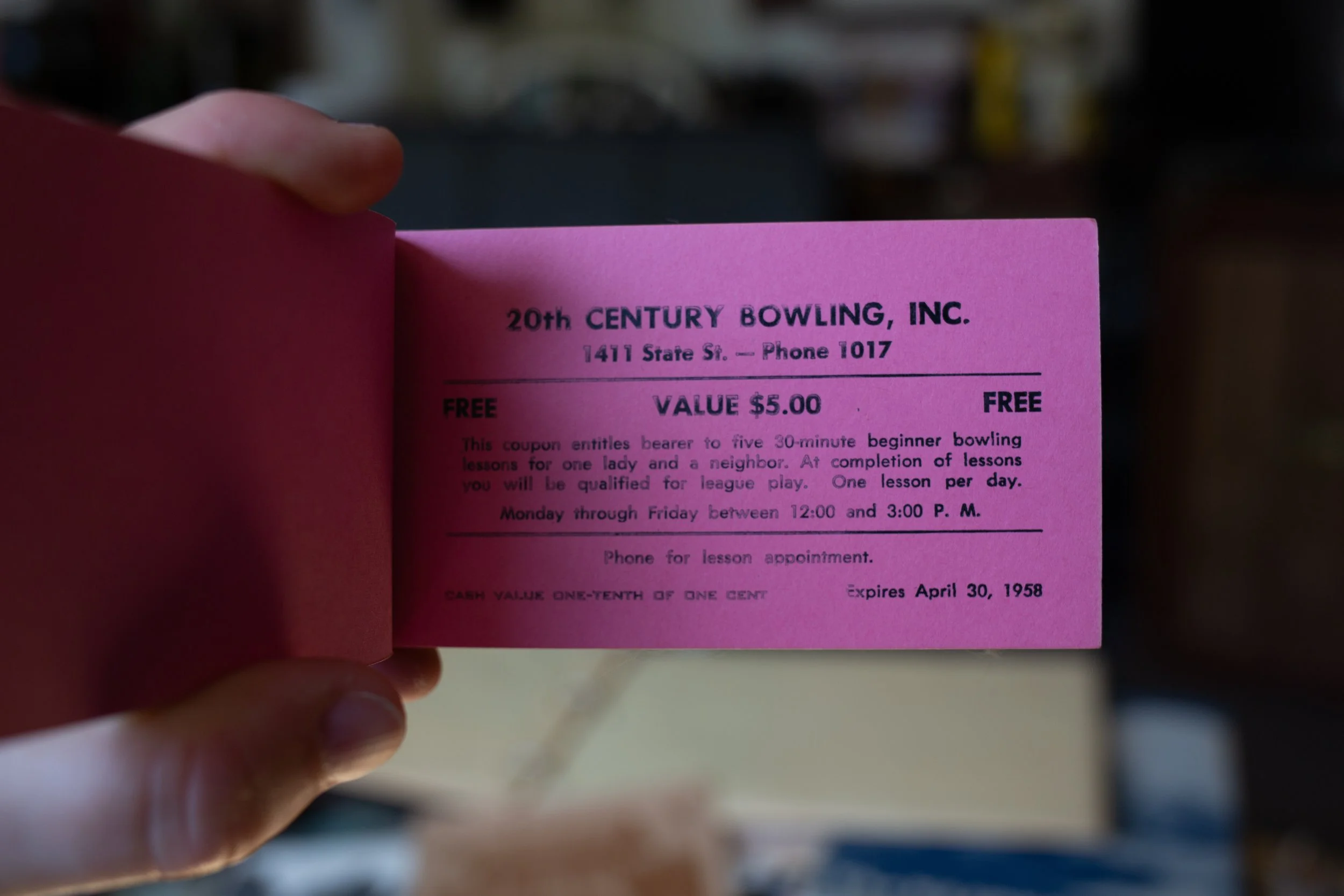
A magenta coupon for 20th Century Bowling on State Street in Bellingham, Wash. offers five beginner bowling lessons for “one lady and a neighbor”. The offer was only valid from 12 to 3 p.m. on weekdays, and expired April 30, 1958.
Afternoon sunlight spills across a wicker coffee table cluttered with vintage matchbooks and faded photographs. “Where is it?” comes a mutter, followed by hands rifling through the yellowed pages and timeworn artifacts, each touched by the warm glow pouring through the adjacent window.
With a look of relief and a humble smile creeping onto their face, Jesse Dooghan, a young collector and amateur historian, emerges with a small, worn leather book. It’s stamped with the gold logo of the Bellingham National Bank and dated from 1916. “Here it is,” they say.
Dooghan has long, dark brown hair and bangs, with symmetrical silver facial piercings and tattoos spreading down to their fingers. They’re wearing a plain white top with a doily they sewed as sleeves over the shoulders.
The black, pocket-sized banking book is one of their favorite finds. Its aged pages are dense with information in a tightly spaced serif font, from interest calculation charts to a list of proverbs. Reminders and budget records litter the pages in flowing cursive script from the original owner. Their hat, glove size and other identifying information are listed on the first page in case the book is lost.. Many banks used to give out these books for customers to access general banking advice and to record their withdrawals and deposits.
Dooghan found the book at Aladdin’s Antiques and Records, located in the basement of Penny Lane Antique Mall on Holly Street in Bellingham. Sam Boroughs, a Penny Lane employee and a friend of Dooghan, once set aside a Bellingham coupon book from 1958 for them.
After knowing Dooghan for a couple of years, Boroughs has learned what types of items they’re interested in and set aside other items, like antique belt buckles. “I do that for a lot of customers. When I get to know their taste and see things that I know they’ll like, I'll reach out to them to see if they’re interested,” Boroughs said. He and Dooghan have a similar interest in local history artifacts, which makes knowing what they would pick very easy.
“I like getting historical gifts from people when they know that I'm into it,” Dooghan said. “Now I get all kinds of things, which is super cool.”
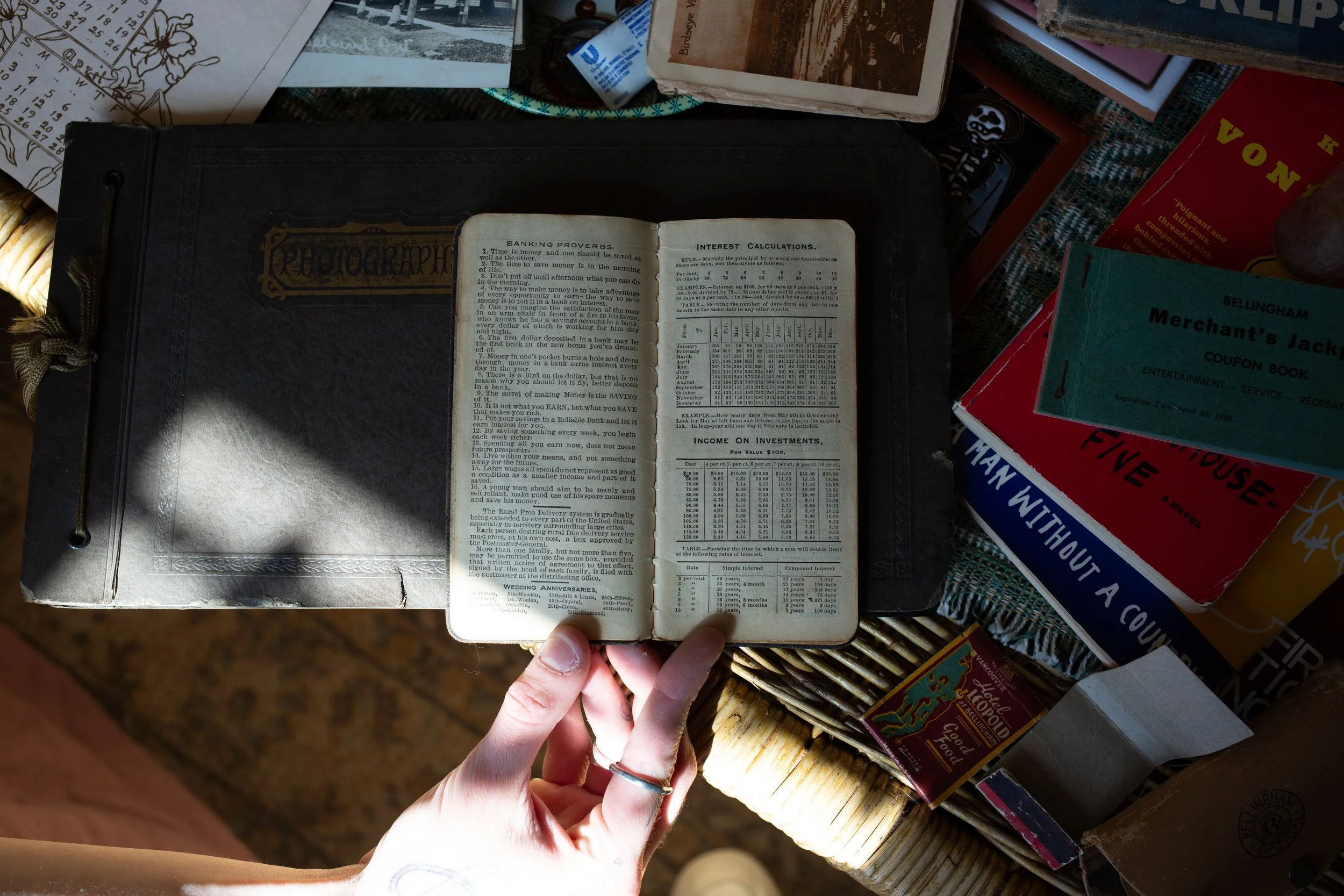
Jesse Dooghan holds open the pages of a Bellingham National Bank book from 1916 in their Bellingham, Wash. home on April 22, 2025. The aged pages contain tables for calculating interest on investments and a list of banking proverbs.
Now 23 years old, Dooghan’s collecting habits started when they were young. Their mom opened an eBay shop the year they were born. She started them out by helping them collect Garfield and Smurf keepsakes, which they still have in boxes in their basement. “My mom ingrained it in me pretty young to collect things,” Dooghan said. “Makes life a bit of a treasure hunt, which I like.”
Last year, Dooghan started an Instagram account, @grandocurrence, where they posted photos from online archives and the Western Washington University Library archives. The account is named as a reference to the old Grand Theater in Bellingham, which was open from 1905 to 1970. A few months into starting the account, Dooghan began to post their own artifacts they’d found digging around at beaches and local estate or thrift shops.
Dooghan said that finding items by chance at beaches in Bellingham feels special. They treasure the experience of uncovering an object that could have washed up at any time. They have found items like old glass medicine bottles and miscellaneous papers with the names of well-known Bellingham locations, like York Street. “That was really exciting for me,” Dooghan said. “I felt like an archeologist.”
Boroughs has noticed an uptick in younger people coming to Penny Lane looking for bits and bobs of local history in the four years he’s worked there. “Up until the last couple years, it was usually just older guys looking for newspapers,” Boroughs said. He attributes this trend to Generation Z growing up with streaming services, leaving them to yearn for the permanence of physical media, like records and VHS tapes. Dooghan’s Instagram account is one way they connect with younger audiences who can intentionally appreciate their curation of Bellingham and Washington ephemera.
Penny Pinchers Estate Clearance is another Bellingham venue Dooghan frequents. The shop manages estate sales by buying and selling antiques for families. Personal memorabilia from homes in town are condensed into one place, resulting in a gold mine for Dooghan.
At Penny Pinchers and Aladdin’s, Dooghan takes the time to dig through each section. The sounds of lapel pins clanking and papers rustling fill the air. They hunch down on the carpeted floor and leaf through stacks of old photos, advertising pamphlets and other faded trinkets to find something that catches their eye. “There’s just so many different mediums. It’s almost like unlocking a new part of the thrift store,” Dooghan said.
Old film prints are sometimes stamped with the location and date they were developed, which makes sorting through them easier. The Clyde Banks Photo Service was one of the primary film developers in Bellingham in the mid-1900s, and their stamp shows up frequently on Dooghan’s finds.
The cluttered and curated display cases in the thrift stores Dooghan visits are off-limits for them, because it’s less of a genuine find. “It feels like cheating. I know it’s there if I really need it, but I need to find it myself,” they said. And sometimes they already have the same item in their collection.
Dooghan stores most of their paper and photo items in big plastic bins under their bed. They also display small objects and wall art in their bedroom and living room, adding to their eclectic, maximalist decor. Their approach to preservation is simple.
“Honestly, I figured if they lasted this long, then if I keep them in the same conditions, they'll continue to last,” Dooghan said. They don’t fret over creasing the spine of a booklet or handling photos with their bare hands.
Jeff Jewell, photo archivist at the Whatcom Museum, recommends a more protective approach for preserving paper ephemera. He shared that official archival-grade preservation plastics have marked-up prices, when more accessible and affordable items work just as well. Jewell recommends using photo albums, mylar plastic sleeves or food-grade plastic like a Ziploc bag to store items. Old advertisements and pamphlets were typically made from thin, lower-quality paper. “We can preserve these things by keeping fingerprints off of them, dust, light—all things that damage papers over time,” Jewell said.
Dooghan’s methods are more relaxed because they aren’t as focused on preservation. They believe antique items are meant to be experienced and touched, and their imperfections are a reflection of how many hands an item may have passed through in its lifetime.
Sharing is an important and meaningful part of collecting, Boroughs said. He likes to talk about his items and is curious to learn about what other collectors have. “It’s cool to see people who are actually really interested in keeping these things and preserving and displaying them,” he said. “It's a very gratifying exchange—being able to show off cool things to other people and vice versa.”
In the pursuit of sharing their collection, Dooghan aims to start a lending library of sorts. They hand-carved a prototype rubber stamp resembling a library book checkout card, with a space for name, date and source of each item. “I didn’t want to rely on a printer, I wanted to do something using my hands,” Dooghan said.
Dooghan said they would consider offering delivery or pickup from their home to interested patrons. For them, it’s about meeting people’s needs so local history is more accessible. “That’s the point of a library, it’s for everyone.”
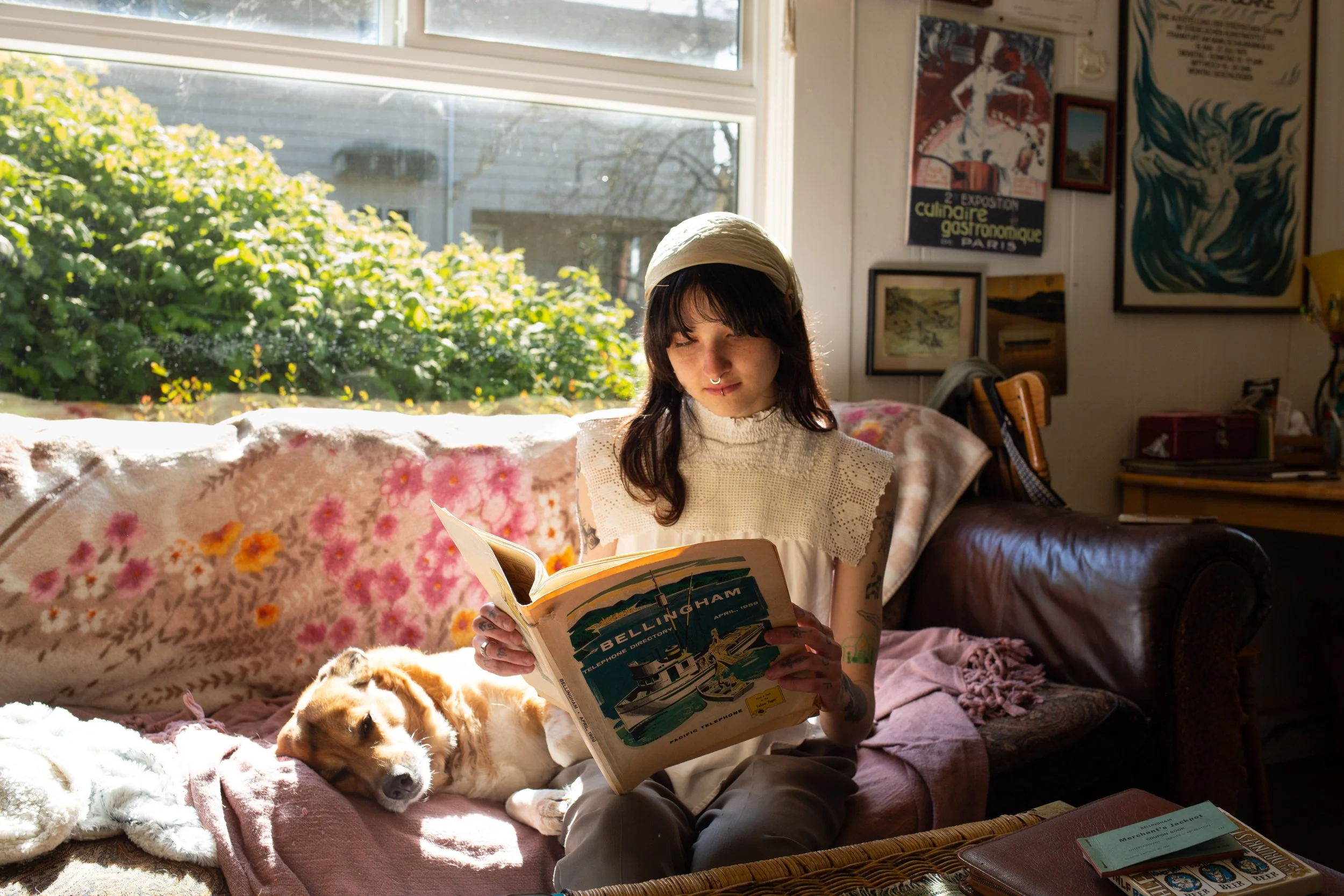
Jesse Dooghan flips through a Bellingham telephone directory from 1959 in their Bellingham, Wash. home on April 22, 2025. Their dog, Ruthie, lies sleepily next to them on the sun-drenched couch.