
Dive into the world of sustainable foraging
Story and photos by Jase Picanso
Published October 3, 2025
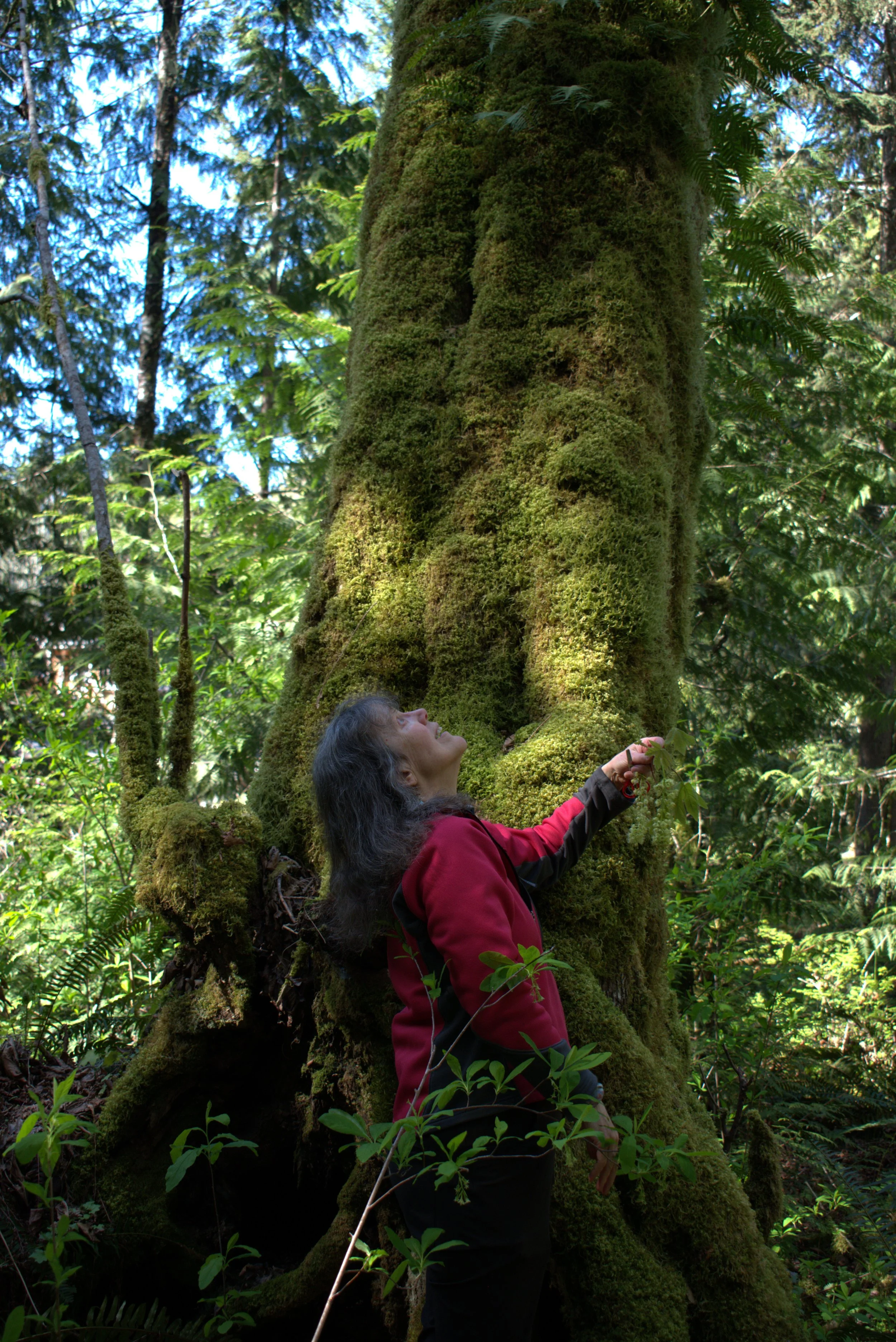
Jennifer Hahn looks up towards the top of a maple tree, as she holds one of its fallen maple blossoms on April 17, 2025.
Just down the stream from Lake Padden, I find myself in the dead of the woods. A gray-haired woman is ahead of me, wicker basket in hand, guiding me carefully across the forest floor.
"Watch where you step!" she warns.
The damp dirt below is sprinkled with dozens of bigleaf maple sprouts that we attempt to carefully tiptoe around.
“The wildlife around here eats these,” she explains, quickly answering my unvoiced curiosity.
For the next three hours or so, I walked alongside Jennifer Hahn — author of Pacific Harvest: A Northwest Coast Foraging Guide and former editor-in-chief of Klipsun Magazine’s Volume 14, Issue 4, published in 1984.
Wild food surrounded us, from the dandelions underfoot to the pine needles overhead. Hahn explained these foods can be served up and enjoyed, raw or cooked.
Throughout our walk, Hahn emphasized the importance of sustainable foraging, a value deeply rooted in her practice. In her foraging guidebook, she acknowledges that the land she forages on in the Chuckanut Mountains of Washington is the ancestral and traditional territory of the Noxwsʼáʔaq (Nooksack) and Lhaq'temish (Lummi) peoples.
Indigenous lifeways have profoundly shaped what is now commonly known as the “wild foods of the Pacific Northwest Coast.” This knowledge, passed down over generations, has endured despite waves of assault on the families, cultures, and homelands of the Native peoples whose space we now occupy, Hahn writes.
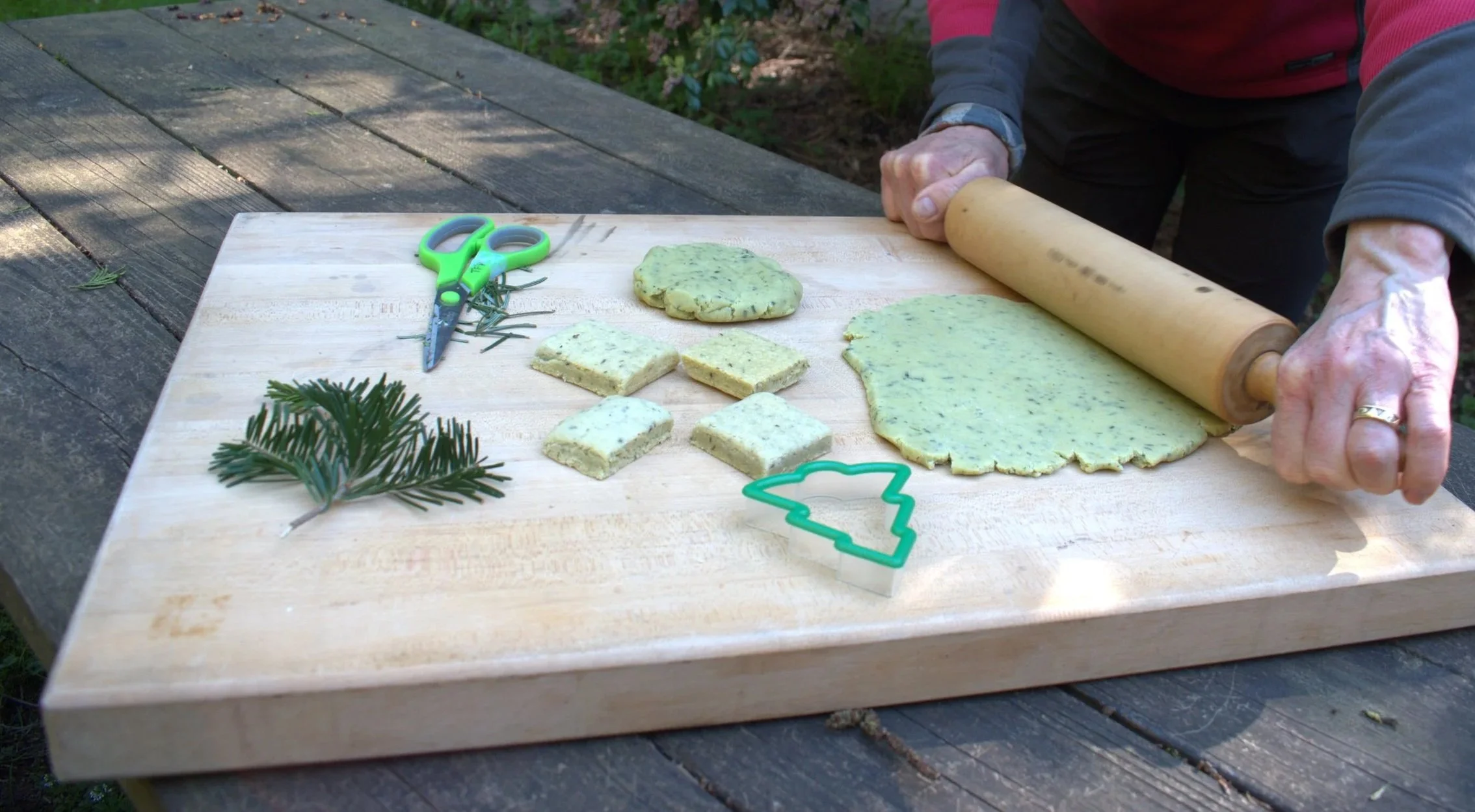
Jennifer Hahn snips off pine needles of a grand fir branch into her hand, to prepare it for a wild food recipe on April 17, 2025.
Early on in the tour, we stop to chat about the lady fern fiddleheads that live along a stream within the forest. It is there that she shares with me recipes from her book. Some were developed through her own kitchen experiments, others contributed by teachers, chefs, herbalists: people who seek to connect the forest to your plate. She reminds me that nature has long been occupied by creatures and traditions that rely on these delicacies and their preservation.
The very trail we walk, just outside of Hahn’s house, hosts the stream that flows through Lake Padden and eventually finds its way back to the ocean.
“Everything is so connected here on the land that I live, to the bigger ocean that's connected to every continent and that's a profound thing: to live in a place like that and keep that awareness,” said Hahn, as we admired the gentle rippling of the water that she made sure not to step in and disrupt.
The following are some of the foods I learned about on this excursion, as well as some culinary tips from Hahn.
Lady Fern Fiddleheads
"Just like asparagus, it has a crisp snap," said Hahn as she easily harvested a fiddlehead from the demure sprout of a lady fern, which is harvestable in the spring.
Lady fern can be found along stream banks like the one Hahn and I stood beside, or in the deep shade of moist woods and shaded seeps along the Northwest Coast.
After harvesting, Hahn rubbed off the spiky bits that covered the frond — which, she explained, are edible but can be a texture issue for some.
You prepare them much like garden asparagus, and according to Hahn, they can be even more delightful, poached, pan-fried in butter or dipped in fondue or tempura batter. The key is to make sure they’re fully cooked.
Lady fern contains a chemical called thiaminase, which depletes the body of vitamin B. Heating deactivates the compound, so it’s important never to eat fiddleheads raw.
Hahn recommends blanching them to neutralize the chemical, then plunging them into cold water to stop the cooking process. After that, she suggests marinating them with ingredients like sherry vinegar, honey, shallots, fresh mint and a few petals of salmonberry, either as a relish or a flavorful side.
Hahn shared a story she’d heard from friends in the Cascade foothills, where harvesters had been collecting every last fiddlehead to sell at Pike Place Market — a clear case of overharvesting.
“With the weather changes and the droughts, the lady ferns are growing smaller fronds, they’re not as big as they were a couple of years ago,” said Hahn.
That makes harvesting these fronds sustainably more important than ever. No more than a third of the fonds should be harvested in any given plant, every other year, to prevent the rootstalk from depleting.
Native Wood Sorrel
Within the forest, we made frequent stops to examine plants I wouldn’t have given a second glance to on my own. Native wood sorrel, however, had a mystical appearance in its clover-shaped leaves as if there were a real chance of finding a four-leaf clover among its clusters.
Hahn placed her basket on the forest brush before slipping on a pair of safety gloves and pulling out a small pair of red scissors. She carefully grabbed one of the delicate leaves and snipped it.
“Here, try this,” she said, handing it to me.
I looked at the leaf with uncertainty before taking a cautious bite. To my surprise, it tasted exactly like lemon zest.
Spring is its prime picking season, but it continues to grow throughout the summer, mostly in clusters within the rainforest understory. To harvest, one simply snips the leaves and stems just above the ground, the stems are tasty too. According to Hahn’s book, they can be stored in a rigid container wrapped in a damp cloth and kept in the refrigerator.
Sorrel can be eaten raw, on a sandwich, in a leafy green salad with apples and candied pecans, or used in warm dishes like Thai coconut soups or simple sorrel soup, a traditional spring tonic in Old European cooking. This is just one of the many recipes Hahn shares in her book.
Of all the plants she had me try raw on the outing, the sorrel was my personal favorite, and I certainly wouldn’t have minded eating more of it.
Grand Fir
Hahn sent me home with a container of freshly baked, pine tree–shaped Grand Fir sugar cookies, surprising me with the fact that you can bake what looks like, and most certainly is, pine needles into a cookie. The lemony cookies tasted much like other herb-based sweets; rosemary cookies come to mind for comparison. Grand Fir has a citrusy, woody flavor when the needles are mature, and the more needles you use, the stronger the flavor becomes.
For a tea rich in vitamin C, Hahn recommends pouring eight ounces of boiling water over two teaspoons of dried needles. The fir tea can even be mixed into a Grand Fir sorbet for a seasonal treat during the colder months. But that’s not to say you can’t cook with the needles, too.
Pulverized fresh needles can be added to shortbread cookies or homemade crackers, similar to the cookies Hahn asks me to help roll out.
Hahn places a cutting board with a matching rolling pin onto the picnic bench that sits just outside her home. The lush scenery of the surrounding forest, the same one she takes her foraging students into, frames the house. Hahn teaches a wild food ecology class at Western Washington University through Fairhaven College.
“We go out and we forage, and we also make these love dishes, but we study a lot of scientific papers. We look at what's happening in the world in terms of how these plants and animals are affected by climate change, drought, marine heat waves, invasive species — there's all these things they have to deal with. And in the last 15 years, it just seems to have amplified,” said Hahn.
She hands me a rolling pin, and even in dough form, the pine aroma of the cookies is already apparent. The recipe is one shared by Hahn’s friend Elizabeth Campbell — an ethnobotanist, herbalist and educator of native and traditional plants who is a member of the Spokane Tribe.
The pine from these evergreen trees has been used in both food and medicine by Indigenous peoples for thousands of years. Not only are they mineral-rich, but also high in vitamin C.
Hahn paired the cookies with herbal tea made from native plants she had foraged during our outing.
“When you are a forager and you love animals and plants, it makes you think: How can I forage for a future, and what is it I need to be aware of to forage in a way that caretakes the things that take care of me?” said Hahn.
Local food can transport you to a sense of place — and whether you’re a novice or experienced forager, you can find anything from wild mushrooms, berries, flowers and leaves to seaweed and shellfish. Eating wild food can help you gain a new appreciation for the nature that both surrounds and nourishes us.
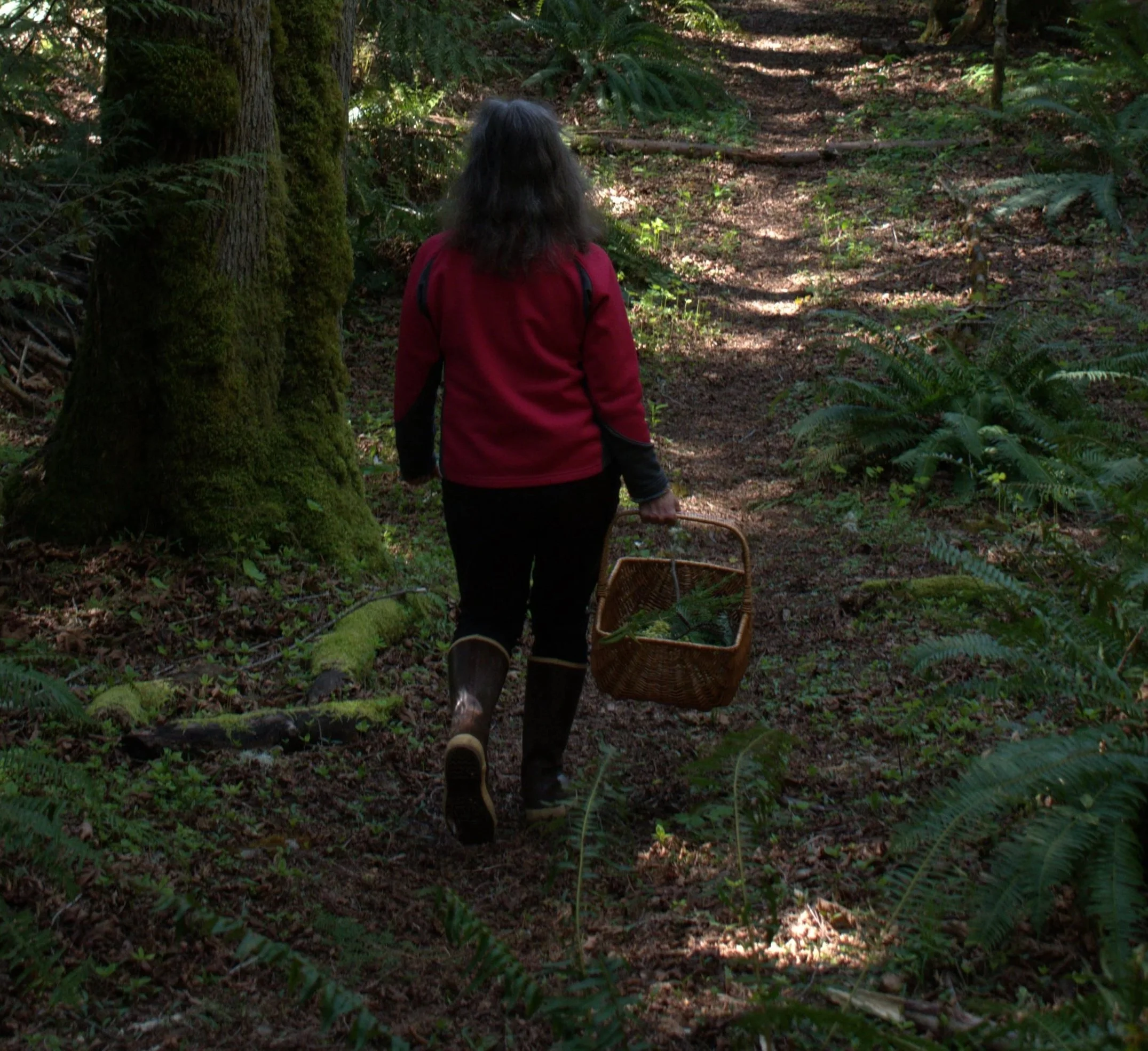
Jennifer Hahn walks through the forest along Lake Padden while carrying a basket filled with foraged plants on April 17, 2025.