
Exploring how stalking impacts college students
Story by Allie Van Parys
Illustration by Grace Matson
Published October 3, 2025
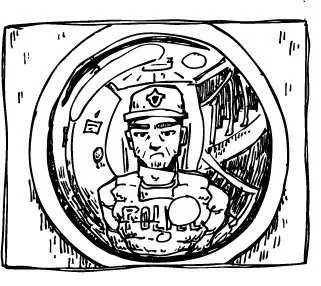
“Oh that’s ironic,” said a Western Washington University campus police officer. “The sign on your door.”
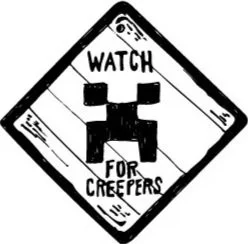
An image of a Minecraft creeper hung on my door with the caption “watch for creepers.” All day, every day, I watched for literal creepers — obsessively checking that my blinds were closed and peeking over my shoulder when I walked outside. Instead of hearing the hissss of a Minecraft creeper, I heard “Where are your favorite spots to study?” and “Where do you work?”
In September 2024, shortly after moving into my sophomore-year dorm, I was stalked.
It started with a compliment. I told him I liked his pants and ended up getting his Instagram. Harmless enough. I was hoping to make new friends. Within a few days, conversations quickly shifted. I felt trapped in a dynamic of what started as a casual acquaintance and turned into a constant conversation with him. He responded to every Instagram story I posted. Always with a question. Always something to keep the conversation going. The messages began to pile up. It felt off, like he noticed everything I did.
Like me, Aeryn Gonzales’ experience escalated online. During their first year at Western Gonzales was berated with insults on social media. To block this person wasn’t enough. They always found Gonzales and began the cycle again. A large number of stalking victims, up to 80%, are stalked through technology, according to the Stalking Prevention, Awareness and Resource Center.
“They would message me, saying ‘You’re a skank,’ and ‘You’re a whore,’ just trying to make me feel bad about myself,” Gonzales said. Perpetrators can keep a level of anonymity behind a screen, Gonzales explained. This is true for many who are stalked online.
Hannah Sullivan, name changed to protect privacy, explained that social media can create a level of parasocial relationship between the stalker and their victim. “They think they’re building a bond, even though it’s on one side.”
Over winter break, Sullivan went out to dinner in her hometown with someone from a dating app. It started with a strange vibe — the date was long, too long. Sullivan couldn’t quite find the right way to end it, even after agreeing to drive him home.
“I love you,” the man said to Sullivan when they reached his house.
Sullivan immediately stiffened and tried harder to get him out of the car. Before leaving, the man said “I love you,” again, solidifying the discomfort that filled the car.
Immediately after he slammed the door shut, Sullivan raced home. As she pulled into her driveway, she noticed an AirPod case sitting on the passenger seat and froze. The earbuds weren't hers. Apple designed a feature where AirPods can be tracked. Perfect for if you lose them, but not if they were left in your car after an intensely uncomfortable first date.
Sullivan barreled through her neighborhood, throwing the AirPods out of her car on the other side. “Once I’m back in Bellingham, this whole thing is over,” Sullivan said to herself after blocking his phone number.
Unfortunately, it wasn’t over. He found Sullivan’s Instagram, despite never giving it to him or disclosing her last name. After that, she received repeated calls from a random Seattle number, which she anxiously ignored.
When Sullivan finally returned to Bellingham, she was leaving class as she spotted a figure that seemed familiar. “They had a hat and a mask on, so I didn’t think anything of it,” Sullivan said. “Why on Earth would it be that guy?”
“Just tell me why. I want you to tell me why,” the man said as he walked uncomfortably close behind Sullivan. It was him.
After that, Sullivan was left alone to her spiraling thoughts and paranoia. Stalking has a distinct trait of feeding on the victim’s lack of knowledge of what may happen next.
Confiding in her friends helped Sullivan heal from this situation, but not without noticing how differently they reacted when she told the story.
“Why would you be on Hinge in the first place?” Sullivan’s male friend said, blaming her for this situation. Explanations of why this circumstance was scary seemed to fall flat with her male friends, while her female friends reacted with acute empathy, sharing their own similar experiences.
“I look back on some things and it was just so naive of me,” Sullivan said. “I just wanted to be nice and drive him home.”
Stalking is a form of domestic violence often met with belittlement. This can be both by the listeners of the event and the survivors. Downplaying what happened seemed easier than acknowledging that the situation we were in was truly dangerous, Sullivan explained.
Marjie George, the Whatcom Domestic Violence and Sexual Assault Services (DVSAS) development director, said her best advice is to take anything that seems off seriously. “The inclination is to minimize it, because it doesn’t feel like ‘real’ violence,” George said. “It can really impact a person’s quality of life and can easily lead to escalated violence.”
Anna Smith, name changed to protect privacy, commented on her experience with feeling pressured to cater to her stalker’s emotions. It began with the intent of friendship, just like mine. He had problems making friends. It was a small town, which led to cliques and social isolation. Everyone knew everyone, Smith said, so she felt guilty distancing herself — even when clear boundaries were crossed.
“He had expressed some pretty intense ownership of my time,” Smith said. He would appear at her house unannounced and did not give her space. Even though she socially pulled away and evidently rejected him, he didn’t listen.
“I remember being out with some friends and my parents had texted that he’d come back,” Smith said as she recalled her feelings of hopelessness and being out of control. He wouldn’t leave her alone. “I just started crying.”
Smith shared that keeping yourself safe overrules hurting someone’s feelings. “I had a hard time letting him down because I was the one that encouraged us to become closer,” Smith expressed. If she left now, she knew his mental health would suffer. This pressure, as women, is beaten into us at a young age. Being polite, bending over backward to accommodate men's unsettling behavior, even if our intuition tells us otherwise.
I had a hard time believing that I was being stalked. The phrase felt too strong and I felt bad applying it to what was happening to me.
“Women are taught from an early age to be polite, even if it goes against human instinct,” the campus police officer said. “You can tell him to go away – you can tell him to fuck off,” he said, staring into my eyes to make sure it drove deep.
I wiped my sweaty hands on the back of my pajama pants as I recalled the situation to the police officer. A few short hours before, he was right behind me with his camera on the porch my neighbor and I share. His excuse was to ask if we had seen an enamel pin he lost, but something didn’t add up about his story. My gut screamed that something was wrong as a familiar panic reminded me of previous situations when a man shattered my sense of safety. Despite my rejecting his request to sit and take photos on the porch, he asked my neighbors and got the approval he was searching for.
I paced back and forth in front of the peephole until he left, but that wasn’t where the night ended. The moment I thought I was in the clear, I saw a figure moving outside my window in the pouring rain. It was midnight at this point and my roommate and I couldn’t take it anymore.
He was outside my window, peering in, but I still had reservations. It didn’t feel that serious. How would I have proof if I called someone? Would anyone be able to help? I really didn’t want to call the police — I hate confrontation — but other options wouldn’t shake my unease.
The police arrived and it was a spectacle. My roommate and neighbors peered out, trying to catch a glimpse of him getting a talking-to. We craned our necks to see the bench he lurked on. It was shrouded in the iconic Ridgeway evergreen branches, but the man’s reflective “police” lettering on his vest was unmistakable.
“It’s always better to make a big deal about something than not enough of a deal,” George said. Although I barely saw him after that night, he was scared straight by the prospect of gaining a trespassing order. Who knows what may have happened if I let being polite overrule my gut. Sometimes survival depends on the courage to be impolite.
Sidebar
Title: How to take control of your safety
Information provided by Marjie George, Whatcom DVSAS development director
Trust your gut. Your brain is trying to tell you something and you should listen.
The greatest misconception is that stalking always looks a certain way. It can come in many forms.
Document everything and take specific note of time and date stamps of when each event happened. Clarity on exactly what happened benefits reporting the issue.
Filling out an anti-harassment protection order in the state of Washington is accessible through DVSAS, including advocates that can walk you through every step and offer support during court hearings.
Healing is different for everybody. Reclaim the part of yourself that gets robbed when you are put in the position of stalking. Many find help through therapy or support groups, while others benefit from conversations with a close friend.
To get immediate help, call DVSAS toll free, 24/7 helpline 1.877.715.1563.