
Bridging the decades between the early Jordan era to digital drops, the passion for sneakers unites generations
Story and photos by Sean Lynch
Published October 3, 2025
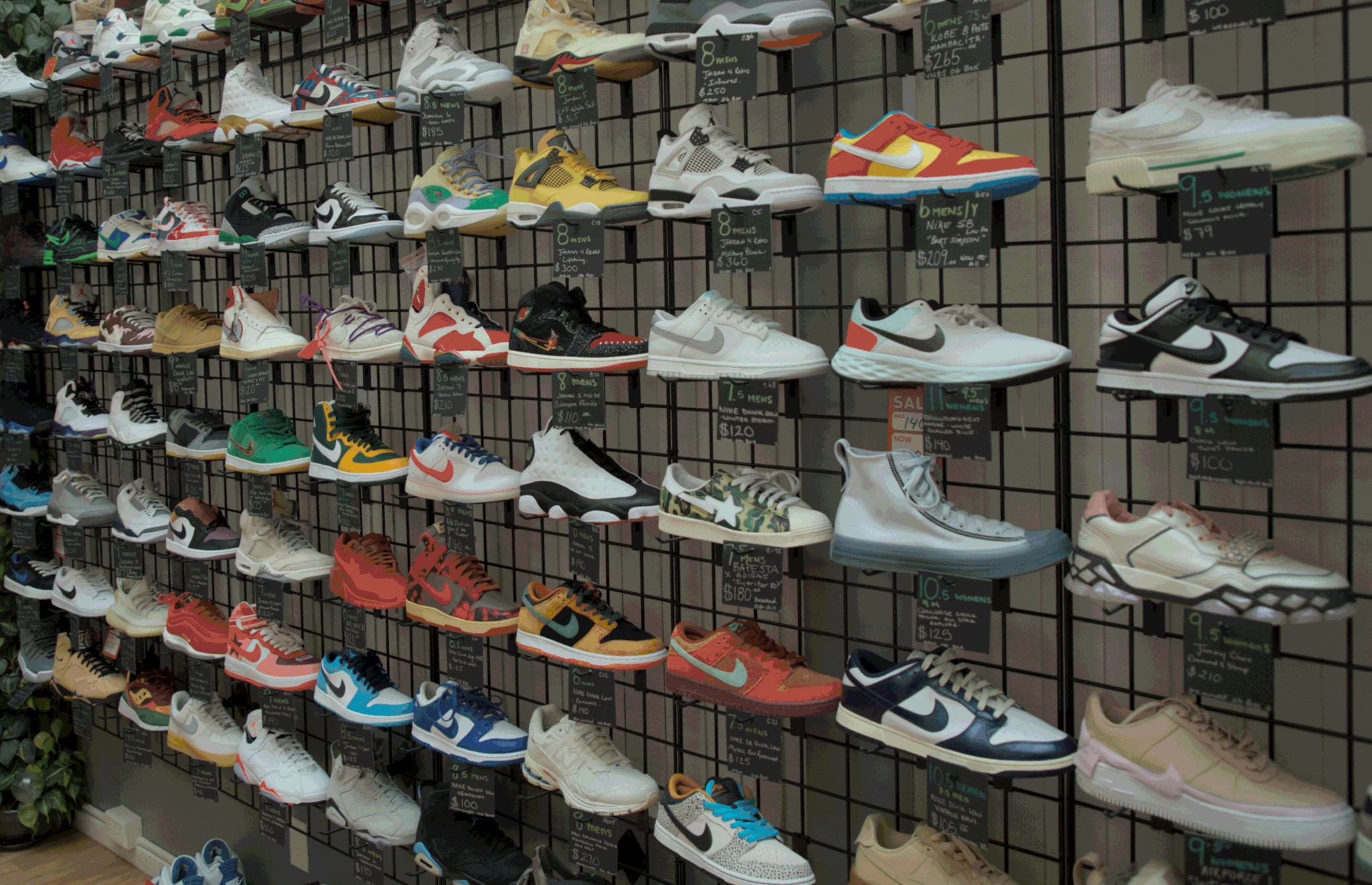
While Nike Dunks and Air Jordans largely line ReLaced’s walls, a closer look reveals unique finds like the camo Bapesta x Adidas “Superstar 80s” and the Icecream x Reebok Question Low.
In a brick-laden multi-business complex in the heart of downtown Bellingham, a dark hallway gives way to an explosion of color — and hype. Air Jordans, Nike Dunks and Air Force Ones, along with other sneakerhead essentials, flood the walls of ReLaced, an independent sneaker store run by husband and wife Jesse and Lidija Reading.
While Lidija laces up a sneaker, Jesse, standing confidently in a pair of crisp Travis Scott x Air Jordan 4s (originally released at $225, now fetching $1500 on the resale market), tells me he’s not wearing them for my viewing, or anyone else's.
“If I go out there and people see these on my feet, they assume I'm wearing them for the world,” Jesse said. “I think a lot of real sneakerheads do it for themselves — they do it because they love shoes, and I think a lot of people don’t quite see it that way.”
Jesse and Lidija began ReLaced in March 2024 out of that love for shoes. Jesse, an avid Jordan collector, saw a niche for a sneaker store in Bellingham after hearing that the Bellis Fair mall’s Champs Sports — a sports retail chain — had permanently closed. He and Lidija knew, though, that the Bellingham sneaker scene is not a massive market, and that the endeavor wouldn’t be a “big money maker.”
However, they assert that a dedicated community of enthusiasts still exists here. “You could go to the middle of Montana, and you’re gonna find sneakerheads,” Jesse said. “It’s just about how willing they are to come out of the woodwork.”
The term “sneakerheads” describes individuals deeply passionate about sneakers, expressed by collecting, selling, trading and attending sneaker conventions like Sneaker Con, which travels globally and hosts around 20 events per year. For these enthusiasts, sneakers aren’t just something to put on your feet and go about your day, but something to extensively appreciate for their designs, history and cultural significance.
As with any collecting hobby, that dedication can reach extreme levels. The person who owned the largest collection of sneakers in history, almost predestined to do so with the name Jordan Michael Geller, was in 2012 certified by the Guinness World Records for his 2,388 pairs of sneakers. While an anomaly, Geller’s collection mirrors the passion of the broader sneaker community, fueled by the evolution of the athletic shoe into a coveted cultural phenomenon.
According to Jesse, that evolution began in the early ‘80s, inspired by New York City Hip-Hop acts Run DMC and Beastie Boys and their affinity for Adidas sneakers. But it wasn’t until Nike released the Air Jordan 1 in 1985, the same year its namesake Michael Jordan was drafted to the NBA, that a catalyst for modern sneaker culture was born.
“The shoes superseded Jordan. He was obviously amazing, but I think their success was a combo of how well Nike did Nike and how Jordan was their spokesman,” Jesse said. “That was 40 years ago, and Jordans still sell out in 35-40 seconds online when they release.” Millennials, who grew up during the Jordan era, represent the largest portion of sneakerheads, at 39%, according to a 2023 YouGov poll.
Now, even with Jordan long retired, the passion continues to captivate younger generations. Lidija recalled when a 9-year-old boy came into their store with an inquiry for a school talent show. While blindfolded, his mother filmed him while his brother handed him sneakers, and just by feeling the texture and shape of each one, he named as many as he could in 30 seconds.
“They start young — really young,” Lidija said. “They come in here and try to trade us — crappy shoes, but that’s how you know they’re into it.”
Unlike the older generations, these young sneakerheads grew up with easy access to a wealth of information about sneakers through the internet. Social media plays a significant role in this early engagement, with kids now potentially constantly exposed to the latest sneaker drops and trends. This enthusiasm, coupled with the limited availability of the newest, most coveted sneakers, can lead many of them to engage with the online sneaker resale market, which Jesse and Lidija are wary of, especially with the popular online reselling platform StockX.
“They say right now, even with StockX clothing, that 85% of it is fake,” Jesse said. “People go, ‘Well, it has a StockX tag,’ and that used to mean something, but it doesn’t anymore. When you’re making a cut off of a shoe like they are, you get to a point where you’re like ‘How much of my profit am I throwing out the door by fact-checking all these sellers?’ So, they get sloppy.”
While understanding that the online resale market is a “force to be reckoned with,” the ease of buying a sneaker online hasn’t been entirely negative for ReLaced. As a brick-and-mortar store, they offer a crucial element that the internet lacks: the ability to try shoes on in person, guaranteeing a right fit, both in style and comfort, before purchase.
“On some resale platforms, you can't return things. So if people buy shoes online that they can’t try on first, and then they get them and don’t like them or they’re not the right size, we benefit because they then have to come and sell them to us,” Lidija said.
In the world of online shopping, the two also deeply value the in-person connection that the store acts as a hub for. “We like to say we’re the barbershop for sneakers — you can come in here, hang out, play basketball… You don’t have to feel like you have to buy something here,” Jesse said.
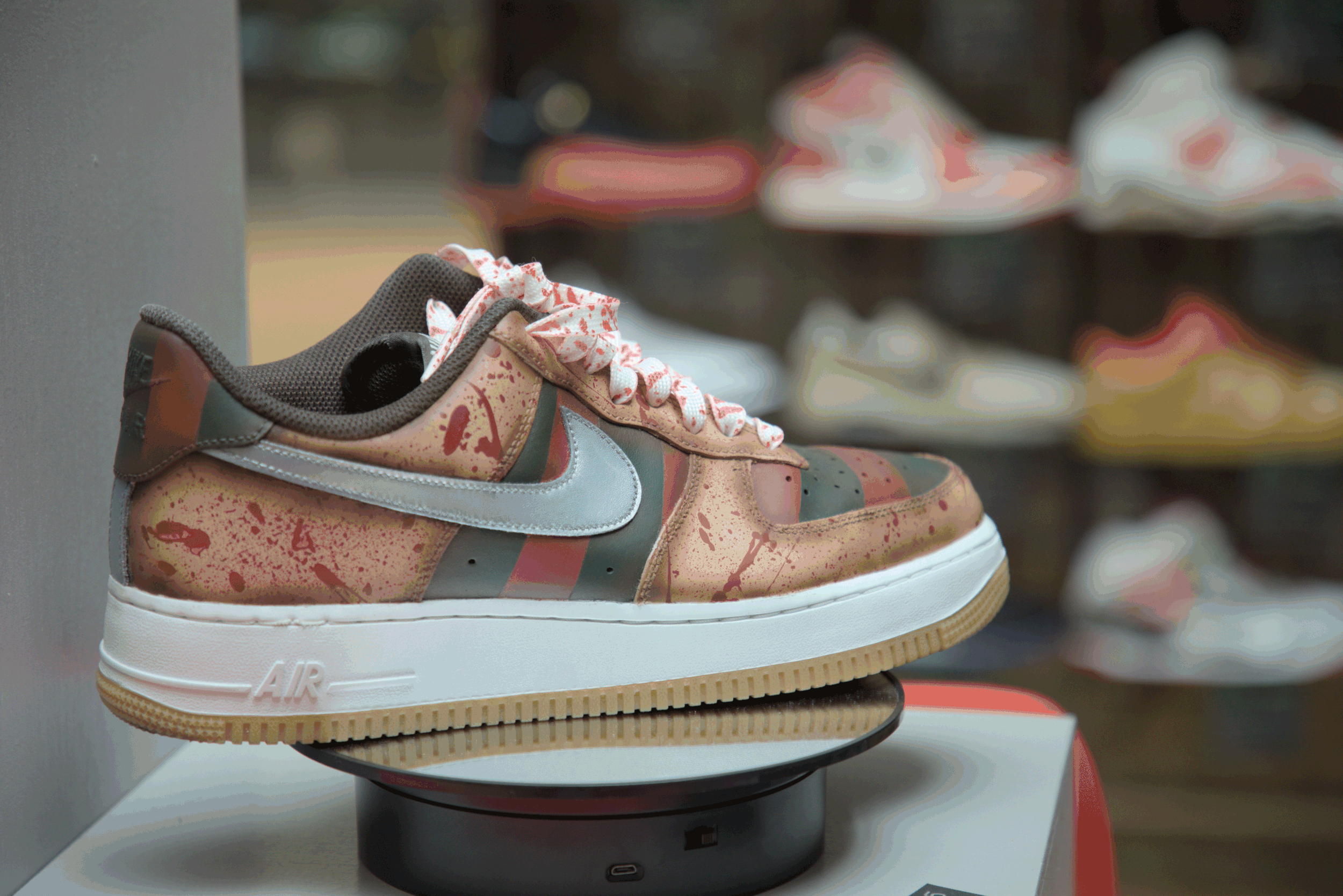
This custom Freddy Krueger-inspired Air Force One is the centerpiece of ReLaced, sitting solo and rotating in the middle of the store. These are not to be confused with the Freddy Krueger Dunks, one of the most infamous and rare sneakers on the market due to their unreleased status and destruction of most pairs due to copyright infringement.
Through the Collector’s Lens
Dubbed as “New York Joey” by Jesse and Lidija due to his NYC roots and demeanor, Joey Ferrer is a regular buyer and trader at ReLaced. A chef in Fairhaven by day, he’s an avid sneaker enthusiast who’s been collecting since his high school days.
It’s a Tuesday afternoon and Ferrer is in his Bellingham home watching an NBA playoff game, New York Knicks vs. Boston Celtics. The air is filled with a distinctive herbal aroma. Beside the TV sit shoe boxes upon shoe boxes in rows of three, each one graced with either the Nike or Air Jordan logo.
Ferrer digs between the stack and pulls out a box. Opening it, he reveals a pair of Jordan 12 “Flu Games,” a black leather sneaker with a red bottom. His eyes are fixed on the shoe as if he’s watching the basketball game just behind it.
“This might be my favorite shoe. They’re called the ‘Flu Games’ because Jordan wore them in the Finals when he had the flu — but really he had food poisoning,” Ferrer says. “To me, they symbolize perseverance and overcoming hardship.”
Ferrer boasts around 50 pairs of sneakers in his collection, with only a few that have yet to touch pavement. He keeps his unworn pairs above his more easily accessible rotation on his towering shoe rack, its summit reaching just a few inches from the ceiling.
“My second job, when I was 17, was at Foot Locker,” Ferrer says. “I was already into sneakers before, but that made me able to afford them — the employee discount helped, too.” Now 44, Ferrer is not too interested in some of the current era sneaker drops, such as the Travis Scott Air Jordan collaboration, which he calls “overrated.” “There’s a lot of nostalgia in my collection — this is my era, this is what I grew up in when basketball turned me on to sneakers,” he says.
For Ferrer, the nostalgia his collection brings him isn't just visual, but also tied to the shoes’ smell and texture. He often invites me to poke my nose into an (unworn) sneaker and take a whiff, and each time I’m hit with a fresh leathery scent that Ferrer says he can’t get enough of.
Feeling a sneaker’s texture, Ferrer proclaims, is not just a satisfying pursuit, but incredibly important in distinguishing between original pairs and replicas. “Instead of reading or watching videos about replicas, I bought them for the sole experience of studying them. It got to the point where I was paying damn near retail for a replica,” Ferrer says.
He then begins a crash course on identifying between an authentic sneaker and a fake one, beginning by handing me a Jordan. “Feel the stitching. Feel the curves of it. Feel how the leather bends in your hands — That one's authentic. Now, feel this one.” Ferrer passes me the fake Jordan, but to my vision and touch, they might as well be from the same pair; I simply can’t discern between the two.
“Feel how stiff that toe box is?” I hesitate to answer until I'm holding both shoes in hand, pressing their toe boxes simultaneously until I just barely notice a difference in firmness. But at that point, I’ve forgotten which level of firmness represents hundreds of dollars and which does not. “It looks almost like a toy, like they 3D printed that shit,” Ferrer says.
The distinction may be clear for an enthusiast like Ferrer, but this exactness in replicas is what makes the online sneaker market, with hundreds of dollars at stake, so daunting for newcomers. What further complicates the landscape are reselling apps that no longer authenticate shoes from their resellers, making every online purchase a gamble.
“There are fakes out there that are scary. Once I was so desperate for a pair — the seller said they were $350, but I usually saw them going for $450,” Ferrer says. “My mind was like ‘I need this shoe,’ but something told me ‘Nah, don't do it this way.’”
While these subtle nuances in price can be hard to navigate, sometimes spotting fakes can be glaringly obvious. Ferrer remembers seeing someone online selling a pair of Eminem x Carhartt x Air Jordan 4s — a sneaker that typically sells at an astonishing $40,000 — for just $150.
“If you’re seeing a normal person walking around in those shoes, they’re replicas,” Ferrer asserts with unwavering confidence. “I don't care how rich I am, I could have a billion dollars to pee on and I would not buy $40,000 sneakers. I’d rather do something else, like buy $40,000 worth of weed… or open up a business with it. There’s something that money can go to besides literally grinding it into the ground.”
While holding disdain for these astronomical sneaker prices, Ferrer knows firsthand how expensive the hobby can become. He recently traded three pairs of sneakers — their value adding up to $800 — for one of the most hyped drops of the year so far: Air Jordan 4 x Nigel Sylvester “Brick by Bricks.” The shoe is almost fully firewood-orange with white accents sprinkled in, representing the iconic brick architecture of New York City. As an NYC native now living across the country, these kicks hold personal significance to Ferrer — but he has yet to put them on.
“I don’t want to rush it and just put them on to wear to the store. They’re gonna be worn, but it’s gotta be a special day,” he says.
While a highly hyped, expensive drop, Ferrer’s refrain to wear these sneakers until the right moment speaks to an underscored philosophy in the sneaker community: that sometimes a shoe's personal meaning to its wearer holds more value than its resale price.
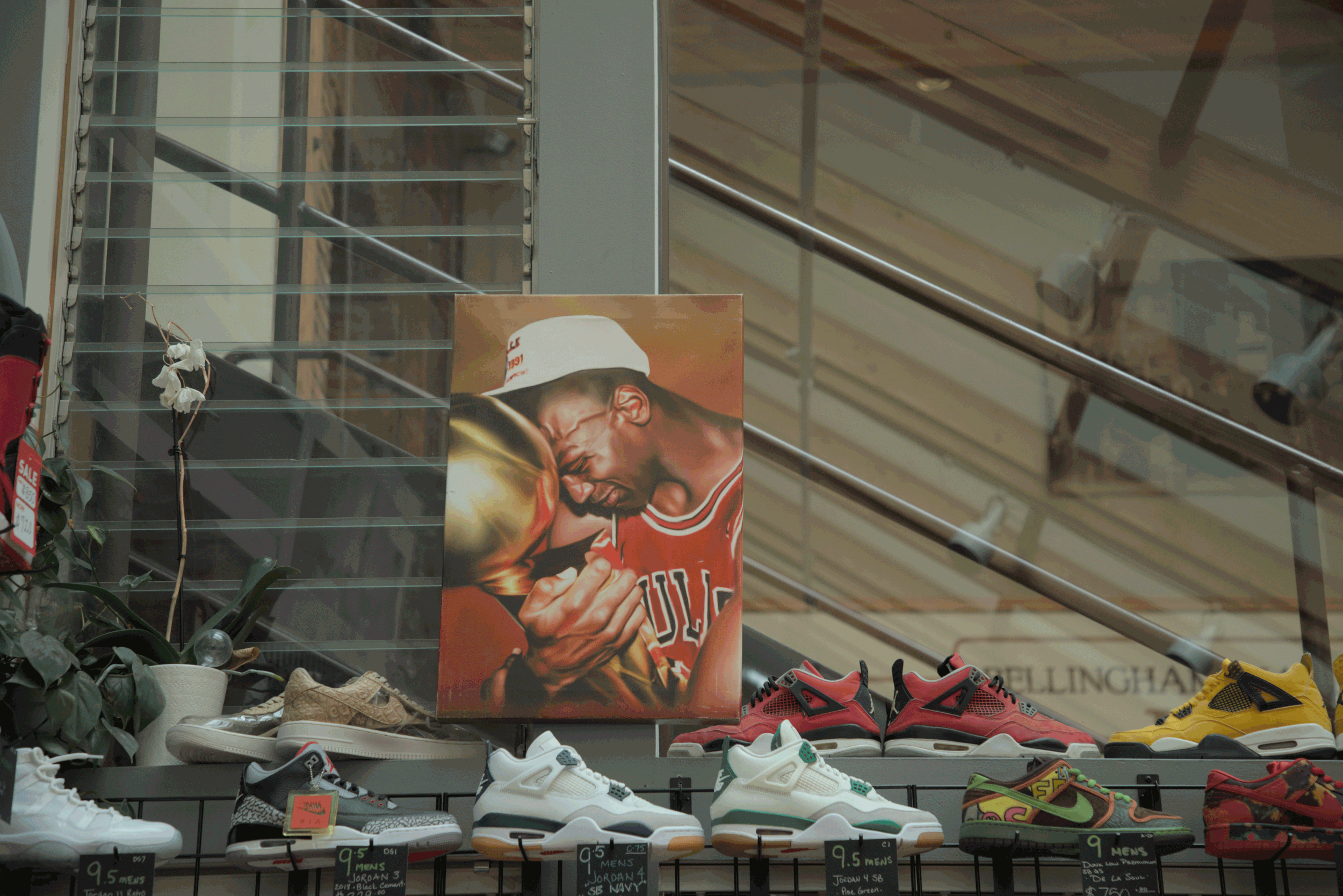
This photo of an emotional Michael Jordan was taken after he won his first NBA championship in 1991. It’s hung above some of his most notable sneaker models.