
The impact of texturism
How hair can shape personal identity within the Black community
Story and photos by Julieta Larios
Published April 7, 2026
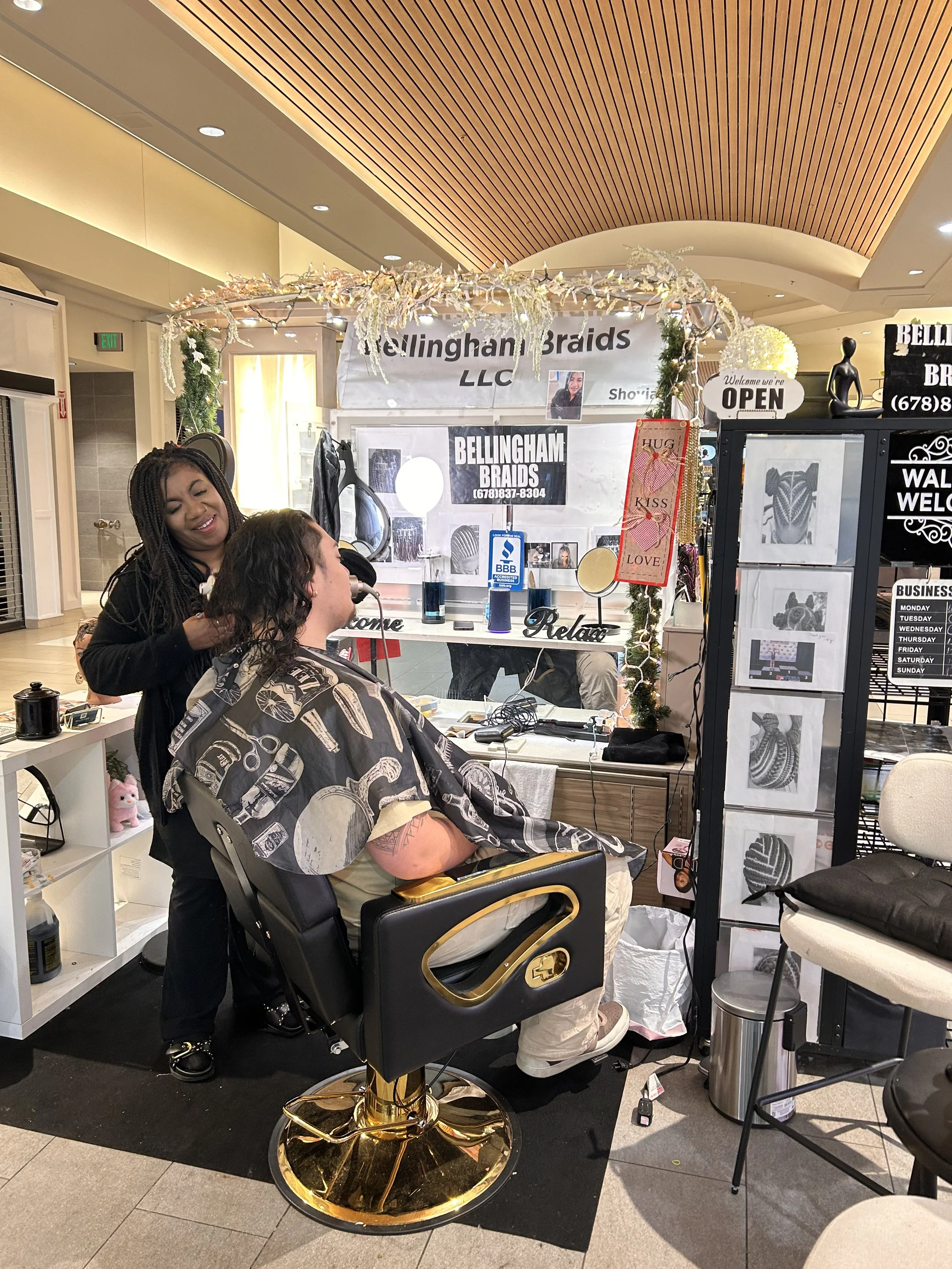
Shovia Muchirawehondo braids a client’s hair at her Bellingham Braids booth inside Bellis Fair Mall.
Every morning, it was the same routine: wake up, turn on the straightener and smooth their 3C curls flat. As a biracial child adopted into a Black family, Addison Brown learned early that straighter hair would grant access to the same privileges and perceptions often afforded to white women.
“I know my mom straightened it because, one, it was easier to deal with. And two, it also gave me privileges out in the world, not having curly hair,” Brown said.
This was something their mother enforced on herself, too. Brown recalled seeing their mother's natural hair only a handful of times; most of the time, it’s covered by a wig or hair cover. Brown’s curly 3C hair texture is naturally looser than their mother’s, coily 4C hair.
“She's like, ‘you're not going to be able to get a job with that. You're not going to be able to go out; people are going to see you differently,” Brown said of their mother’s messaging. “She was genuinely worried for me; she thought I was doing something crazy, just having my hair in a natural state.”
Brown isn’t the only one experiencing this. For centuries, Black hair has been discriminated against for its styles and textures, leading many people to feel forced to adapt to Eurocentric standards either by chemically relaxing their hair or wearing wigs or sew-ins to achieve a looser hair texture. The pressure to follow these standards has long been internalized through systemic racism and can be traced back to slavery, according to the African American Museum of Iowa.
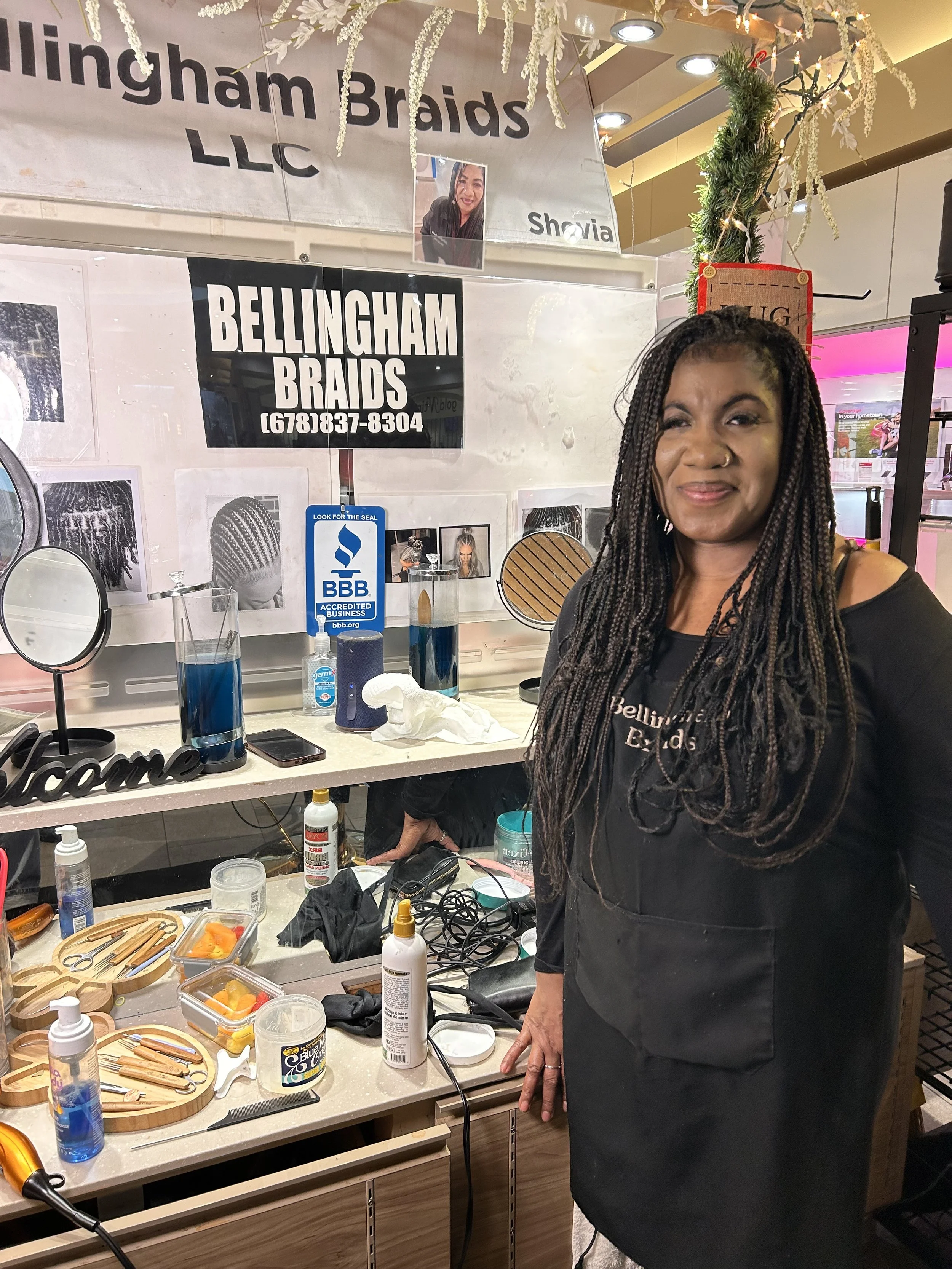
Shovia Muchirawehondo in front of her Bellingham Braids booth inside Bellis Fair Mall.
Shovia Muchirawehondo, owner and stylist of Bellingham Braids LLC, has worked with a wide spectrum of hair textures. Amid the hum of chatter echoing around her booth in Bellis Fair Mall, Muchirawehondo carefully combs through her client's hair, meticulously twirling each braid.
Muchirawehondo's approach blends skill and knowledge of hair textures. As a stylist and mother to Black children, she understands how being biracial creates a texture difference that, for some, is unfamiliar and new to care for. For parents with limited experience caring for textured hair, learning to manage it on their own can be challenging.
The absence of resources and conversation about textured hair can be seen as a byproduct of systemic racism toward Black people in the United States. Brown shared this sentiment.
For instance, enslaved people were subjected to a caste system that grouped them based on skin tone and hair texture, leading to the creation of colorism and texturism. People with less coily hair and lighter skin were given better treatment, according to the Halo Collective, an organization based in the United Kingdom whose mission is to end Black hair inequality.
According to the African American Museum of Iowa, slave traders understood the importance of hair and the link between identity, often shaving enslaved people's hair as a humiliation tactic. This blatant discrimination attempted to erase the history of Black styles and textures.
Progress has been made with the introduction of legislation such as the CROWN Act, passed in 30 states since 2019. This act protects against workplace and public school discrimination based on race-based hairstyles. Although progress has been made, the effects of this hair-based discrimination are still prevalent today in educational and professional settings.
Jolie Volel is a natural hair specialist and stylist located in Frisco, Texas, and owner of Jolie’s Vision. Her main inspiration for running her business comes from the beauty of natural hair when properly cared for.
“I'm very big on natural hair and being confident in what you were blessed with, like curls, coils, and things like that,” Volel said. “Those hair types are the most unique, interesting, special type of hair.”
Volel recalls many of her clients requesting services that would leave their coils looser, more manageable, or completely straight. She attributes these insecurities to childhood pressure from role models enforcing or encouraging the idea that straight hair or chemical relaxers were the key to success. “I feel like most of the time, it comes from just childhood, the way they grew up,” Volel said. “Whether their mom just took them to the salon to get their hair chemically changed, like a perm, or just like a texture relaxer.”
Her goal is to create a space that encourages Black women to embrace their natural hair. She believes that in wearing your hair naturally, this can directly combat feelings of insecurity about hair texture stemming from texturism and comparisons with those with looser textures. Of course, this acceptance comes coupled with a need for education on how to effectively care for and style natural hair.
“That's most of the problems I see when a 4C girl comes to me and is like, ‘Hey, I really don't like my hair texture. I feel like it's just unmanageable,” Volel said. “But once they get on that regimen, and they realize, hey, this isn't too bad, they tend to fall in love with their natural hair.”
Despite improved access to stylists and hair education, Black hair care is still a tedious process. Myeshia Babers, who holds a doctorate in cultural anthropology, talked about her own hair journey and the challenges of managing hair that does not fit into a single texture.
Babers explained that her hair has never fit into a neat category in terms of styling. She has noticed that her hair has two different textures, making it behave unpredictably. Unlike most textured hair, she said, hers does not curl or shrink when wet. Instead, it stretches, and when dry, it experiences little shrinkage and lots of frizz.
“When I have gone to different stylists or new stylists, some have asked if I've had a relaxer before,” Babers said. “They think there's chemical damage, but I haven't, not at this point, not in a long time since middle school. That's just how my hair has always behaved.”
Growing up, Babers knew she could walk into any Black salon and find a stylist who knew how to work with her hair, but the reactions she received from stylists made her realize her hair behaved differently from other clients’ hair. She recalled getting a relaxer in middle school, which she ended up disliking, and flat-ironing her hair in high school for special events. On another occasion, when she was in high school, Babers remembers a faculty member attempting to put an accessory in her straight hair, assuming she was wearing artificial hair.
“The first thing that crossed my mind was she must have assumed that Black girls' natural hair couldn't be that long. And then later I had other thoughts or assumptions about the way she tried to just touch my hair,” Babers said. “The length was the first thing that hit me, but that moment in itself showed me how people carry unconscious assumptions about what Black hair is or supposed to look like, even when they think they're being kind.”
For Babers, instances like this one are what reinforce the stigma that hair is just something on your head. She counters that, over time, how hair is done and how it is perceived can greatly impact one's self-perception. She added that when discussions on Black hair solely focus on appearance, it thus discredits all the effort that goes into styling and caring for textured hair.
Although she’s aware of the societal influence on hair appearance, Babers still chooses to straighten her hair. “I wear more controlled, low-manipulation styles when I'm going to work. I'll straighten it more in public spaces, because those styles read as orderly and acceptable,” Babers said. “At home, I do the opposite. I take out the tension and avoid heavy product. I just let my hair exist more freely, and that's just the manifestation of the messaging in the home.”
Today, Babers reflects how the world operates under this appearance-based perception, but that doesn’t discount the significance that Black hair holds.
“What gets overlooked is the daily relationship people build with their hair — the patience, the negotiation and the constant decisions,” Babers said in an email. “Black hair is both deeply meaningful and deeply practical at the same time.”