
The linguistic difference between ‘dis’ and ‘dat’
How regional dialects and accents form and evolve over one's life
Story by Bodey Mitchell
Illustration by Royce Alton
Published April 7, 2026
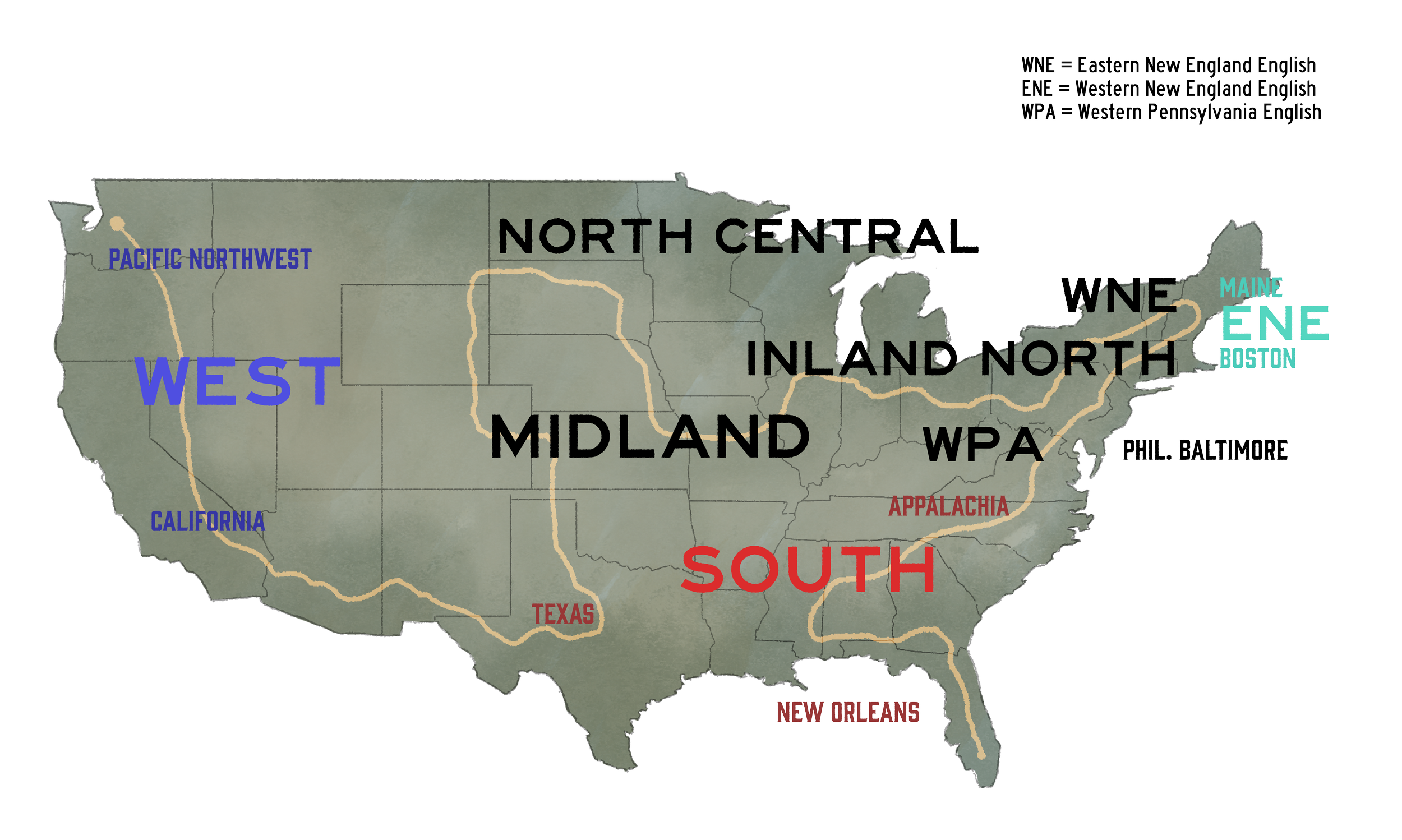
An illustration showing a map of the U.S. with its unique regional dialects. Places like the East Coast have a lot more variation in dialects and accents compared to the western half of the U.S.
From living on your own for the first time to navigating roommates and the dining hall, college brings a lot of change. But what a student may not notice — at least not right away — is how their accent or the way they talk changes throughout their time in school.
Across the 3.8 million square miles of the United States, regional dialects have developed since the country was settled in the 16th century. From Northeastern states like New Hampshire or Vermont to Western states like California, each region has its own distinct dialect that has formed from the melting pot of cultures found in the U.S.
Jennifer Nycz, an associate professor of linguistics at Georgetown University, said that major U.S. dialect regions include the American South, the Inland North around cities like Chicago and Buffalo, the New York City area and New England, and much of the western United States.
But even within those regions, the dialects and lingo become more individualized to the area.
“There's quite a few large regions, but also a lot of variation within those regions,” Nycz said.
The differences in U.S. dialects are due to chain shifts, or systematic variations in language, Nycz said. While other languages have around five to six vowel sounds, the English language contains 14 to 20 different vowel sounds.
Nycz said that these actions and the resulting dialects can be understood with a symbolic map of the tongue’s position in the mouth when pronouncing different sounds. The quadrilateral diagram represents the side view of a head, with the pointy corner at the front of the face. The location on the chart corresponds to tongue height (high vs. low) and front–back position.

A vowel map showing how different vowel sounds are articulated relative to one another based on tongue height and placement in the mouth. When vowels in the low back part of the vowel map are pronounced, the tongue is low and back in the mouth.
“I'm from New Jersey, and I distinguish words like ‘cot’ and ‘caught.’ I slept on a cot. I caught the ball,” Nycz said. “So these are two vowels, kind of in the low back part of the vowel space, which means that when you produce them, your tongue is low and back in the mouth.”
For someone from California, Nycz said, these two vowels merge, leaving one less vowel in the low part of the vowel space.
Throughout history, these unique dialects have also been shaped by historical migrations and “substrate effects,” which Nycz describes as the influence of large founding populations who spoke other languages.
“We see this in parts of the Midwest where they have large populations of people who came from Scandinavia,” Nycz said. “You can still hear that in some of the vowels in New York City English in some of the consonant features, like the population of Dutch speakers that were present in New Amsterdam before it was New York.”
So when New Yorkers pronounce the “th” sound as a “t” or “d,” Nycz said this likely traces back to Dutch, a language that doesn’t include the “th” sounds found in English. Words like “this” or “that” will sound like “dis” or “dat.”
These unique dialects can also blend on college campuses. Nycz said that studies have shown that over the course of a school year, roommates begin to sound more like each other. This is attributed to the dialects they arrived at school with, converging after a few semesters.
“They looked at a wide variety of students from different regions at Ohio State and found that there were some changes over time where people kind of shifted their accent, and it really depended on the social networks of the students at school,” Nycz said.
Nycz said that the more someone is around a different dialect or in a space where a new dialect is spoken, the more similar their own pronunciation will become. The longer the exposure, the more long-term the changes to someone’s dialect.
For Ines Steeman, a student from Belgium at Fort Hays State University in Kansas, these different dialects were something she had to get used to while attending college in the U.S. Steeman, who grew up speaking Dutch in Belgium, which is its own dialect known as Flemish, learned British English growing up and had to get used to the differences in dialects, especially in Kansas.
“In Kansas, just the use of ‘man, sir, y'all,’ I feel like it's very different,” Steeman said.
Steeman also noted how many of her peers speak in internet slang, something she and her friends back in Belgium never used.
“In the beginning, I wasn't really aware of the abbreviations that people would use,” Steeman said. “When I first came, I was like, ‘What are you talking about?’”
Internet trends also influence dialects, Nycz said, as specialized terms emerge from online spaces such as Reddit and evolve into shared memes, especially on college campuses.
Nicole Treece, who is from Seattle and attends school at George Washington University in Washington, D.C., noted that people on the East Coast come across as more formal when speaking. Treece also emphasized the range of accents she’s heard in the city, something she feels was less common in Seattle.
While it may not be as noticeable as other accents, Seattle does have an accent. In a video shared by University of Washington Linguistics Professor Betsy Evans, she notes that people from Seattle have an accent that subtly comes out in certain words. For example, words like bag will sound closer to “beg” or “bayg,” with the vowel shifted upward.
“Everyone has an accent, even if we can't regionally place it,” Nycz said. “An accent is just how we produce the words and sounds of our language. We all have one, and we all have one that is potentially influenced by the accents of people around us.”