
Punk’s purpose
Finding community with people hardwired to headbang
Story by Sophia Raymond
Published Feb. 03, 2026
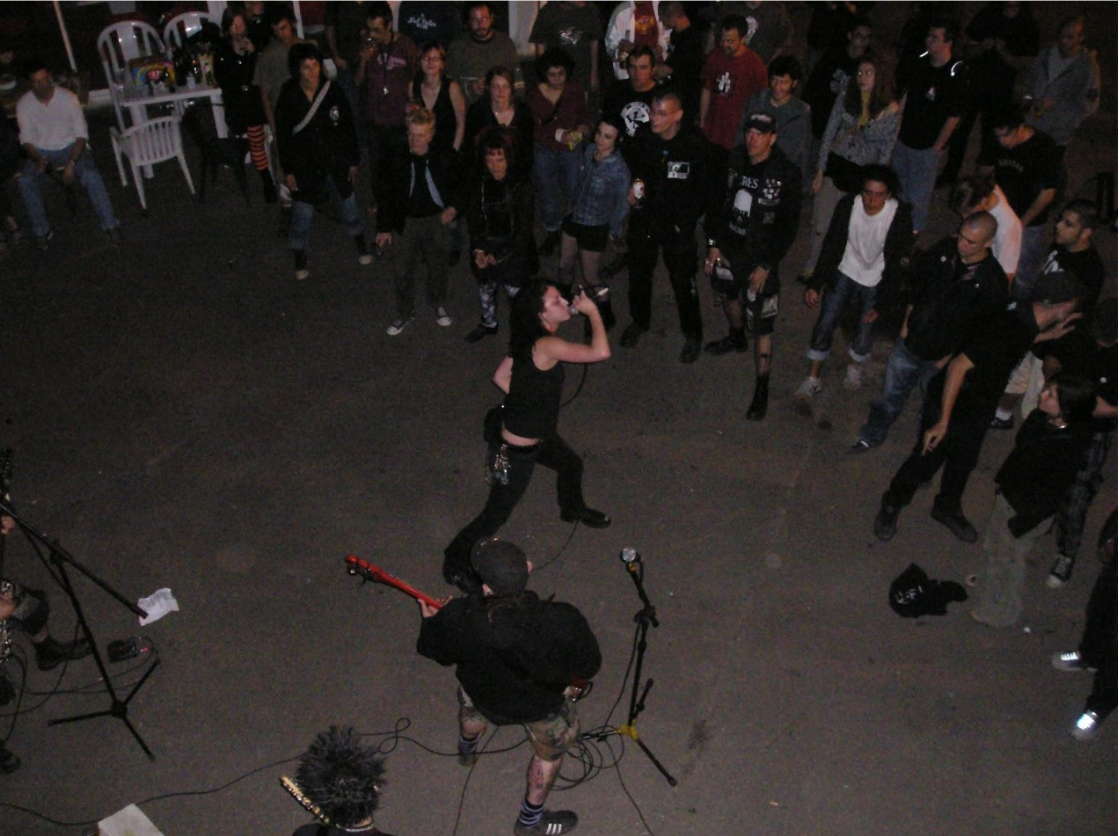
Provoked performs in Switzerland during Olmsted’s 2005 European tour. // Photo by Richard Olmsted
Blue and pink lights shine down on the stage; it’s the brightest spot in the underground venue. People slowly fill the dim basement, finding their place in the small crowd. Black and white concert posters are plastered on the walls, softly lit by orange and white string lights. The first cover artist — the only solo act of the night — walks onto the stage.
He’s got Crocs on with mismatched socks. It’s his first show in three years, but he doesn’t hold back. People bop their heads at the raspy singing, cheering on the Jeff Rosenstock cover artist. Before singing the last song, he thanks Make.Shift Art Space for letting him perform alongside the other artists, and emphasizes the importance of community.
Next up is The White Stripes’ cover band. The thump of the drums and vibrations of the bass radiate in my core, starting at my feet and going up through my torso. My ears ring from the riffs of the electric guitar. The smell of sweat builds as heads bang harder to the beat. The audience is starting to let loose, twisting their bodies, gyrating to the music.
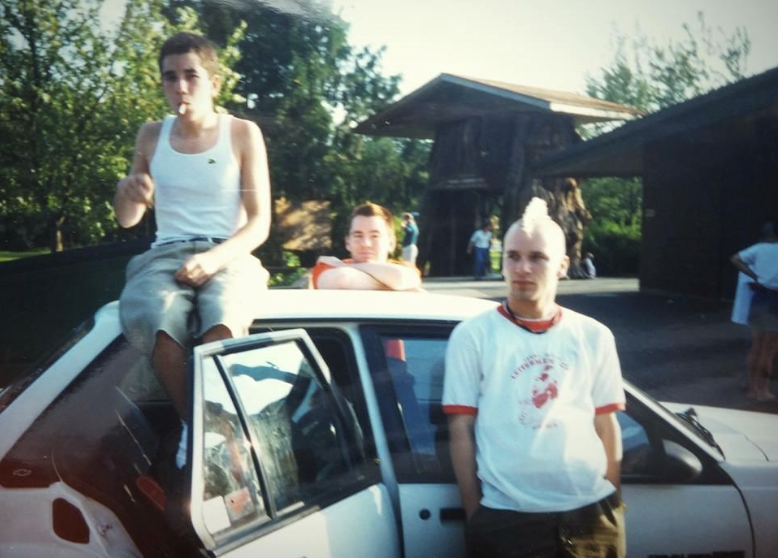
Engelson with two friends, Aaron and Jeremy, at Smokey Point Rest Area on Northbound I-5 in the late ‘90s. // Photo courtesy of Jeff Engelson
FOUND FAMILY
Jeff Engelson has lived in Skagit County for most of his life. He got his first taste of punk when he picked up a skateboard and took to the streets in the ‘80s. Other kids in the neighborhood skateboarded, and those who liked punk “gravitated toward each other,” according to Engelson.
“I know it sounds cliché, but punk rock just kind of finds you,” Engelson said. “It's like a group of kids that just don't seem to fit in or belong necessarily anywhere that kind of end up together.”
With parents at work — or out of the picture — kids in the neighborhood learned to take care of one another. They’d skate, drink, smoke weed and help each other when they needed it.
Growing up, Engelson’s parents were pretty relaxed. He could stay out skateboarding and listening to rowdy music as long as he was home when the streetlights turned on. The only pushback he faced was from his mom, but even she was mostly accepting.
“I came home with a mohawk, bright green spiked up, and she was like, ‘What the hell did you do?’” Engelson said. “Meanwhile, my stepdad's like, ‘It looks cool,’ and she's all pissed. ‘Shut up, Dwayne,’ and she's all mad at him.”
In the ‘90s, Engelson met Richard Olmsted, whom he’s still friends with. Olmsted moved out of the house when he was a tween and found himself surrounded by friends with shared values.
“It's just an amazing community of weirdos that it's easy to appreciate everybody for who they are,” Olmsted said. “It's hard to even think of what it would feel like as an outsider coming into that community, because to me it just feels like such a given of how inclusive and welcoming it is.”
The do-it-yourself attitude engrained in this culture contributes to this innate sense of belonging within the community. Punk rockers have produced their own CDs without record labels, crafted their own merch and set up their own venues for shows since the late ‘70s, according to a social science journal from 2010, “Punk: The Do-It-Yourself Subculture.” This emphasis on inclusivity makes one thing clear: anyone can play punk music, no matter their skill level or their resources.
“A lot of the early bands — and still to this day a lot of bands — they just pick up instruments and don't know how to play them and learn as they go,” Engelson said.
This music is about expression and staying true to yourself, not about being the best. Most band members make it clear that they’re not rock stars; they’re ordinary people with day jobs.
"I think there's a certain irreplaceable authenticity to people that aren't trying to impress people, so much as they are just sort of (expressing) themselves in these artistic or, you know, whatever ways,” Olmsted said. “I think that that passion is unmistakable.”
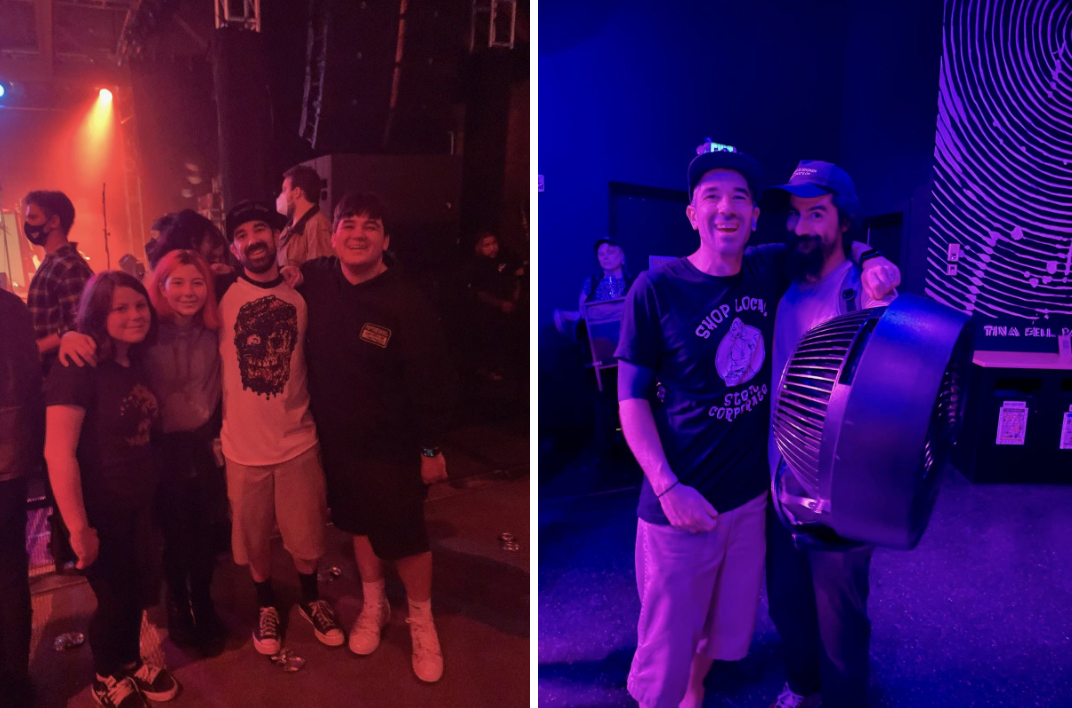
Left: Jeff Engelson with his two daughters, Kyah and Lea, and son, Chayton, at a music show at the Showbox Sodo on April 10, 2022. // Photo courtesy of Jeff Engelson
Right: Engelson with Jesse Sendejas, a musician in the band Days N’ Daze, at The Vera Project on May 17, 2023. // Photo courtesy of Jeff Engelson
CUT FROM THE SAME CLOTH
The scent of cigarettes and sweat lingers in the basement as the lead singer of The White Stripes cover band announces their next song, one that can’t be found on Spotify or Apple Music. They learned it from a CD that was gifted to him by his family. “Thanks to my parents,” the lead singer called out from the stage.
“You’re welcome,” replied a middle-aged man, holding a camera pointed toward the lead singer, a proud smile printed across his face.
This isn’t the only father who’s passed down his love of music to his kids. Once they were old enough, Engelson started bringing his son and two daughters to punk shows. It’s become a whole family affair.
“My daughter just last night was sewing patches on stuff and listening to punk rock music, and it's cool because my kids now show me new punk rock that I'm like, ‘hey, who is this you're listening to?’” Engelson said.
These shows are a place to build connections, which can only happen if people in the community support one another. Olmsted's one critique of the do-it-yourself attitude is that you can’t do it all by yourself — you need that camaraderie.
“I think through that you just naturally evolve into these communities of people supporting each other, and it becomes a really small world really quick,” Olmsted said.
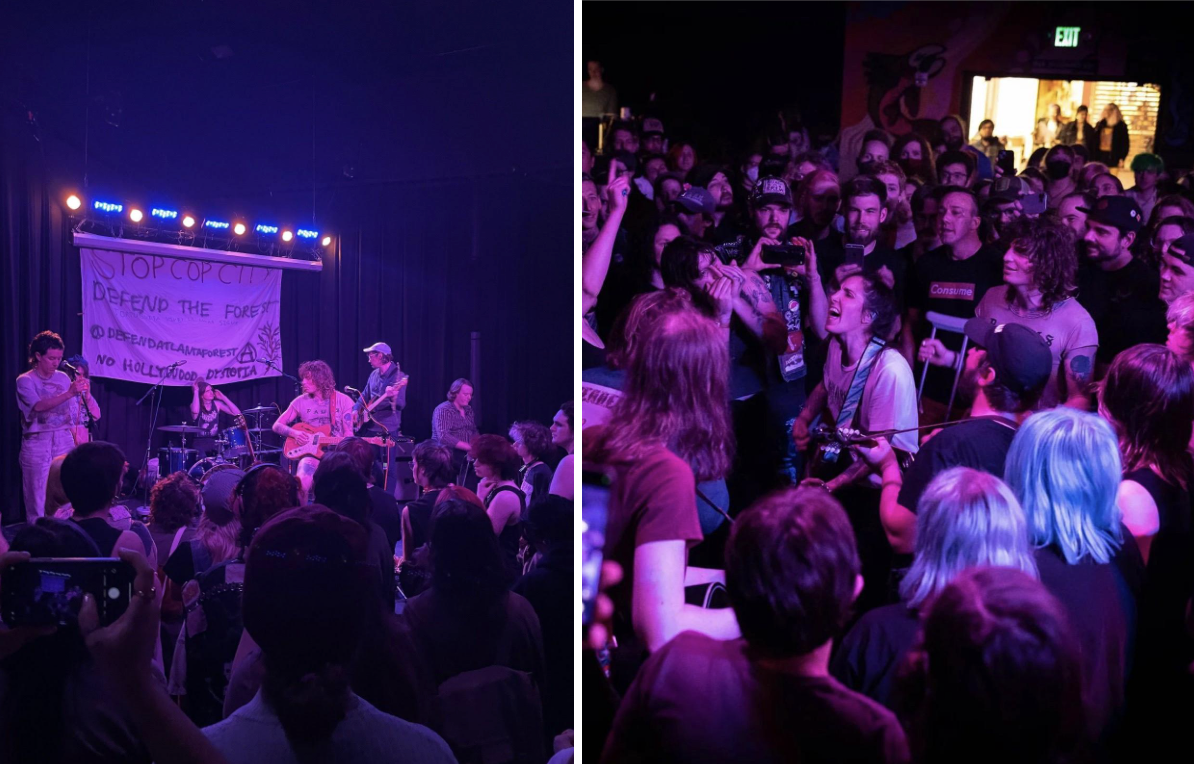
These are two photos from a music show at The Vera Project in Seattle on March 22, 2023. // Photo courtesy of Jeff Engelson
A SENSE OF SYNERGY - BETTER TOGETHER
After their set, the band members join the Croc-wearing cover artist in the audience to listen to the next act. The White Stripes’ lead singer motions for the crowd to spread during a particularly heavy Failure song. He jumps into the space — others following suit. Bodies purposefully collide and ricochet off one another, smiles scattered in the vortex.